Gen Z Retention India: Evidence-Based Strategy Guide

How Indian CXOs build evidence-based Gen Z retention strategies -- manager coaching, career transparency, psychological safety, and flexible work -- with proven ROI data.
India's Gen Z Retention Crisis: Why the Old Playbook Has Stopped Working
By 2025, Gen Z constitutes 27% of India's workforce -- tens of millions of young professionals who are reshaping what work looks like, what employment means, and what organizations must offer to earn genuine commitment rather than passive presence. Yet 34% report being actively disengaged, the highest disengagement rate of any age group. Forty-two percent planned to switch jobs in 2025. In some sectors, the exodus is already statistically dramatic: one large ITES company in Hyderabad watched 36% of its 2,000 Gen Z graduates resign within 18 months -- at a replacement cost of 1.5-2x annual salary per departure.
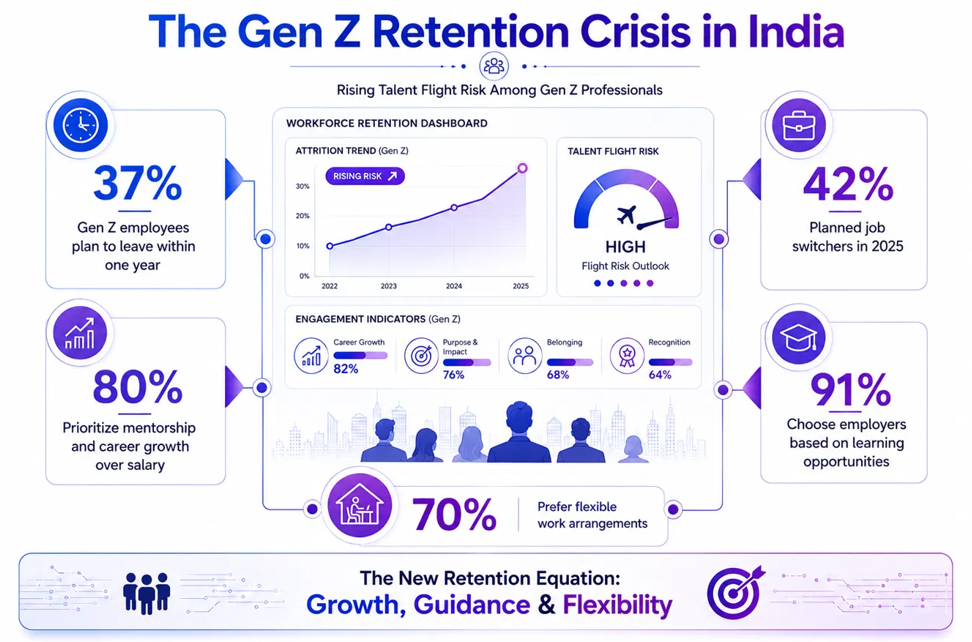
The retention playbook of previous decades -- structured salary progression, job security, stable hierarchies, and periodic recognition events -- has not become irrelevant for this cohort. It has become insufficient. Gen Z has grown up with information transparency, social media visibility into peer experiences, and a pandemic-era recalibration of what work is for. They watched previous generations accept conditions that damaged their health and relationships in exchange for career advancement and organizational loyalty. They have consciously decided to make different trade-offs. Understanding those trade-offs, and designing organizational systems that respond to them without abandoning performance standards, is the defining talent management challenge for Indian CXOs in this decade.
37%Of Gen Z employees in India plan to leave their current organization within a year -- with disengagement building months before the resignation email arrives, making proactive retention architecture essential (India Gen Z Workforce Research, 2026) |
"Companies offering clear career progression paths alongside flexibility see 47% lower turnover rates. The ROI of Gen Z retention investment is not marginal -- it is transformative." -- India Employer Forum Research, 2025 |
What Is Actually Driving Gen Z Attrition in India? The Evidence
The most important insight from India-specific Gen Z retention research is that salary is rarely the primary driver of departure. A comprehensive Apna.co survey finds that 80% of Gen Z professionals in India prioritize mentorship and clear career growth pathways over salary. Unstop research finds that 77% prefer organizations offering genuine growth and skill enhancement when considering a job switch. Compensation matters -- 41% of Indian Gen Z are dissatisfied with their pay -- but it functions as a final straw when growth, respect, and flexibility are already absent, not as the primary attrition trigger.
Five factors consistently emerge as the actual drivers of Gen Z departure in Indian organizational research:
• Lack of growth and learning opportunity: 91% of Indian Gen Z cite learning opportunities as the primary factor in employer choice, and 94% identify on-the-job learning as the most helpful tool for career growth (Deloitte India, 2025). When roles become repetitive, development plans remain vague, and there is no visible pathway to the next level of contribution or responsibility, Gen Z departs -- predictably and quickly.
• Poor manager quality and insufficient guidance: CHROs across Indian industries report consistent patterns -- low manager connection, lack of professional guidance, and absence of the mentorship that Gen Z believes management should provide. Research finds that nearly half of Indian Gen Z are not receiving the mentorship they expected when they joined. They do not leave organizations; they leave managers who cannot coach, will not communicate transparently, and do not create the environment in which growth is genuinely possible.
• Toxic culture and psychological unsafety: Randstad's 2025 Workmonitor finds that 44% of Indian workers have quit due to toxic workplace culture. Among Gen Z specifically, 48% attribute quiet quitting to workplace toxicity. Nepotism, micromanagement, disrespect, and the normalization of behaviors that would be unacceptable in healthier cultures create conditions from which Gen Z exits quickly -- having neither the financial dependency nor the generational tolerance for sustained psychological harm at work that previous cohorts often felt obligated to absorb.
• Inflexible work arrangements: 70% of Gen Z employees in India prioritize flexibility and autonomy in role selection. Post-pandemic, hybrid and remote options have become baseline expectations rather than premium benefits. Organizations requiring full-time office presence without substantive justification tied to collaboration quality or mentoring outcomes -- rather than management preference or sunk real estate costs -- see this rigidity translate directly into resignation patterns.
• Misalignment between stated values and lived experience: Gen Z has uniquely strong pattern-recognition for the gap between what organizations say they stand for and how they actually operate. When organizational values appear on walls and websites but do not govern actual decisions about resource allocation, promotion, workload distribution, or responses to misconduct, Gen Z disengages before they formally resign -- the quiet exit that shows up in productivity data months before it appears in attrition statistics.
Five Evidence-Based Retention Levers That Actually Work
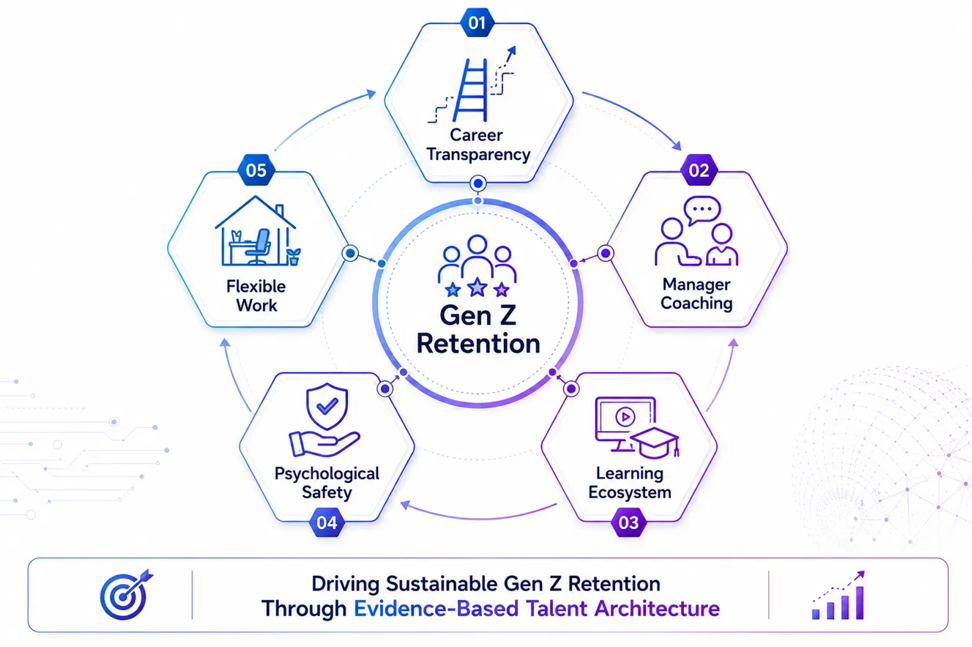
Lever 1: Clear Career Paths with Honest Progression Criteria
Unlock the Full Research
Create a free account or sign in to access the complete methodology, deep-dive analysis, and key implementation frameworks.
Don't have an account? It's free to join.
Organization Learning Labs
Research & Insights Division


Comments