Gen Z-Ready Organization Design India 2030

How Indian CXOs and GCC leaders redesign organizational culture, leadership practices, and systems to attract, engage, and retain Gen Z talent through 2030 and beyond.
Why Designing Gen Z-Ready Organizations Is a Strategic Imperative, Not an HR Initiative
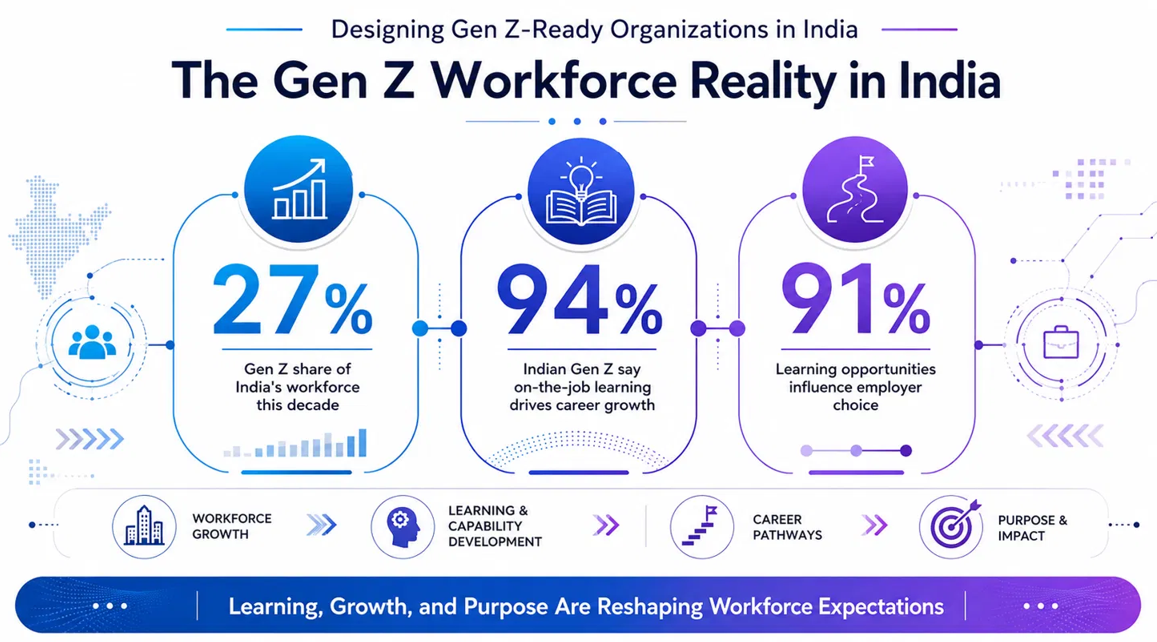
Gen Z is on track to constitute more than 27% of India's workforce within this decade. In technology and services firms -- GCCs, IT majors, digital-first companies -- they already represent the largest single cohort of new hires and in many organizations the majority of the associate-level workforce. The strategic question for CXOs is no longer whether to adapt organizational culture, leadership practices, and systems to this generation. That question has been answered by the data. The question is how to do so in a way that creates genuinely multi-generational organizational effectiveness rather than simply layering Gen Z preferences onto legacy structures.
Deloitte's Global Gen Z and Millennial Survey 2025, covering over 23,000 respondents across 44 markets, finds that this generation is simultaneously values-driven and acutely pragmatic. They care deeply about purpose, inclusion, ethics, and well-being -- and they will pursue these priorities through employer choice. But they are also intensely focused on career growth, skills development, and financial security. For Indian employers, this combination creates a specific organizational design challenge: workplaces must be simultaneously purposeful and developmental, ethical and performance-driven, flexible and accountable. Organizations that treat these as contradictions will lose the talent. Those that treat them as design requirements will build the most effective knowledge-economy workforces in India over the next decade.
94%Of Indian Gen Z say on-the-job learning drives their career growth -- and 91% cite learning opportunities as their primary factor in choosing an employer (Deloitte India 2025 / IBEF Survey) |
"Gen Z doesn't just want a job. They want an environment where purpose, growth, and psychological safety coexist -- and they have both the information and the options to choose organizations that provide all three." -- Deloitte Global Gen Z and Millennial Survey 2025 |
What Gen Z Wants at Work -- and Why These Are Organizational Design Requirements
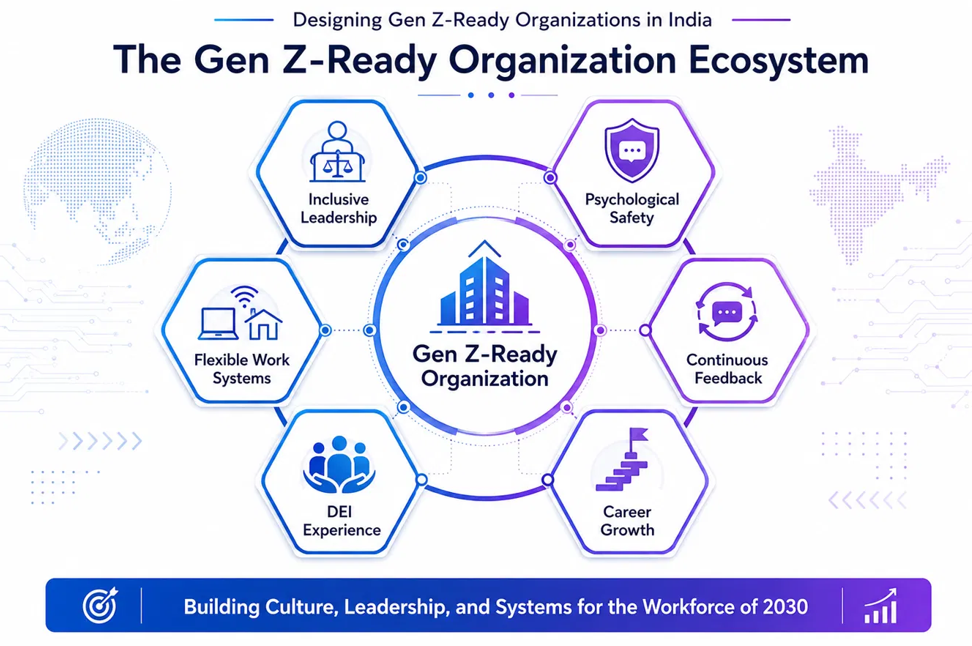
Inclusive and Ethical Leadership
Multiple global and India-specific studies find that Gen Z places unusually high importance on working for leaders they perceive as fair, ethical, and socially responsible. Deloitte's 2025 survey finds that they are more likely than any previous generation to turn down an employer whose values conflict with their own, even when compensation is attractive. Indian campus hiring data echoes this: ethical leadership, respectful management, and fair treatment consistently rank as top factors in employer preference among campus and early-career talent.
The organizational design implication is specific: inclusive and ethical leadership must move from cultural aspiration to measurable management expectation. Gen Z employees pay close attention to how leaders respond to misconduct, treat people across hierarchical levels, and live up to stated values in actual decisions -- and they are both willing and equipped to call out inconsistencies through internal channels or social media. Organizations that embed ethical leadership behaviors into competency frameworks, promotion criteria, and managerial scorecards -- rather than treating them as soft add-ons -- are building a structural foundation for Gen Z engagement that periodic leadership messaging cannot replicate.
DEI as Lived Experience, Not Campaign
Gen Z is the most diverse generation yet in terms of gender identities, backgrounds, abilities, and life choices -- and they expect this diversity to be recognized and respected in daily work experience, not only in annual campaigns or policy documents. Research on Gen Z and DEI consistently shows that younger employees look for concrete, observable evidence of inclusion: diverse role models across levels, non-discrimination policies that are actually enforced, inclusive benefits, active employee resource groups, and equitable opportunity distribution in high-visibility assignments.
In India, many Gen Z professionals specifically look for signals that organizations are serious about gender equity in leadership pipelines, LGBTQ+ inclusion in benefits and culture, disability confidence in hiring and accommodation, and regional and socio-economic diversity in career advancement. Authenticity matters more than perfection: Gen Z wants to see measurable progress, transparent acknowledgment of gaps, and leaders who are willing to learn and course-correct. Organizations that treat DEI as a compliance exercise will see this generation disengage precisely because they have the information to identify the gap between stated commitment and lived experience.
Mental Health and Holistic Well-Being
Research consistently shows that Gen Z reports higher levels of stress and burnout than older cohorts -- and is simultaneously more willing to name these issues openly and to choose employers based on their actual response to them. Post-pandemic Indian data shows growing emphasis among younger knowledge workers on psychological safety, realistic workloads, and access to mental health resources. Individuals under 25 account for 53% of workplace mental health consultations in India -- a statistic that should reframe well-being from a policy aspiration to an operational priority for any organization with a predominantly Gen Z workforce.
Unlock the Full Research
Create a free account or sign in to access the complete methodology, deep-dive analysis, and key implementation frameworks.
Don't have an account? It's free to join.
Organization Learning Labs
Research & Insights Division


Comments