Gen Z Campus-to-Contribution: GCC Early Career Strategy

How GCC and IT leaders can design structured early-career programmes that close India's graduate employability gap and achieve Day 1 productivity for Gen Z hires.
Why the Campus-to-Contribution Gap Has Become a Strategic Business Problem
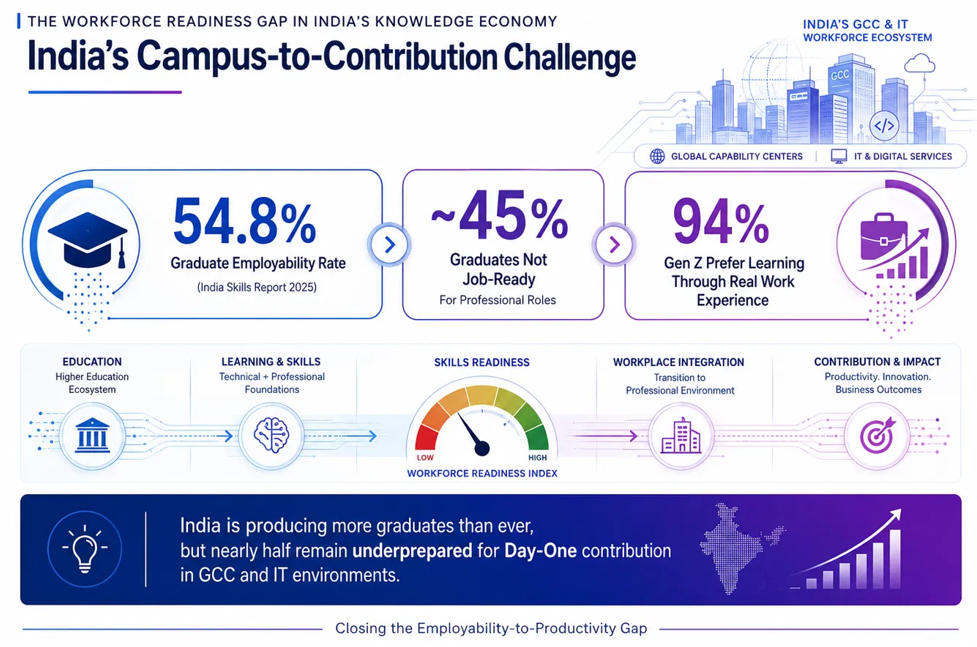
India is producing degrees at a pace unprecedented in its history. Yet the proportion of graduates who are genuinely ready to contribute in a professional environment from their first week of employment has not kept pace. The India Skills Report 2025, based on assessments of over 6.5 lakh candidates conducted by CII in collaboration with Wheebox and AICTE, projects overall graduate employability at approximately 54.81% -- a meaningful improvement from the 42.6% recorded by Mercer Mettl's Graduate Skill Index 2025, but still leaving nearly half of India's graduates structurally underprepared for the roles they are being hired to fill.
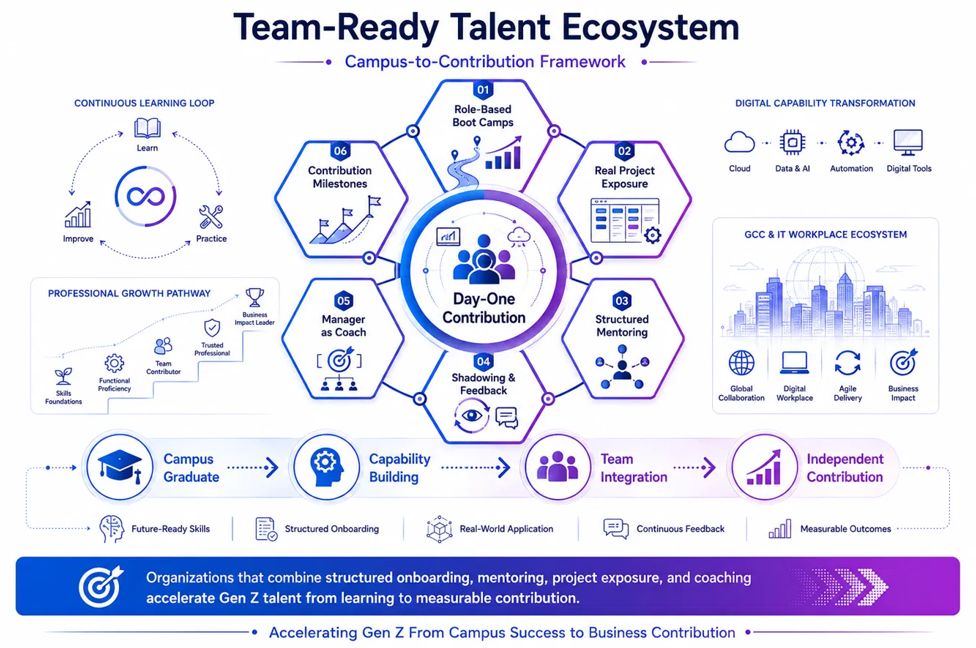
For GCCs, IT services firms, and consulting organizations in India, this employability gap is not an abstraction. It is a daily operational reality that manifests in extended bench time, elevated rework rates, prolonged time-to-productivity for new cohorts, and mounting manager frustration with fresher talent that arrives technically competent but professionally underprepared. The cost is substantial: organizations that have quantified the gap typically find that a fresher who takes six months to contribute meaningfully costs two to three times the salary investment of one who is Day 1 productive -- through direct rework costs, supervision overhead, and opportunity cost on the projects they are not yet capable of handling independently.
The root cause is structural, not generational. India's higher education system remains predominantly theory-heavy, assessment-driven, and individually focused. Campus life rewards individual performance in well-defined, time-bounded examinations. It does not systematically build the collaboration, ambiguity tolerance, stakeholder communication, and professional ownership that define contribution in knowledge-intensive workplaces. Gen Z graduates are not unwilling or unmotivated -- they are among the most aspirational and mobile cohorts India has produced. They are simply not taught how to translate academic success into professional contribution.
~45%Of Indian graduates still not demonstrably ready for the roles they are hired into, despite record degree volumes -- creating a structural early-career productivity gap that compounds across GCC and IT sector hiring cohorts (India Skills Report 2025 / Mercer Mettl, 2025) |
"Mere degrees are not enough for getting jobs, because job-readiness is closely correlated to the development of skills and apprenticeship." -- Professor Lekha Chakraborty, National Institute of Public Finance and Policy |
What the Data Reveals About Gen Z Readiness Gaps
Mercer Mettl's Graduate Skill Index 2025 provides the most granular publicly available picture of where specific readiness gaps lie. The findings are instructive: while technical proficiency in AI and ML domains has risen to approximately 46% of graduates showing employable capability, the soft-skills and learning-agility dimensions that determine actual workplace effectiveness tell a different story. Only 55.1% of Indian graduates are proficient in communication, 54.6% in critical thinking, 44.3% in creativity, and just 46% demonstrate adequate learning agility.
These gaps matter disproportionately in the GCC and IT context because the work is fundamentally collaborative and adaptive. A software engineer who can write clean code but cannot run a client status call, explain a design decision, or navigate a disagreement in a sprint retrospective creates a bottleneck that affects the entire team. The employability research from India consistently shows that graduates with stronger soft skills and demonstrated learning agility enjoy significantly better early-career outcomes than peers with comparable or even superior academic scores -- and that the delta grows over time as organizations increasingly value adaptive capability over static knowledge.
The Deloitte Global Gen Z and Millennial Survey 2025 adds an important dimension from the employee perspective: 94% of Indian Gen Z respondents identify on-the-job learning as the most helpful tool for career growth, yet nearly half report a significant gap between the guidance and mentorship they expect from managers and what they actually receive. More than 20% of Indian Gen Z and millennials believe their formal education has simply not equipped them with the skills required for a fast-evolving technology workplace. This is not a perception problem -- it is a structural pipeline failure that falls to employers to address through deliberate early-career design.
What Makes an Effective Campus-to-Contribution Journey? The Evidence Base
Leading GCCs and IT firms that have systematically addressed the campus-to-contribution gap have converged on a consistent finding: the difference between a fresher who is productive by Month 3 and one who takes six months or longer is almost never a function of technical knowledge. It is a function of structured early-career design. Organizations that have implemented work-integrated learning models -- embedding graduates in delivery teams for multi-year stints -- report that participants demonstrate Day 1 productivity and dramatically shorter ramp-up times relative to traditionally hired freshers.
The research on employability also establishes clearly that internships, mentoring, and early project exposure are among the strongest predictors of both actual employability and perceived employability: graduates' confidence that they can succeed professionally. The mechanisms are intuitive -- early project exposure forces the translation of classroom knowledge into work contexts, creates genuine accountability, and builds the professional identity that campus environments never require. For organizations that cannot wait for university systems to evolve, deliberately engineering these experiences within the first 12-18 months of employment is the most direct available lever.
Phase 1: Role-Specific Boot Camps (Months 0-3)
Unlock the Full Research
Create a free account or sign in to access the complete methodology, deep-dive analysis, and key implementation frameworks.
Don't have an account? It's free to join.
Organization Learning Labs
Research & Insights Division


Comments