GCCs as Behaviour Labs: Beyond SLAs to Culture Change

How GCC leaders can transform their centres from SLA-driven delivery engines into strategic behaviour labs that test, validate, and scale enterprise-wide culture change with evidence.
Beyond Service Levels: How GCCs Become Strategic Behaviour Labs for Enterprise-Wide Culture Change
Repositioning the Global Capability Centre from delivery engine to the enterprise's testing ground for agility, psychological safety, and data-driven decision-making
Abstract
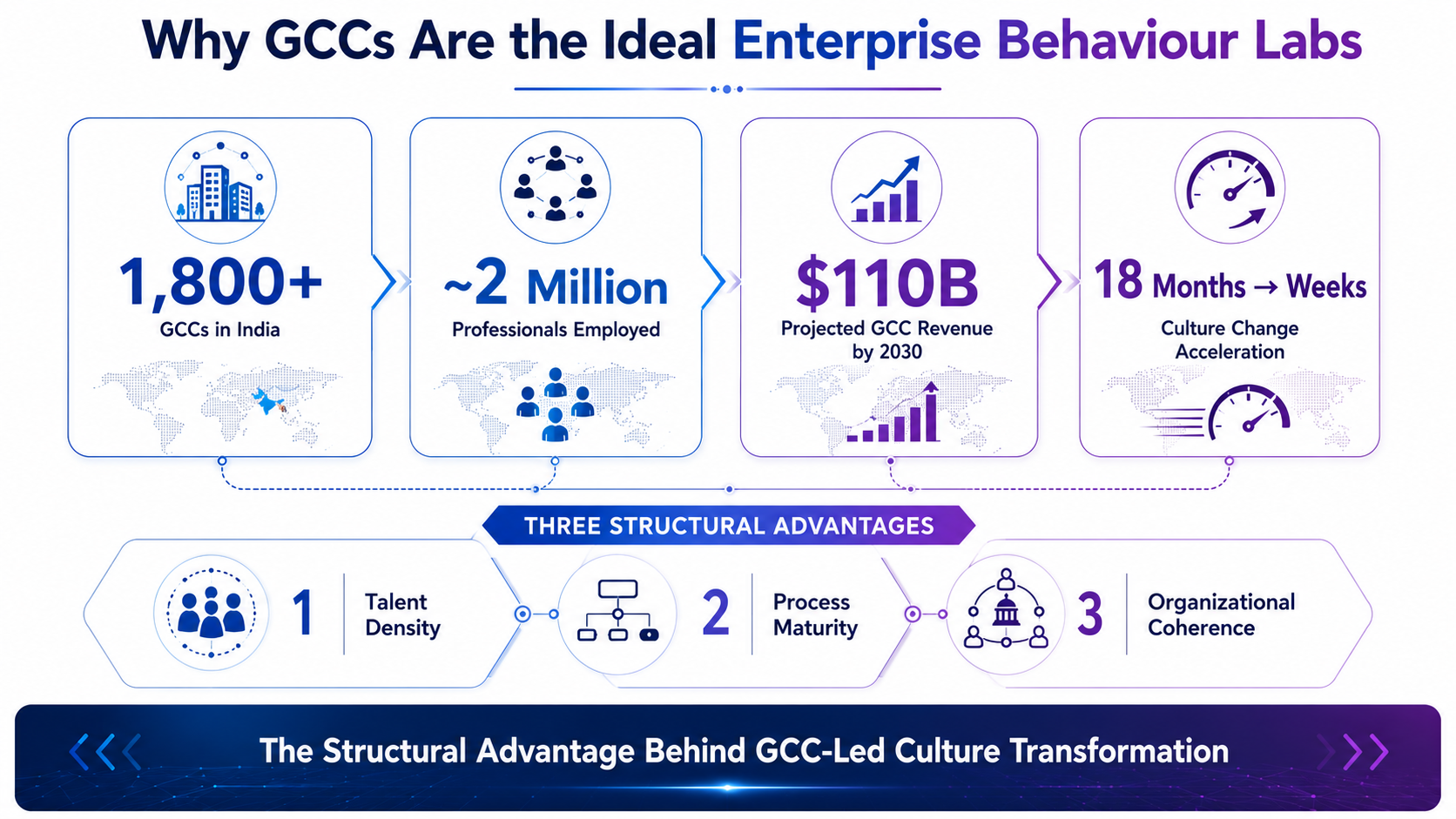
For two decades, the Global Capability Centre has been measured against a narrow set of coordinates: service-level adherence, cost-per-transaction, and attrition. Those metrics remain necessary, but they are no longer sufficient descriptions of what a mature GCC contributes to its parent enterprise. India alone is now home to more than 1,800 GCCs employing close to 2 million professionals, with sector revenue having crossed approximately $70 billion in early 2026 and projected to approach $105 to $110 billion by 2030.
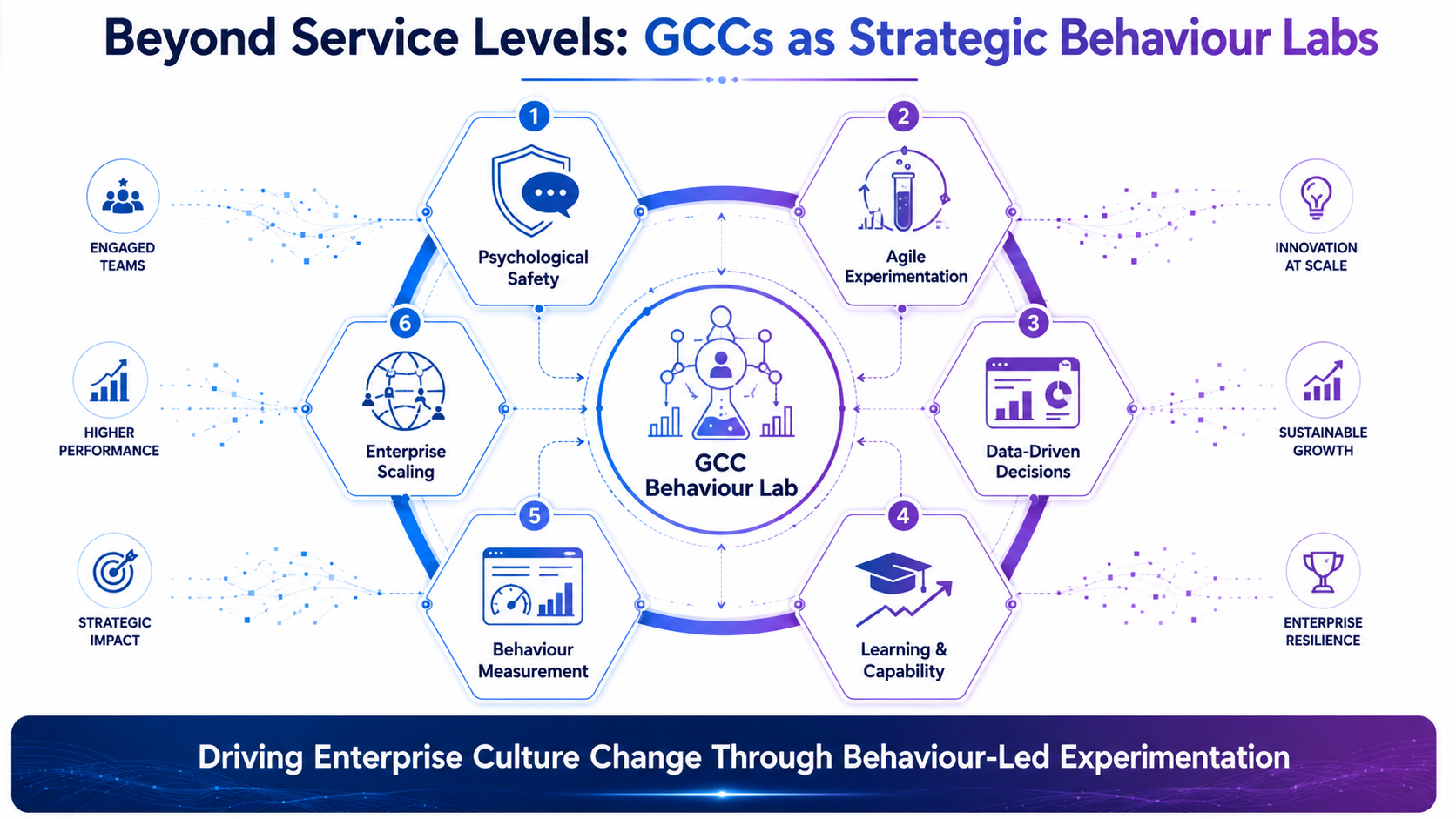
As these centres mature past their original delivery mandate, leading enterprises are discovering an underused asset: GCCs offer a concentrated, measurable, relatively self-contained environment in which new behaviours — agile ways of working, psychological safety, experimentation, and data-driven decision rituals — can be piloted, refined, and only then exported to the rest of the organisation. This article presents a structured case for treating the GCC as a behaviour lab: a deliberate testing ground for cultural change, governed by the same rigour applied to any other enterprise capability build.
1,800+ GCCs in India alone, employing nearly 2 million professionals (NASSCOM-Zinnov, 2026) | $110B Projected India GCC sector revenue by 2030 (NASSCOM-Zinnov GCC Landscape Report) | 35-40% Share of India's GCC headcount in Bengaluru's cluster (Flexiple GCC Statistics, 2026) | 18 months Time a cultural intervention can take to reach enterprise scale vs. weeks in a well-governed GCC |
1. SLAs Are Necessary, but No Longer Sufficient
Service-level agreements built the GCC industry. They gave parent companies a defensible way to offshore work, and they gave centres a clear scoreboard: turnaround time, accuracy rate, cost per FTE. None of that discipline should be discarded. But SLA performance, on its own, has become a commodity. Most mature centres already clear their targets; the differentiation that once came from hitting 99.5 percent accuracy has largely evaporated as the entire industry converged on similar benchmarks.
What has not converged — and what is now emerging as the real point of competitive separation — is culture. How teams give feedback, how decisions get made, how comfortable people are flagging a mistake before it becomes an incident, how quickly an idea moves from hypothesis to validated practice. These behavioural patterns are as material to enterprise performance as any SLA, and they are notoriously difficult to install through policy memos issued from headquarters. They have to be practised somewhere first.
"The GCC, almost by accident of its own structure, is the best-positioned part of most enterprises to be the cultural practice ground — if leadership chooses to treat it that way." — Deloitte Human Capital Trends, 2025 |
The window for repositioning the GCC on these terms is real and time-bound. As AI automates the transactional work that originally justified many centres, the strategic rationale for their existence must be found elsewhere. The GCC that becomes the enterprise's most credible cultural laboratory is the GCC that justifies its existence on terms that cannot be automated.
2. Why GCCs Are Ideal Culture Sandboxes: Three Structural Advantages
Critical Mass of Talent in One Place
A single GCC campus can house several thousand employees spanning technology, finance, analytics, and operations under one roof, often within a single people-management structure. Bengaluru's GCC cluster alone accounts for an estimated 35 to 40 percent of India's national GCC headcount, with several individual centres crossing 5,000 to 7,000 employees (Flexiple GCC Statistics, 2026). That density means a cultural intervention — a new feedback ritual, a revised escalation protocol — can reach a meaningful, statistically usable population within weeks, not years. In a fragmented global business unit, the same intervention would take eighteen months to scope, approve, and deploy.
Process Depth and Documentation Maturity
GCCs typically operate on well-documented, repeatable processes by design — that is what made them viable for offshoring in the first place. This existing layer of process instrumentation is exactly what behavioural experimentation needs: a baseline against which a change in working norms can be measured rather than guessed at. The GCC's documentation discipline, often treated as a compliance obligation, becomes the scientific foundation for its role as a behaviour lab.
Relative Organisational Coherence
Unlike a global enterprise stitched together through decades of acquisitions, a GCC is usually a single legal entity with one leadership team and one HR function. Reporting lines are shorter, and a pilot does not have to clear five different regional HR policies before it can launch. Mid-market and "nano" GCCs — the fastest-growing segment of the sector — are an especially clean test bed precisely because they are small enough to instrument fully and large enough to be representative of the broader workforce.
3. Designing Behaviour Experiments: The Five-Stage Framework
Treating culture change as an experiment, rather than a mandate, changes what leaders are accountable for. The objective shifts from "roll out the new value statement" to "test whether this specific intervention changes a specific behaviour, and prove it with data before asking anyone else to adopt it."
Stage | Discipline and Application |
1. Hypothesis | State plainly what behaviour is expected to change and why. Example: "If engineers receive structured peer feedback weekly, defect-escape rate will fall within one quarter." The specificity of the hypothesis is what makes the experiment defensible. |
2. Intervention | Design the smallest version of the change that can produce a meaningful read. Run it with a defined squad or pod — not the whole centre at once. Scope controls signal quality. |
3. Measure Unlock the Full ResearchCreate a free account or sign in to access the complete methodology, deep-dive analysis, and key implementation frameworks. Don't have an account? It's free to join. O Organization Learning LabsResearch & Insights Division On this pageResearch DetailsIndustryGCC Leadership & Governance AuthorOrganization Learning Labs PublishedJun 24, 2026 You Might Also Be Interested In Information Technology Designing the future-ready digital engineering organization Banking, Financial Service And Insurance A Systematic, Empirical Framework for Capability Development in Retail Banking Banking, Financial Service And Insurance Why Capability Beats Strategy in Retail Banking Organizations |
Comments