GCC Talent Gravity Wells: Learning Ecosystems That Retain Top Talent

How GCC leaders can engineer talent gravity wells — learning-powered ecosystems with visible mobility and experimentation culture — that attract ambitious professionals and reduce attrition.
GCCs as Talent Gravity Wells: Designing Learning-Powered Internal Ecosystems That Top Talent Fights to Join
Why the GCCs winning the next decade are not the largest or the best-paying, but those deliberately engineered as ecosystems where learning intensity, visible mobility, and a culture of experimentation make leaving harder than staying
Abstract
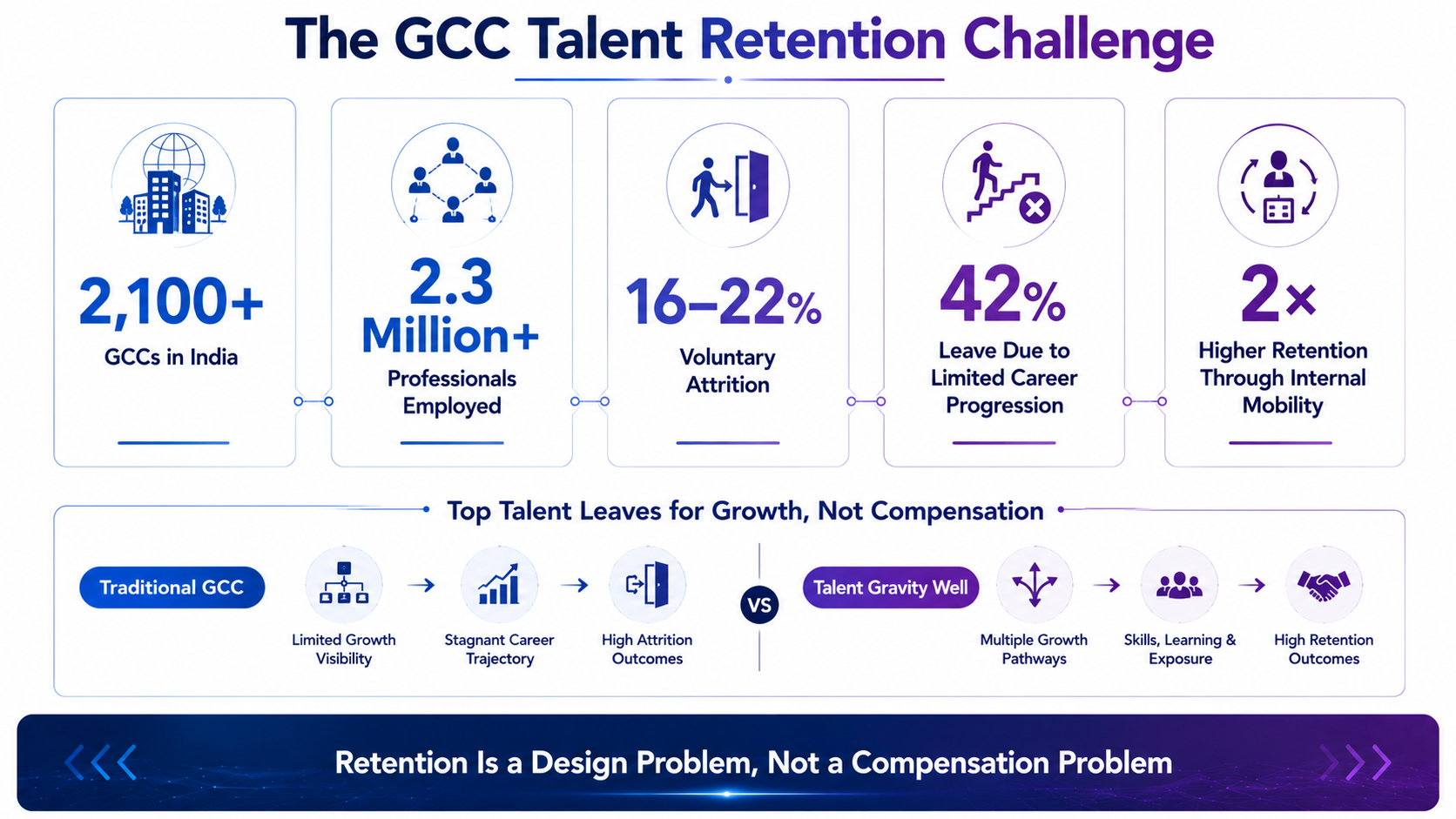
India's Global Capability Centres have crossed an inflection point most leaders have not yet priced in. The ecosystem now counts more than 2,100 centres, over 2.3 million professionals, and close to $100 billion in annual value — a base that has expanded roughly 32 percent since FY2021. Scale, in other words, is solved. Retention is not.
Voluntary attrition across India's GCCs still runs 16 to 22 percent, climbing toward 30 percent in AI, machine learning, and senior engineering roles, and the single most common reason senior talent gives for leaving is not compensation but a ceiling on career progression. This article argues that the GCCs winning the next phase are those deliberately engineered as talent gravity wells: ecosystems where learning intensity, visible mobility, and a culture of experimentation pull ambitious professionals in and make leaving harder than staying.
1. From Talent Warehouses to Talent Magnets: The Defining Shift
For most of the last two decades, a Global Capability Centre earned its place in the enterprise by being dependable: a location to consolidate process and deliver predictable output at scale. That model built something real. India alone is now home to more than 2,100 GCCs, employing upward of 2.3 million professionals and generating close to $100 billion in annual value, according to the Zinnov-NASSCOM GCC Landscape in India FY2026 report. But scale has quietly stopped being the differentiator. When almost every multinational already runs a centre, the question that keeps CXOs up at night is different: will this be the place the best people choose to build a career, or merely a stop on the way to somewhere else?
That is the shift from talent warehouse to talent magnet. A warehouse stores capability until it is needed. A magnet pulls capability toward it continuously because the environment itself is the draw. We call this second model a talent gravity well — an internal ecosystem so rich in learning, mobility, and visible growth that ambitious professionals actively seek it out, and having joined, find it harder to leave than to stay.
"When NASSCOM's 2025 research asked departing senior engineers why they left, pay ranked third. Limited career progression, cited by roughly 42 percent, and lack of ownership over outcomes, cited by 28 percent, ranked well ahead of it. A gravity well is the structural answer to that ceiling." — NASSCOM GCC India Research, 2025 |
Voluntary attrition across India's GCCs runs 16 to 22 percent today, spiking to 25 to 30 percent in AI/ML and senior engineering roles — precisely the talent every centre is trying hardest to keep. The organisations that treat retention as a compensation problem will continue losing to the ones that treat it as a design problem.
2. Anatomy of a GCC Talent Gravity Well: Four Observable Attributes
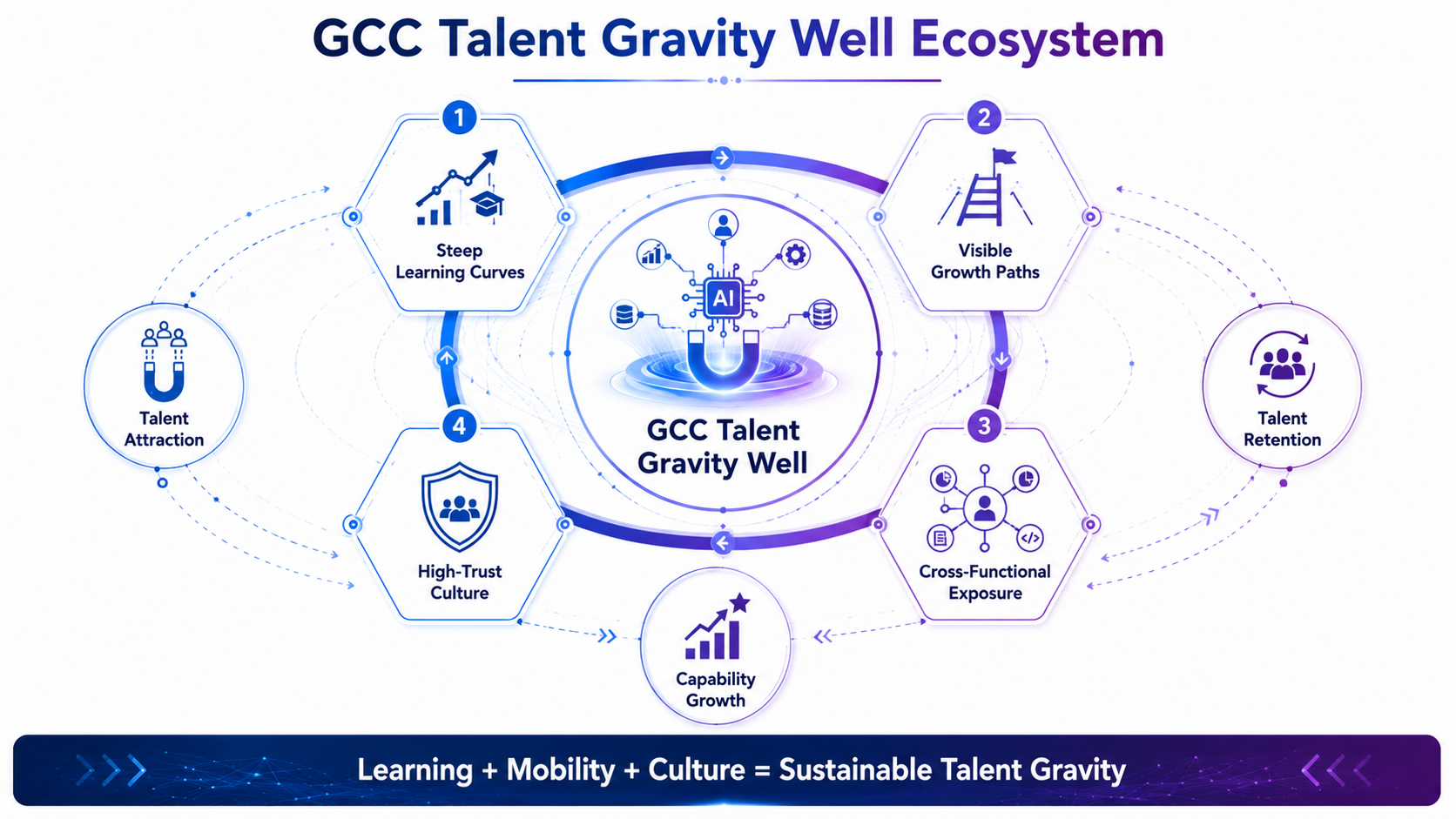
Not every GCC that calls itself strategic has actually built gravity. The difference shows up in four attributes that are observable on the ground, not just claimed in a town hall presentation.
Gravity Attribute | What It Looks Like in Practice |
Steep learning curves | Complexity and exposure grow faster than the org chart does, so capability compounds even in quarters when a title does not change. New challenges arrive before the previous role is fully mastered. |
Visible growth paths | Every role has a credible next role — mapped, published, and understood by the person currently in it — rather than implied or held by managers as a retention lever to deploy in stay interviews. |
Cross-functional exposure | People move across product, platform, data, and domain lines early and often, instead of spending years walled inside a single tower. This cross-domain synthesis is what ambitious professionals value and what competitors cannot easily replicate. |
High-trust culture | Leaders default to sharing strategy, scope, and constraints rather than treating context as something doled out on a need-to-know basis. Transparency signals that the organisation values the person's judgment, not just their output. |
Contrast that with the transactional, ticket-driven GCC. Work arrives as a queue. Success is measured in SLAs, throughput, and tickets closed. A person's value is their current sprint velocity, not their trajectory. A transactional GCC can be efficient and still leak its best people every two years. A gravity well is what it looks like when an organisation decides that retention is a design problem, not a compensation problem, and builds accordingly.
3. Learning as the Engine of Gravity
If gravity is the outcome, learning is the engine. The most resilient GCC learning ecosystems combine two layers that are too often built and managed in isolation.
The first is structured learning: academies, cohort-based upskilling tracks, and formal certification pathways aligned to where the business is headed, not just where it has been. The second is informal learning: practice communities, guilds organised around a skill or domain, and mentoring relationships that move knowledge sideways and downward through the organisation without waiting for a course catalogue to catch up. Centres that build only the first layer produce credentialed people who still cannot solve a novel problem under pressure. Centres that build only the second produce pockets of excellence that never scale.
What ties the two together is learning velocity — how fast a person's capability actually changes, not how many hours of content they have consumed. The pressure to move fast is real: the working half-life of a technical skill has compressed to roughly three years, and NASSCOM estimates that more than 40 percent of tech roles inside Indian GCCs already face a meaningful skill gap. Centres cannot out-curriculum that pace. They can only out-practice it, which is why practice-based learning — live projects, sandboxes, and labs where people build against real, messy problems rather than case studies — has become the central currency of a gravity well, not an optional add-on.
Unlock the Full Research
Create a free account or sign in to access the complete methodology, deep-dive analysis, and key implementation frameworks.
Don't have an account? It's free to join.
Organization Learning Labs
Research & Insights Division


Comments