GCC Learning Intelligence: Building the Enterprise Capability Spine

How GCC leaders can transform distributed expertise into a coherent learning intelligence hub — and why this shift makes GCCs the most strategically valuable node in the global enterprise.
Orchestrating Global-Local Learning Intelligence: How GCCs Turn Distributed Expertise into an Enterprise Capability Spine
Why the GCC that learns to harvest and redistribute distributed knowledge across the enterprise will become the most strategically irreplaceable node in the global operating model
Abstract
Global Capability Centres are at an inflection point. For two decades, they served primarily as delivery engines — cost-efficient extensions of headquarters executing well-defined tasks at scale. The next decade demands something fundamentally different: GCCs as orchestrators of learning intelligence, integrating knowledge flowing from HQ, business units, and local markets into a coherent capability development engine that powers the entire enterprise.
This article maps the architecture of that transformation — from sensing distributed expertise across geographies to codifying it as reusable organisational capital, from designing a learning supply chain that converts insight into application to identifying the behaviours and roles that make orchestration stick. The argument is not that GCCs should add learning to their list of responsibilities. It is that learning orchestration is the capability that unlocks everything else GCCs aspire to deliver.
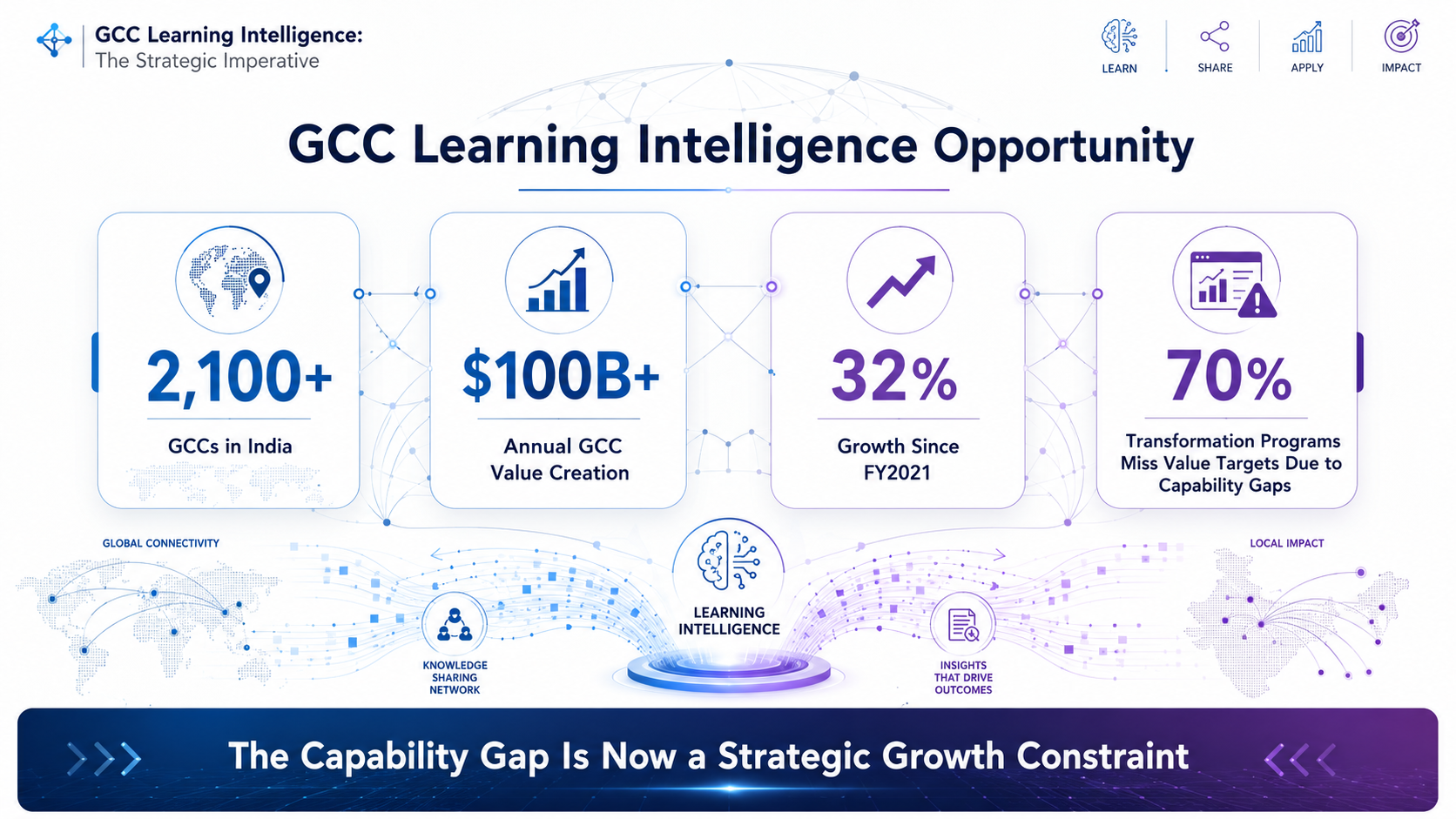
1. Distributed Expertise, Fragmented Learning: The Problem No One Has Named Clearly
Ask any enterprise leader where their organisation's best knowledge lives, and the honest answer is usually: everywhere and nowhere. A risk team in Bengaluru has built a proprietary early-warning model that outperforms anything the global centre uses. A customer operations unit in Warsaw has cracked a particular kind of churn through a low-tech relationship protocol that never made it into a case study. A product engineering cluster in Hyderabad runs retrospectives in a way that dramatically shortens the design-to-release cycle — but only people in that building know it.
This is the fundamental paradox of the modern multinational: distributed operations generate exceptional local intelligence, but the organisation's learning architecture was never built to harvest it. Most knowledge management efforts capture what is easy to capture — formal training completions, documented processes, leadership frameworks produced by consultants — and miss the harder, more valuable material: the adaptive judgment, the workarounds that actually work, the peer-developed heuristics that experienced practitioners carry in their heads.
"Global Capability Centres sit at a uniquely powerful intersection. They span HQ expectations and local realities. They host deep functional expertise alongside contextual market knowledge. They have the scale to sense patterns that single-country teams cannot see." — McKinsey Center for Organisational Learning, 2024 |
The opportunity is to reposition GCCs not as recipients of learning from headquarters, but as the node that stitches distributed expertise into a coherent, continuously improving learning system. This is not a marginal upgrade to what GCCs already do. It is a structural reimagination of their role in the enterprise value chain — one that makes them genuinely irreplaceable rather than merely efficient.
2. The GCC as Learning Intelligence Hub: A Different Operating Logic
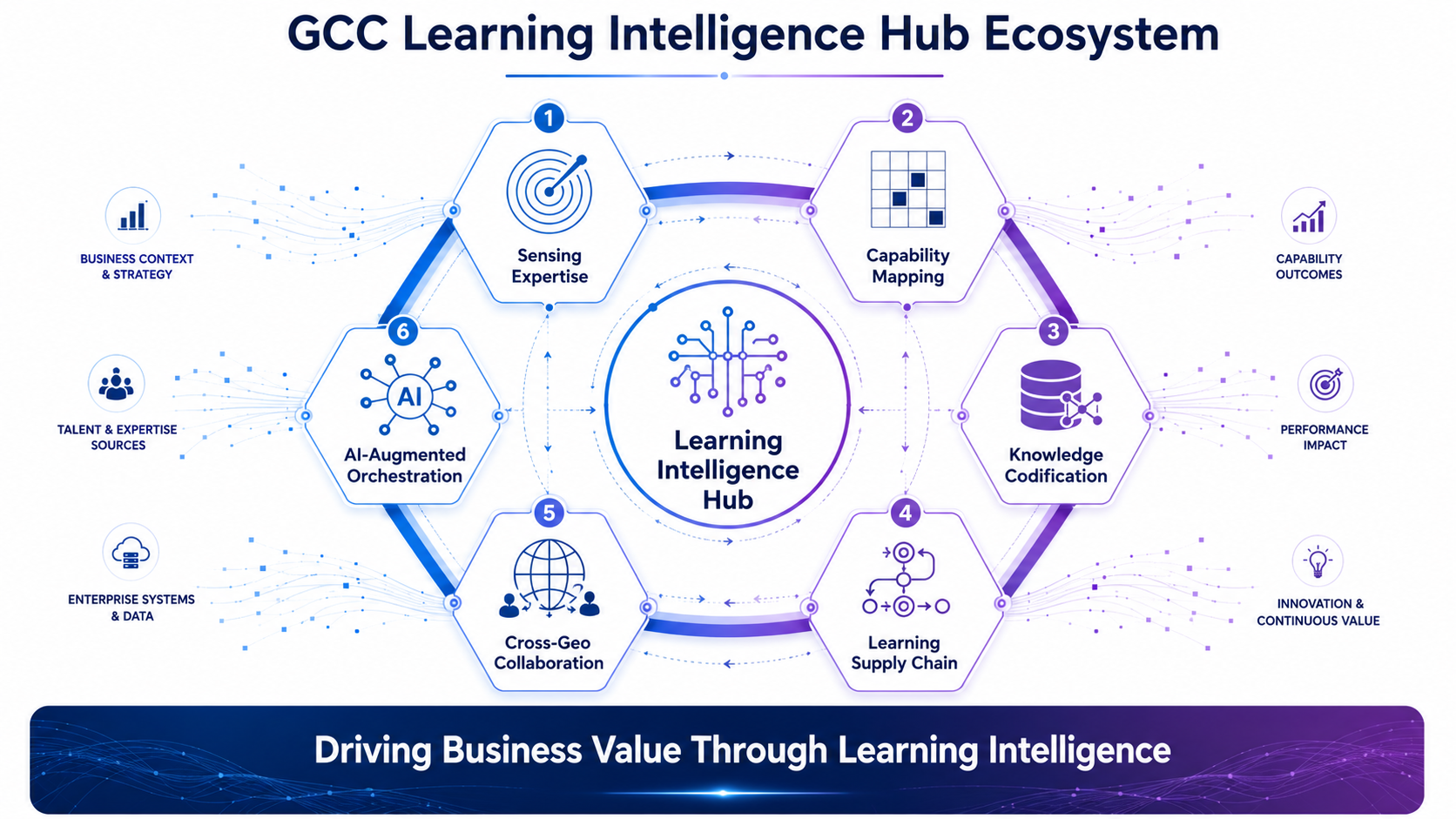
Traditional conceptions of the GCC in learning tend to cast it in a passive role: receive training content from HQ, localise where necessary, deploy to teams, report completion rates. This model is not wrong — it is simply insufficient. It treats learning as a commodity that flows in one direction and measures outputs (completions, hours, satisfaction scores) rather than outcomes (capability change, performance impact, knowledge retention).
A learning intelligence hub operates on a fundamentally different logic. It performs three functions that passive delivery cannot replicate.
Sensing Patterns Across Regions
The hub systematically monitors where performance is accelerating, where teams are inventing workarounds to compensate for gaps in formal guidance, and where expertise is clustering in pockets the rest of the organisation has not yet discovered. This is not passive data collection — it requires active curation: conversations with practitioners, analysis of performance variation, and post-project reviews that dig beneath surface-level lessons learned.
Codifying Distributed Best Practice
Once identified, distributed expertise must be translated from tacit knowledge — what a practitioner knows how to do — into explicit knowledge that others can learn and apply. Most organisations default to documentation: write it up, put it in a portal, mark it shared. But documentation without context, validation, and application support sits unread. Genuine codification requires understanding what conditions make a practice effective, what adaptations it needs for different contexts, and what the failure modes look like.
Feeding Insights Back as Reusable Organisational Assets
The final function is intelligent distribution — not broadcast. Different teams need different things. A reusable asset is not a document dumped in a shared folder; it is a modular, searchable resource that arrives in the workflow of the person who needs it, with sufficient context for immediate application and a feedback mechanism that allows it to improve over time.
What distinguishes this from traditional analytics roles is orientation. Analytics looks backward — what happened, why did it happen, what do we report. Learning intelligence looks forward: what do practitioners need to know to perform better tomorrow, and what does the enterprise already know that has not yet been mobilised?
3. Building Global-Local Capability Maps
Before a GCC can orchestrate learning intelligence, it needs a clear picture of the capability landscape it is navigating. A global-local capability map does three things: it identifies capabilities that are genuinely enterprise-wide and should be consistent everywhere; it surfaces capabilities that are locally differentiated and valuable precisely because of their context-specificity; and it locates the gaps and overlaps that represent the highest-priority learning investments.
Four domains routinely surface in GCC environments as particularly rich targets for this mapping exercise:
Capability Domain | What the Capability Map Typically Reveals in GCC Environments |
Risk and Compliance | HQ holds the policy framework; local teams hold market-specific application knowledge; the GCC holds cross-jurisdictional pattern recognition. The gap is almost always in the transfer layer between these three. |
Customer Operations | Universal service principles combine with intensely local variation in communication norms and channel preferences. GCCs generating comparative insight across multiple markets are not systematically redistributing it. |
Product Engineering | Deep technical expertise coexists with significant gaps in product thinking and business translation. The highest-value capabilities are hybrid — engineers who challenge requirements, PMs who understand technical constraints. |
Finance and Analytics | The most differentiated GCC capability is rarely technical accuracy but interpretive judgment: seeing what the numbers mean in context, anticipating leadership questions, framing insights that drive decisions rather than just report them. |
The discipline of capability mapping forces conversations that most organisations avoid: not just what do we need people to know, but where is that knowledge already living, who is currently holding it, and what would it take to make it accessible to everyone who needs it. This discipline alone creates significant enterprise value before any learning programme is designed.
4. Designing the Learning Supply Chain
The concept of a learning supply chain reframes capability development as a production system with identifiable stages, accountable owners, and measurable throughput. It borrows the logic of operational excellence — eliminate waste, reduce cycle time, improve quality, build feedback loops — and applies it to the process of turning organisational insight into individual and team capability.
Supply Chain Stage | Key Discipline and Common Failure Mode |
Stage 1: Insight | Curate the significant from the abundant. Common failure: collecting everything rather than identifying what is genuinely actionable and not already known. Unlock the Full ResearchCreate a free account or sign in to access the complete methodology, deep-dive analysis, and key implementation frameworks. Don't have an account? It's free to join. O Organization Learning LabsResearch & Insights Division On this pageResearch DetailsIndustryGCC Leadership & Governance AuthorOrganization Learning Labs PublishedJun 24, 2026 You Might Also Be Interested In Information Technology Designing the future-ready digital engineering organization Banking, Financial Service And Insurance A Systematic, Empirical Framework for Capability Development in Retail Banking Banking, Financial Service And Insurance Why Capability Beats Strategy in Retail Banking Organizations |
Comments