GCC Cognitive Edge: From Cost Centre to Behavioural Operating System

How GCC leaders can move beyond cost arbitrage to become the enterprise's behavioural operating system — the shared layer of decision norms, collaboration habits, and learning that scales globally.
From Cost Arbitrage to Cognitive Edge: How GCCs Become the Behavioural Operating System of Global Enterprises
Why the most advanced GCCs are quietly becoming the shared layer of norms, habits, and decision routines that determines whether distributed global teams actually work as one organisation
Abstract
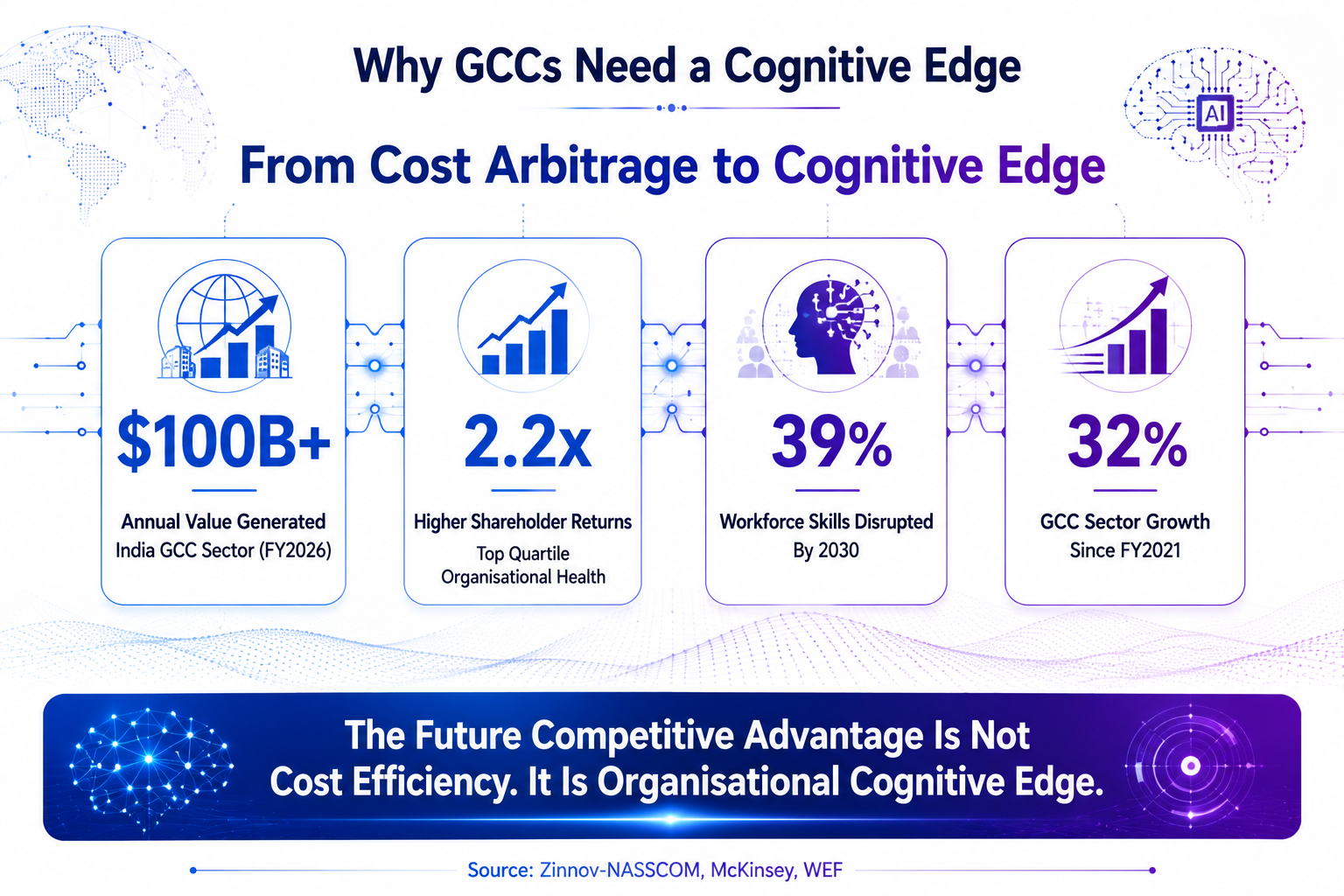
Global Capability Centres have spent two decades proving they can run processes cheaper, faster, and more reliably than anywhere else in the enterprise. That argument is now table stakes. The more consequential question for 2026 and beyond is not what a GCC can deliver, but how it teaches an entire global organisation to think, decide, and learn.
This article argues that the most advanced GCCs are quietly becoming the behavioural operating system of their enterprises — the shared layer of norms, habits, and decision routines that determines whether distributed teams actually work as one organisation. We outline what a behavioural OS is, why GCCs are structurally positioned to own it, the seven signature behaviours that mark a high-impact centre, the capability systems required to install those behaviours at scale, and the governance and KPIs leaders need to make the shift deliberate rather than accidental.
1. The GCC Identity Crisis: Beyond the Cost Story
For most of their history, Global Capability Centres were sold — internally and externally — on a simple promise: the same work, done for less. That promise built an entire industry. It also built a ceiling. Once a centre has optimised cost-to-serve, automated its transactional volume, and consolidated its processes, the old narrative runs out of road. Boards stop asking "how much did we save?" and start asking "what is this centre actually making us better at?"
That question lands at an awkward moment. Enterprises are simultaneously betting on AI, decentralising decision rights, and trying to operate across more time zones, languages, and regulatory regimes than ever before. Cost efficiency does not solve any of that. What solves it is consistency in how people think and work, regardless of where they sit. That is a behavioural problem, not a cost problem — and it raises a useful provocation: what if the GCC stopped trying to be the enterprise's cheapest engine room and started becoming its behavioural operating system instead?
"The GCC that can answer the question "which ways of working would quietly stop happening anywhere in the organisation if this centre disappeared?" has already made the shift from delivery engine to behavioural OS. Most centres cannot yet answer it." — KPMG GCC Strategic Evolution Report, 2024 |
2. What Is a Behavioural Operating System for Enterprises?
Every enterprise runs on two systems simultaneously. The first is the technical operating system: the platforms, data architecture, and process flows that move work through the organisation. The second, far less visible, is the behavioural operating system — the shared norms for how people make decisions, escalate problems, collaborate across functions, and learn from what goes wrong.
Strategy documents describe the first system in detail. The second is usually left to culture decks and onboarding slides, which is precisely why it tends to fragment the moment an organisation goes global. Without a deliberately designed behavioural layer, every site, function, and time zone quietly develops its own dialect of "how we do things here" — and those dialects rarely reconcile on their own. The result is duplicated decisions, slow escalation, and innovation that never travels beyond the team that invented it. A behavioural OS makes these norms explicit, measurable, and propagatable — the same way a technical OS makes computing resources explicit, measurable, and accessible.
3. Why GCCs Are Uniquely Positioned to Own the Behavioural OS
GCCs did not set out to own behaviour design, but their structural position makes them the best-placed part of the enterprise to do it. Three advantages stand out:
• Talent density: GCCs typically run the same process for multiple business units, brands, or geographies at once, giving them a concentration of skilled talent that no single regional office can match. This density is the prerequisite for behavioural norm-setting that travels.
• Process ownership: Centres often own end-to-end process design rather than a single fragment, which means they can see — and fix — where a workflow breaks down across handoffs, not just within one team.
• Cross-functional exposure: A GCC analyst, engineer, or product owner routinely works with stakeholders across markets, functions, and seniority levels in a single week. That cross-functional vantage point is exactly where better ways of working get noticed first, and where they can be codified into practices others can adopt.
Together, these advantages mean a GCC is not just executing enterprise processes — it is already shaping how a meaningful share of the organisation decides, collaborates, and escalates. The opportunity is to make that influence intentional: standardise the behaviours that work well in the centre and deliberately propagate them outward, rather than letting them remain a local competitive advantage.
4. Seven Signature Behaviours of a High-Impact Behavioural OS GCC
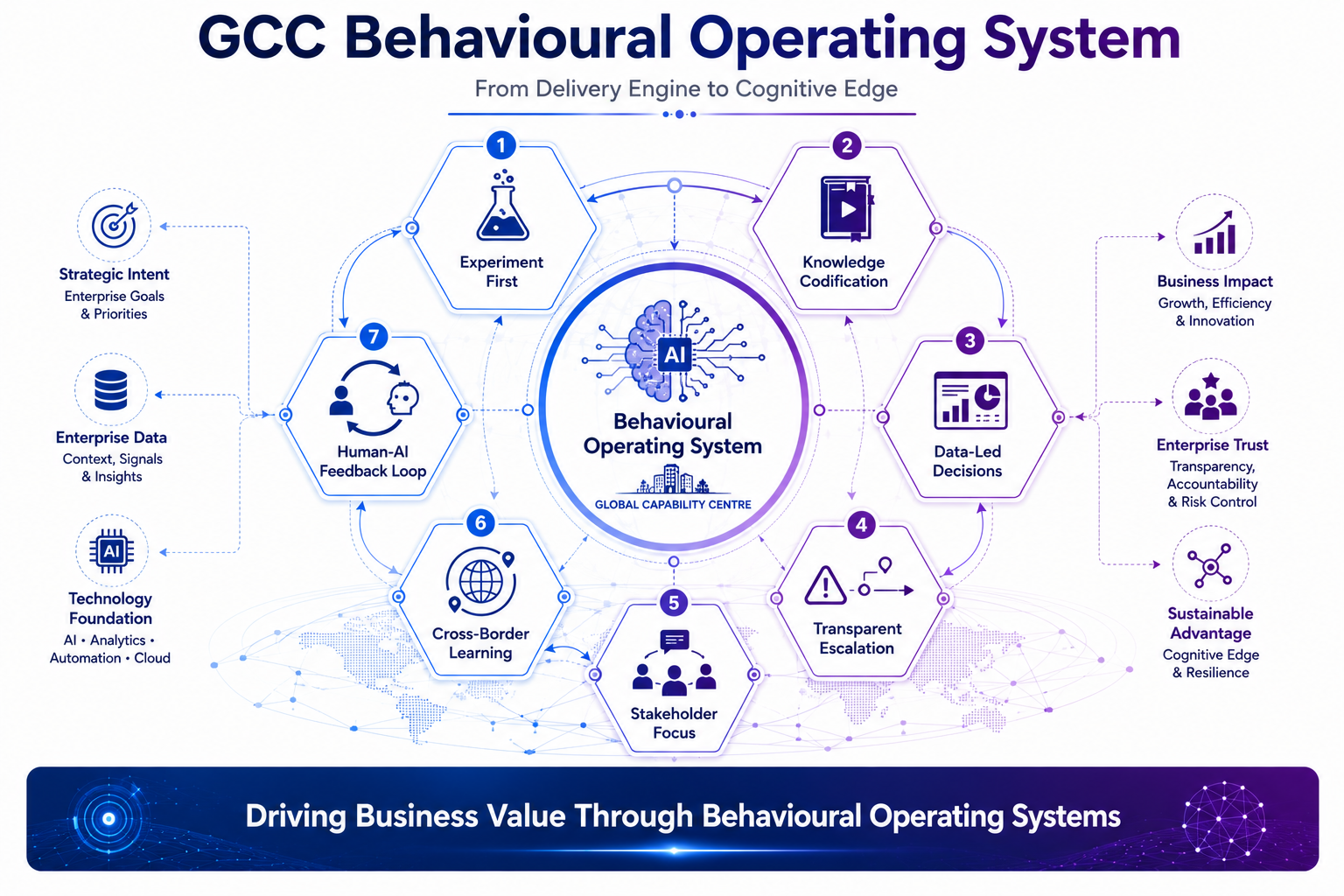
Not every behaviour is worth scaling. The ones that earn a place in an enterprise-wide operating system share a common trait: they reduce friction at the points where work, data, or decisions cross a boundary. Seven behaviours show up consistently in centres that have made this shift.
Signature Behaviour | What It Looks Like in a High-Impact GCC |
1. Defaulting to experimentation over escalation | A process analyst hits an ambiguous edge case and runs a small, time-boxed test rather than opening a ticket and waiting. A claims-processing team pilots a revised intake checklist with one queue for two weeks before requesting a policy change — turning a debate into a dataset. |
2. Codifying knowledge as it is created | Teams treat a solved problem as incomplete until it has been written into a playbook, a decision tree, or a reusable prompt library. An analytics pod that builds a fraud-detection rule documents the logic and threshold rationale immediately, so the next analyst does not rediscover it from scratch. |
3. Data-first decision making Unlock the Full ResearchCreate a free account or sign in to access the complete methodology, deep-dive analysis, and key implementation frameworks. Don't have an account? It's free to join. O Organization Learning LabsResearch & Insights Division On this pageResearch DetailsIndustryGCC Leadership & Governance AuthorOrganization Learning Labs PublishedJun 24, 2026 You Might Also Be Interested In Information Technology Designing the future-ready digital engineering organization Banking, Financial Service And Insurance A Systematic, Empirical Framework for Capability Development in Retail Banking Banking, Financial Service And Insurance Why Capability Beats Strategy in Retail Banking Organizations |
Comments