Future Skills for Automotive After-Sales Service

Discover the workforce capabilities automotive service leaders must build for EVs and SDVs -- from high-voltage safety to predictive diagnostics and ADAS calibration. 2030-2035 strategy guide.
Why the Automotive Service Function Is at a Strategic Inflection Point
The automotive after-sales and service function is undergoing its most consequential transformation in over a century. For 130 years, automotive service was organized around a single operating logic: locate the worn or failed mechanical component, replace or repair it, return the vehicle to the road. That logic is now structurally obsolete.
Electric vehicles (EVs) and software-defined vehicles (SDVs) are not incremental improvements on the internal combustion engine (ICE) era. They represent a categorical shift in vehicle architecture -- from mechanical-dominant systems to electro-mechanical platforms governed by software, data, and digital infrastructure. The consequences for after-sales and service operations are profound. Workshops that thrived on engine diagnostics, transmission overhauls, and exhaust system repairs are being asked, almost overnight, to become capable of managing 800-volt battery systems, ADAS calibration rigs, over-the-air (OTA) software deployments, and predictive analytics platforms.
This is not a capability gap that targeted refresher training will close. It is a structural workforce transformation that demands strategic investment, institutional redesign, and a new operating model for the service function. Automotive service leaders who recognize this shift now -- and build the capability architectures to respond -- will define the customer experience standard for the EV decade. Those who do not will find themselves unable to service the very products their organizations sell.
"The future of automotive mobility will not be won solely by great products. It will be won by the quality of the organizations that service those products." -- McKinsey & Company, The Future of Automotive After-Sales in an Electric World |
The Scale of the Shift: What Has Actually Changed in Automotive Service?
To frame the capability imperative with precision, it is necessary to map exactly what has changed across the core domains of automotive service operations.
High-Voltage Safety: A Non-Negotiable Foundation
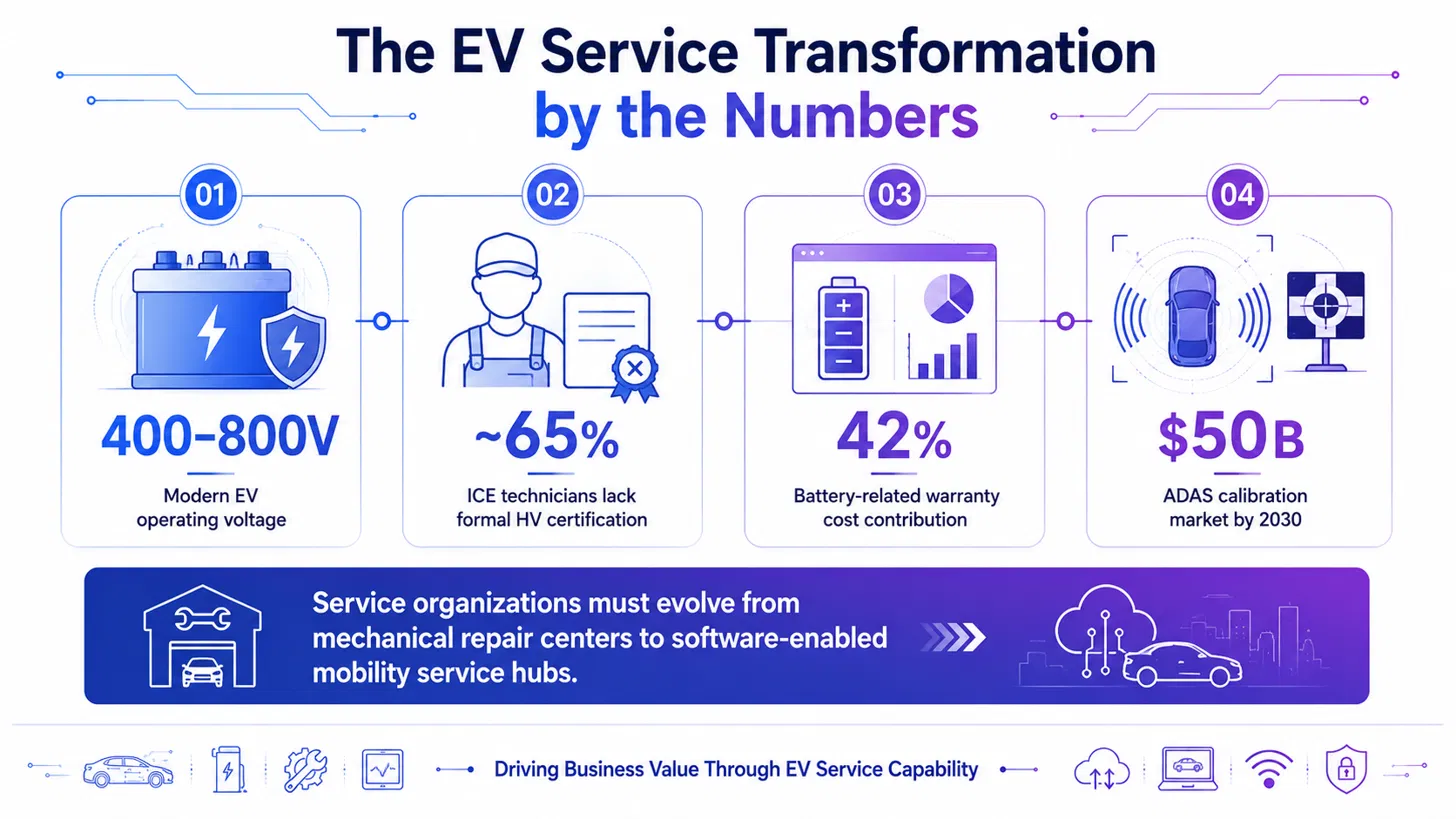
The most immediate and non-negotiable change in EV service environments is the introduction of high-voltage (HV) electrical systems. Modern electric vehicles operate at 400 to 800 volts -- some performance platforms exceeding 900 volts. This voltage range is classified as industrial-grade electrical exposure. A service error at these voltages is not merely an equipment issue. It is a life-safety event.
Before any work on an HV component, technicians must execute a formal de-energization sequence: confirm power-off status using calibrated meters, implement lock-out/tag-out (LOTO) procedures, verify isolation resistance, don personal protective equipment (PPE) rated for HV environments, and prepare documented emergency response protocols. A 2024 TUV Rheinland analysis of EV service safety incidents found that inadequate HV de-energization procedures accounted for the majority of serious technician injuries in early EV service deployments. The message is unambiguous: high-voltage competence is the bedrock capability upon which all other EV service skills are built.
Battery Diagnostics: From Replacement to Data-Driven Analysis
In the ICE era, the 12-volt vehicle battery was a simple ancillary component -- checked occasionally, replaced when flat. In an electric vehicle, the battery pack is the central propulsion system, the most expensive single component (representing 35--45% of vehicle cost), and one of the most complex systems the service function will ever manage.
Modern EV battery packs contain thousands of individual cells, monitored continuously by battery management systems (BMS) that track cell-level voltage, temperature gradients, state of charge (SoC), and state of health (SoH). Service teams are no longer simply replacing batteries when they fail catastrophically. They are interpreting data streams to diagnose degradation patterns, predicting cell-level failures before they cascade, and making warranty determination decisions based on algorithmic analysis.
A 2024 Bosch Mobility Solutions analysis estimated that battery-related service incidents account for approximately 42% of EV warranty costs in the first three years of vehicle life. The capability to diagnose battery systems accurately -- rather than replace unnecessarily -- represents a direct financial lever for both OEMs and service networks. Service advisors must now be capable of explaining battery health in plain language: interpreting capacity degradation, addressing fast-charging concerns, and managing customer expectations about long-term performance.
Software-Defined Vehicles: When Service Requires Software Engineering
Perhaps the most structurally disruptive shift in automotive service comes from the rise of software-defined vehicles. Modern EVs receive regular over-the-air (OTA) software updates that modify performance parameters, address functional anomalies, deploy cybersecurity patches, and introduce new feature capabilities. Tesla's OTA infrastructure, which has delivered more than 70 major software updates to vehicles already in customer hands, has established an industry precedent now being adopted by virtually every major OEM.
When these OTA deployments fail -- due to interrupted downloads, file corruption, ECU compatibility conflicts, or network timing issues -- the diagnostic and remediation burden falls to the service network. Technicians must understand how OTA update pipelines are architected, how to identify and diagnose deployment failures, how to execute manual software restoration procedures, and how to manage version rollbacks without compromising vehicle safety systems.
Volkswagen Group's software platform strategy documentation notes that by 2028, software-related service events are projected to account for approximately 25% of all in-workshop time in authorized service centers. The implication is stark: a meaningful proportion of workshop capacity must now be staffed by individuals who can think in terms of digital infrastructure, not just mechanical assemblies.
ADAS Calibration: The Rise of Precision Service
Unlock the Full Research
Create a free account or sign in to access the complete methodology, deep-dive analysis, and key implementation frameworks.
Don't have an account? It's free to join.
Organization Learning Labs
Research & Insights Division


Comments