Future-Ready Retail: Phygital Customer Journey Skills

How retail leaders can build frontline teams capable of orchestrating seamless phygital customer journeys. A strategic capability guide for CXOs and operations heads.
Future-Ready Retail Teams: Building Capability for the Phygital Customer Journey
There is no longer an "online shopper" and an "in-store shopper." There is simply the customer -- moving fluidly across Instagram discovery, mobile browsing, physical visits, app-based payment, and WhatsApp aftercare within a single purchase journey. Customers do not experience channels. They experience a single, continuous relationship with a brand.
The strategic consequence of this reality for retail organizations is profound: frontline teams must be equipped not to serve a channel, but to orchestrate a journey.
Yet across most retail organizations, training has not caught up. Associates are trained in operational silos -- in-store procedures here, e-commerce processes there, customer service scripts for single-channel problems -- reflecting how retailers used to organize themselves, not how customers shop today. The result is a systematic service fragmentation that leaks revenue, erodes customer loyalty, and disengages frontline staff.
This article presents the capability architecture that retail leaders must build to close the phygital execution gap -- and the strategic imperatives that make this not merely a customer experience priority, but a core business transformation requirement for the decade ahead.
"Companies with strong omnichannel execution retain close to 89 percent of their customers, compared to roughly 33 percent for those with weak channel integration. The capability gap between these outcomes is not technological -- it is human." -- Aberdeen Group, via Disprz, 2024 |
The Phygital Reality: What Customers Already Expect in 2025
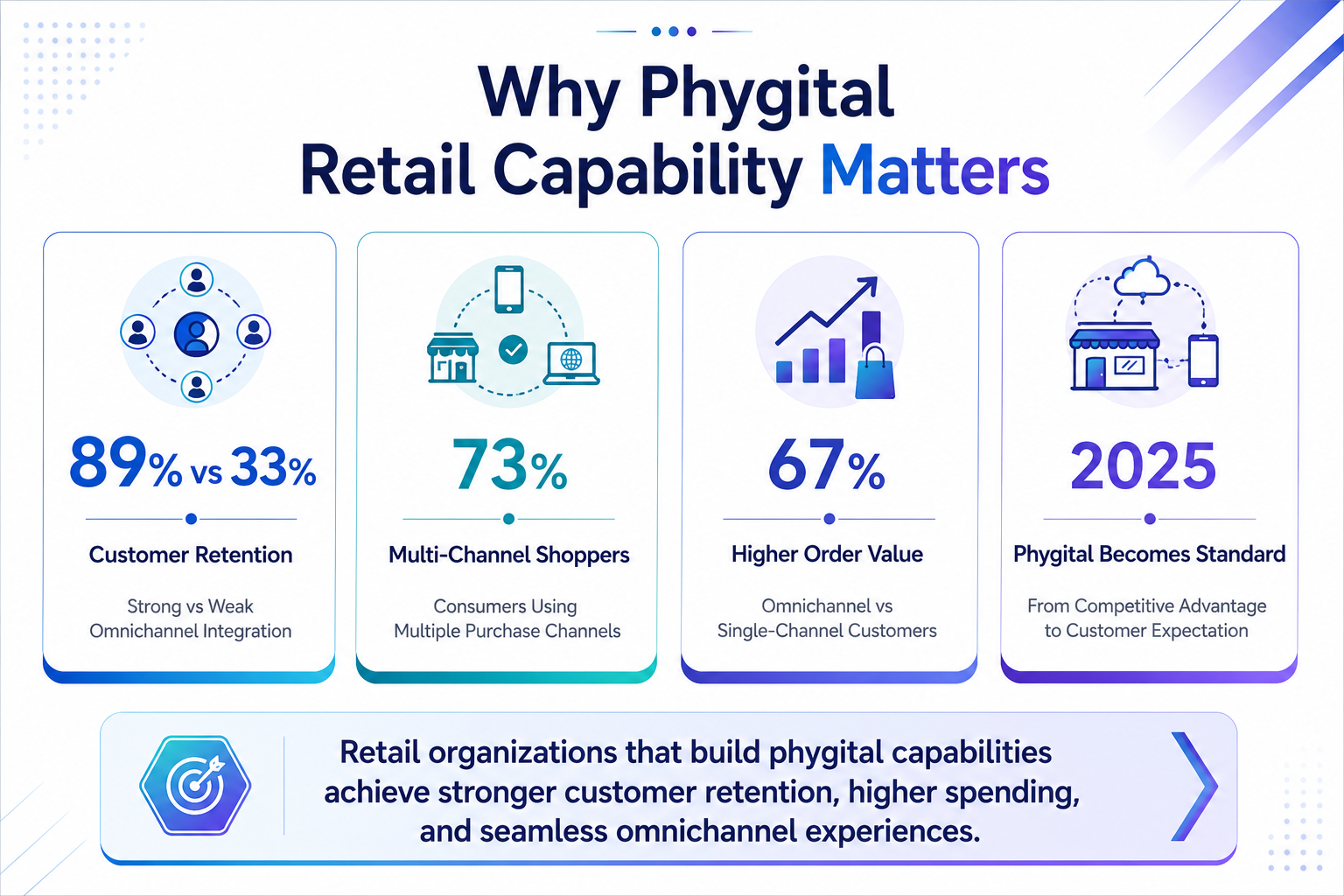
The phygital customer journey is not a future state. It is today's operating reality, and the execution gap between what customers expect and what most frontline teams can deliver is a measurable revenue drain.
The Training Gap: Why Siloed Preparation Fails the Phygital Customer
The specific ways in which channel-siloed training produces broken customer experiences follow predictable patterns across retail organizations:
• A customer who researched extensively online arrives in-store and encounters an associate who cannot access their browsing history, forcing them to explain their needs from scratch -- destroying the continuity value of the digital touchpoint
• Click-and-collect orders fail because the associate handling the pickup cannot navigate the inventory management system confidently, creating wait times that contradict the convenience promise of the channel
• Mobile payment options confuse frontline staff because they were trained on POS systems only, creating transaction friction at the moment of purchase commitment
• A complaint that originated on social media arrives in-store with no context transfer, forcing the customer to repeat themselves and the associate to resolve a problem without access to the digital interaction history
• Digital promotions are not recognized at physical checkout because associates were not briefed on the current campaign, undermining the integrated marketing investment
Each of these failure modes is a training system failure before it is an operational failure. The technology infrastructure for phygital retail often exists. The capability to leverage it does not.
The Four Capability Clusters of the Phygital-Ready Associate
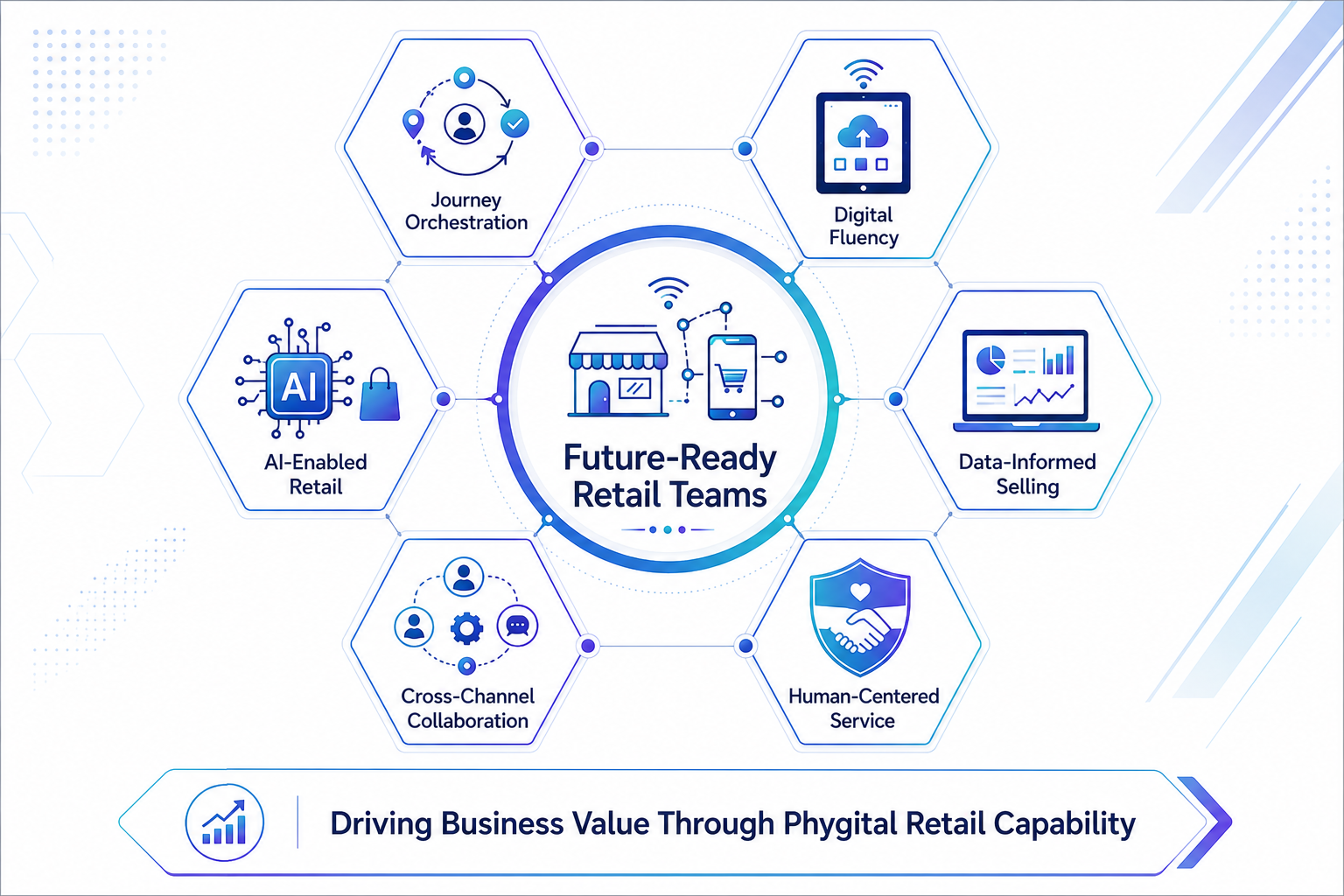
Future-ready retail skills are not about turning associates into IT specialists. They are about enabling frontline teams to orchestrate complete customer journeys -- with confidence, fluency, and genuine human intelligence -- rather than executing isolated transactions. Four capability clusters define the modern retail competency architecture:
1. Journey Orchestration
Journey orchestration is the capacity to understand how individual customers move across channels and to recognize where a specific customer is in their purchase journey at any given interaction. This is arguably the most transformative skill shift required in retail: from transaction-focused to journey-aware.
• Recognizing when a customer has researched online before arriving in-store and adapting the interaction accordingly
• Understanding common customer journey flows: social-to-store discovery, click-and-collect fulfillment, online purchase in-store return, omnichannel loyalty redemption
• Knowing when to resolve directly, when to escalate seamlessly, and when to hand off to digital channels without breaking the experience
• Anticipating next steps in the customer journey rather than reacting to isolated moments
Associates with journey orchestration capability create experiences that feel effortlessly continuous. Associates without it create experiences that feel fragmented and frustrating -- regardless of how good the technology infrastructure is.
2. Digital Fluency
Digital fluency is comfort and confidence with the full suite of tools that enable phygital retail. The goal is not technical mastery but frictionless capability -- making technology invisible to the customer experience by deploying it naturally and confidently.
• Mobile apps and in-store tablets for product discovery, inventory lookup, and customer preference access
• Real-time inventory management systems and omnichannel fulfillment workflows
• Digital payment platforms: contactless, QR-based, app-based, and split-payment options
• Remote assistance tools for customers who need hybrid physical-digital support
• Customer data and loyalty platforms for personalized service delivery
When associates are digitally fluent, technology enhances the customer experience. When they are not, it creates friction, erodes confidence, and undermines the commercial rationale for the technology investment.
3. Data-Informed Selling
Modern retail generates rich behavioral and transactional data. The capability imperative is not data literacy in the analytical sense, but the ability to use data signals ethically and naturally to deliver genuinely personalized service.
Unlock the Full Research
Create a free account or sign in to access the complete methodology, deep-dive analysis, and key implementation frameworks.
Don't have an account? It's free to join.
Organization Learning Labs
Research & Insights Division


Comments