Future-Ready Hotel Workforce Competencies

How hospitality leaders can build integrated workforce competencies across guest-facing, operational, and leadership clusters -- for sustained excellence through 2035.
Multi-Skilled, Multi-Lingual, Multi-Channel: Building the Future-Ready Hotel Workforce
Walk into any competitive hotel today and you can feel the difference between a team that is merely staffed and a team that is capable. Guests are greeted with genuine warmth and contextual awareness. Systems work smoothly because the people operating them understand what the data is telling them. Issues are anticipated rather than escalated because the team has the judgment to act before problems become complaints. This is not serendipity. It is the outcome of deliberate, systematic capability development.
The hospitality industry is at a structural inflection point. Persistent skills gaps, accelerating digital adoption, and rising guest expectations are forcing operators to fundamentally rethink how talent is developed. At the same time, there is a growing recognition that the solution is not simply more training. It is deeper capability: the ability to see clearly, adapt intelligently, and serve with genuine distinction.
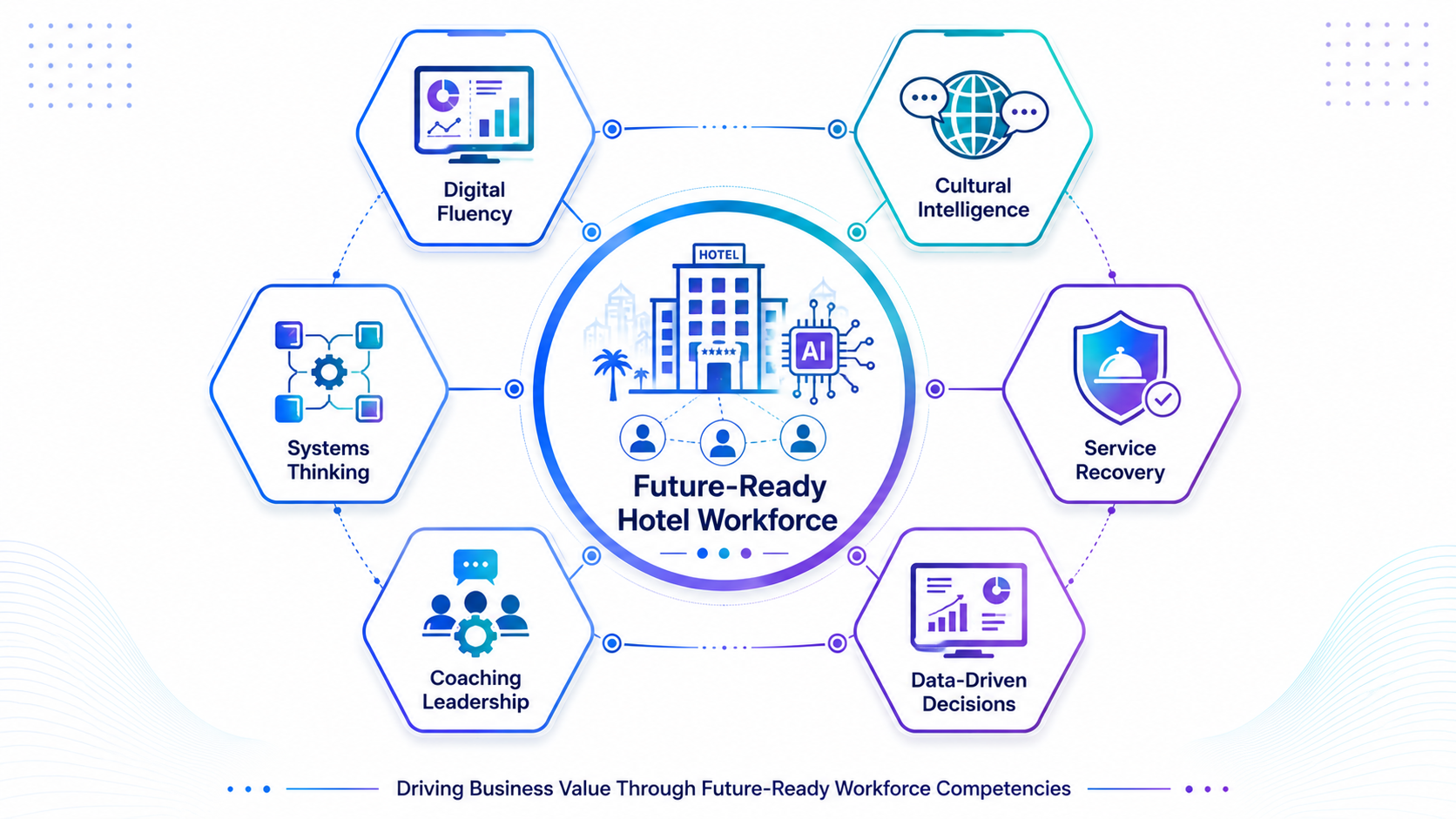
This article examines the three capability clusters that will define the future-ready hotel workforce, the empirical evidence for why each matters, and how hospitality leaders can build the kind of integrated competency advantage that differentiates guest experience leaders from the field through 2035 and beyond.
The Capability Gap Is Real -- and It Is Growing
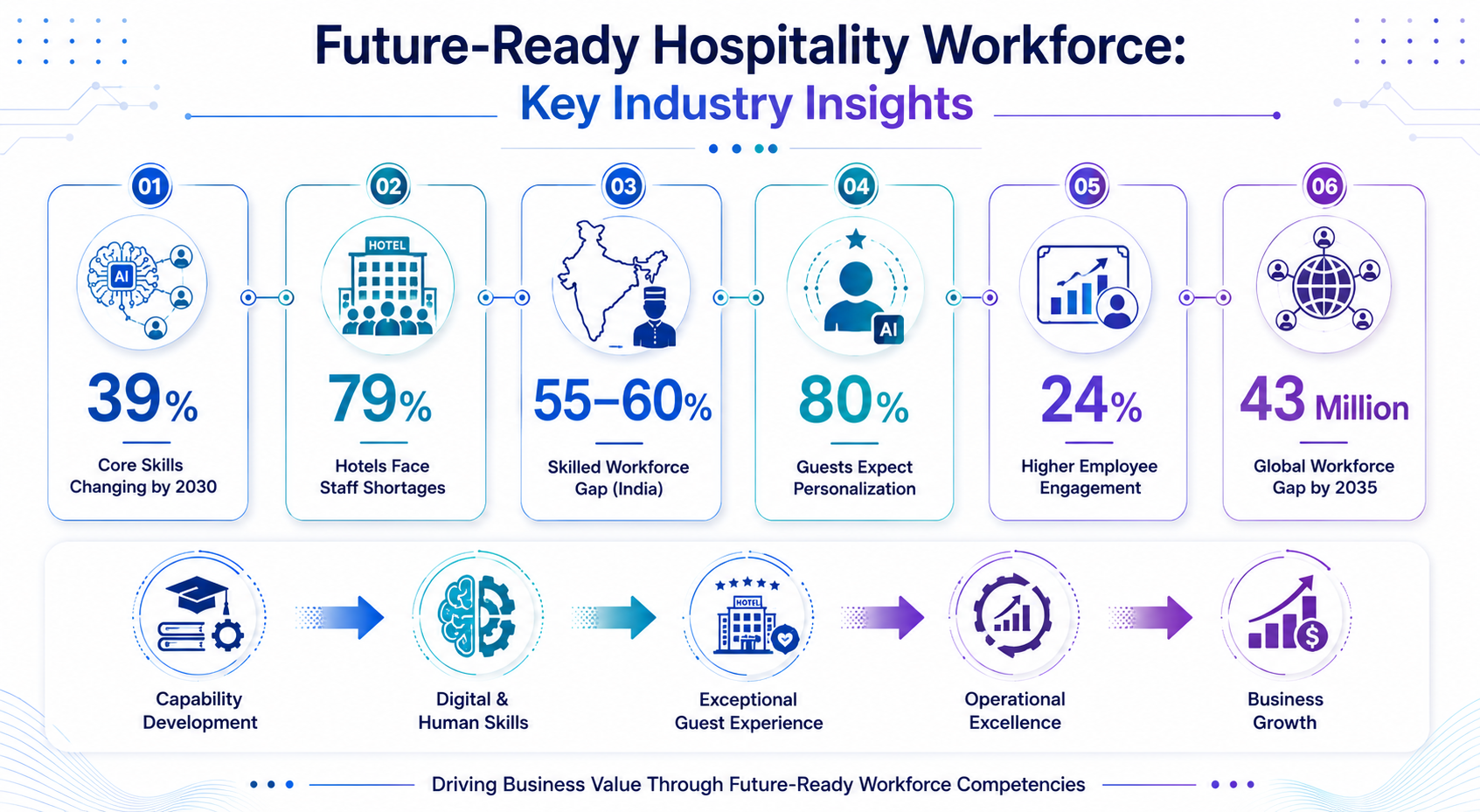
Recent industry data paints a consistent picture across markets. The American Hotel and Lodging Association reports that 79% of hoteliers are experiencing staff shortages. In Europe, 10 to 20% of hospitality positions remain unfilled due to lack of qualified applicants. India faces a 55 to 60% shortfall in skilled hospitality manpower. Vacancies in the UK hospitality sector remain 48% above pre-pandemic levels.
But behind these numbers is a more precise diagnostic: most hospitality organizations are not simply understaffed. They are undercapable in specific, measurable ways. Three capability gaps appear consistently across geographies and property types:
The Digital Fluency Gap
Property management systems, mobile guest applications, digital housekeeping tools, dynamic pricing platforms, and analytics dashboards are now standard operational infrastructure. Yet industry research consistently finds that a significant proportion of hospitality staff work around these systems rather than through them -- creating inefficiency, increasing error rates, and preventing organizations from realizing the guest experience potential of their technology investments. McKinsey research indicates that 80% of travelers expect personalization, yet only one-third of hotel operators feel capable of delivering it. The bottleneck is not technology. It is the human capability to use technology with intelligence and intent.
The Language and Cultural Intelligence Gap
English alone is no longer sufficient for the guest profiles that most hospitality operations serve. As international and domestic travel diversifies, conversational fluency in additional languages and deep cultural competence have become operational requirements, not differentiators. The WEF Future of Jobs Report 2025 identifies aging and growing populations as significant drivers of demand for empathy, active listening, and customer service capability in hospitality -- all of which require cultural intelligence that standardized service protocols cannot substitute for.
The Leadership and Supervisory Capability Gap
Many hospitality supervisors are promoted based on tenure and technical competence rather than leadership readiness. Coaching skills, data-informed decision-making, change navigation, and the ability to build and sustain team psychological safety are frequently underdeveloped, weakening teams precisely when operational pressure makes them most critical. Research from Harvard Business Review indicates that 24% higher engagement and materially lower turnover result from organizations that invest visibly in leadership development across all levels.
"Skills and capabilities deepen perception and understanding. A task-trained employee executes instructions. A capability-developed employee sees patterns, interprets context, anticipates issues, and adapts intelligently." -- OLL Hospitality Research, 2025
Why Capability Matters More Than Task Proficiency
At the heart of the future-ready hospitality workforce is a distinction that most training programs fail to make: the difference between task proficiency and genuine capability.
A task-proficient front desk agent checks guests in efficiently and follows the complaint protocol when problems arise. A capability-developed front desk agent reads the emotional state of a arriving guest, identifies an unspoken need, makes a proactive accommodation that turns an ordinary check-in into a memorable interaction, and handles a complaint by genuinely understanding what the guest needs rather than following a script.
The difference is not personality. It is developed perception. Capability changes what people notice, how they interpret what they notice, and what options they can see. That shift -- from reactive compliance to proactive intelligence -- is the foundation of consistently excellent hospitality.
This is why the WEF's identification of resilience, flexibility, and agility as the most significant skill differentiators between growing and declining roles globally is directly applicable to hospitality. The roles that will grow are those requiring genuine human judgment and relational capability. The roles that will decline are those reducible to procedural execution. Building for the former is not optional for hospitality organizations competing on guest experience.
Three Clusters of Future-Ready Hospitality Competencies
Cluster 1: Guest-Facing Competencies
These capabilities define how guests experience the brand at every interaction. They are the visible surface of the iceberg, supported by the operational and leadership capabilities below.
Language proficiency and cultural fluency: Conversational ability in one or more guest-relevant languages beyond English is becoming baseline in competitive markets. Cultural fluency extends further: understanding how communication styles, service expectations, and social norms vary across guest segments -- and adapting intelligently rather than uniformly. For markets serving significant proportions of Asian, Middle Eastern, or European travelers, this competency directly determines guest satisfaction outcomes.
Service recovery and emotional intelligence: The capacity to handle complaints, disruptions, and special needs with empathy and composure is consistently identified as one of the highest-value capabilities in hospitality. Emotional intelligence enables staff to de-escalate situations without surrendering control of the interaction, preserve guest dignity while maintaining operational boundaries, and convert dissatisfaction into the kind of loyal advocacy that no marketing program can buy.
Unlock the Full Research
Create a free account or sign in to access the complete methodology, deep-dive analysis, and key implementation frameworks.
Don't have an account? It's free to join.
Organization Learning Labs
Research & Insights Division


Comments