Future of Retail Banking Organizations: The 2035 Outlook

Fraud value is rising even as case counts fall. Explore the organizational capabilities that will define future-ready retail banks through 2035 in India.
Future of Retail Banking Organizations: The 2035 Outlook
Fraud losses are rising even as fraud cases fall, and two banks reporting in the same week converted digital investment into sharply different results. What separates them is organizational strategy and governance capability, not the technology each one bought.
EVIDENCE AT A GLANCE
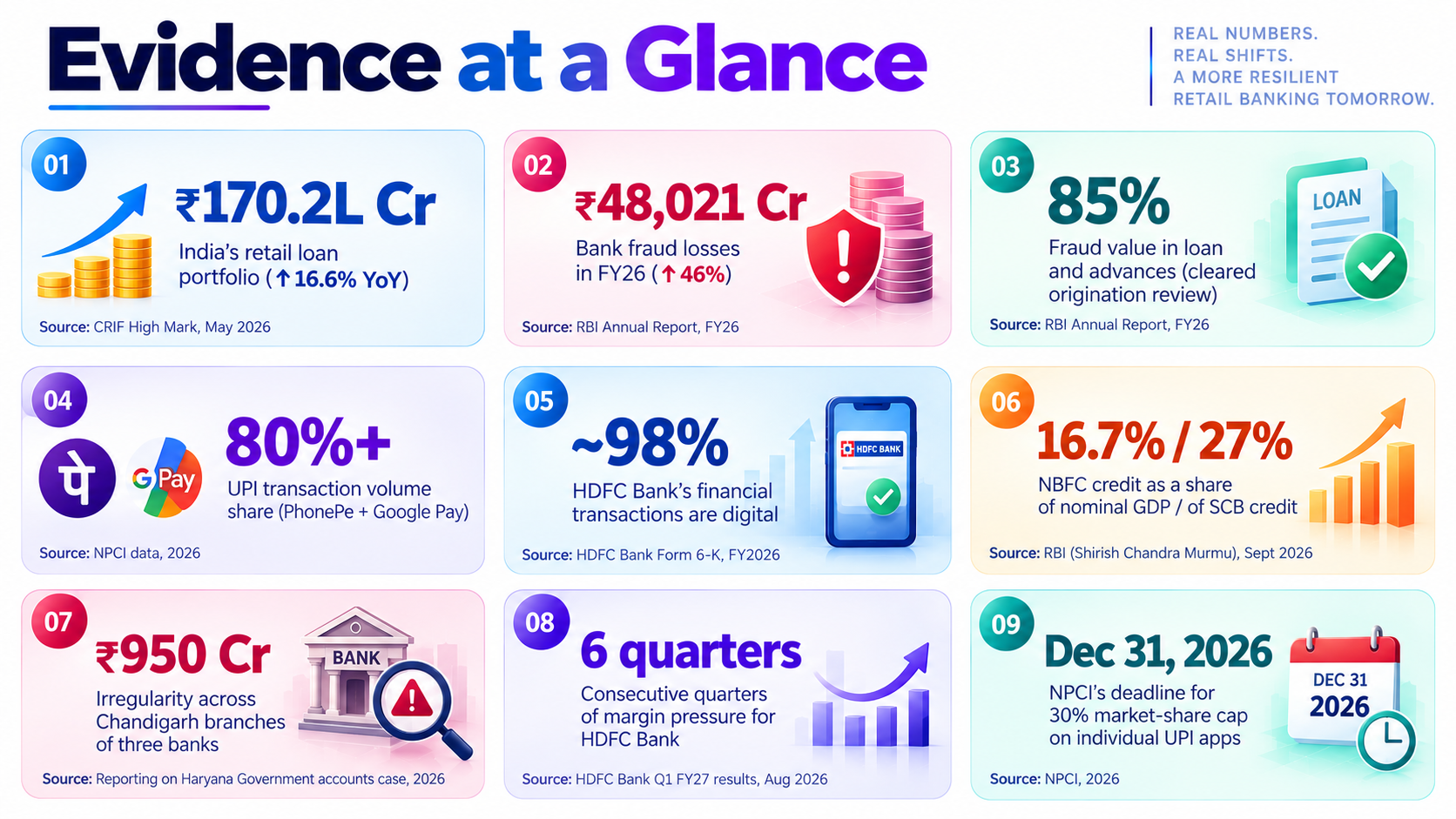
₹170.2L Cr India’s retail loan portfolio, up 16.6% year on year Source: CRIF High Mark, "How India Lends," May 2026 | ₹48,021 Cr RBI-reported bank fraud losses in FY26, up 46% even as the number of fraud cases fell Source: RBI Annual Report, FY26 | 85% Share of FY26 fraud value concentrated in loan and advances fraud that cleared origination review before the loss was recorded Source: RBI Annual Report, FY26 |
80%+ Combined UPI transaction volume share held by PhonePe and Google Pay Source: NPCI data, 2026 | ~98% Share of HDFC Bank’s financial transactions conducted digitally in FY26 Source: HDFC Bank Form 6-K, FY2026 | 16.7% / 27% NBFC credit as a share of nominal GDP, and of scheduled commercial bank credit Source: RBI Deputy Governor Shirish Chandra Murmu, September 2026 |
₹950 Cr Irregularity uncovered across Chandigarh branches of three banks in February 2026 Source: reporting on the Haryana Government accounts case, 2026 | 6 quarters Consecutive quarters of margin pressure HDFC Bank faced before its net interest margin turned positive in Q1 FY27 Source: HDFC Bank Q1 FY27 results, August 2026 | Dec 31, 2026 NPCI’s repeatedly delayed deadline for its 30% market-share cap on individual UPI apps Source: NPCI, 2026 |
The Industry at an Inflection Point
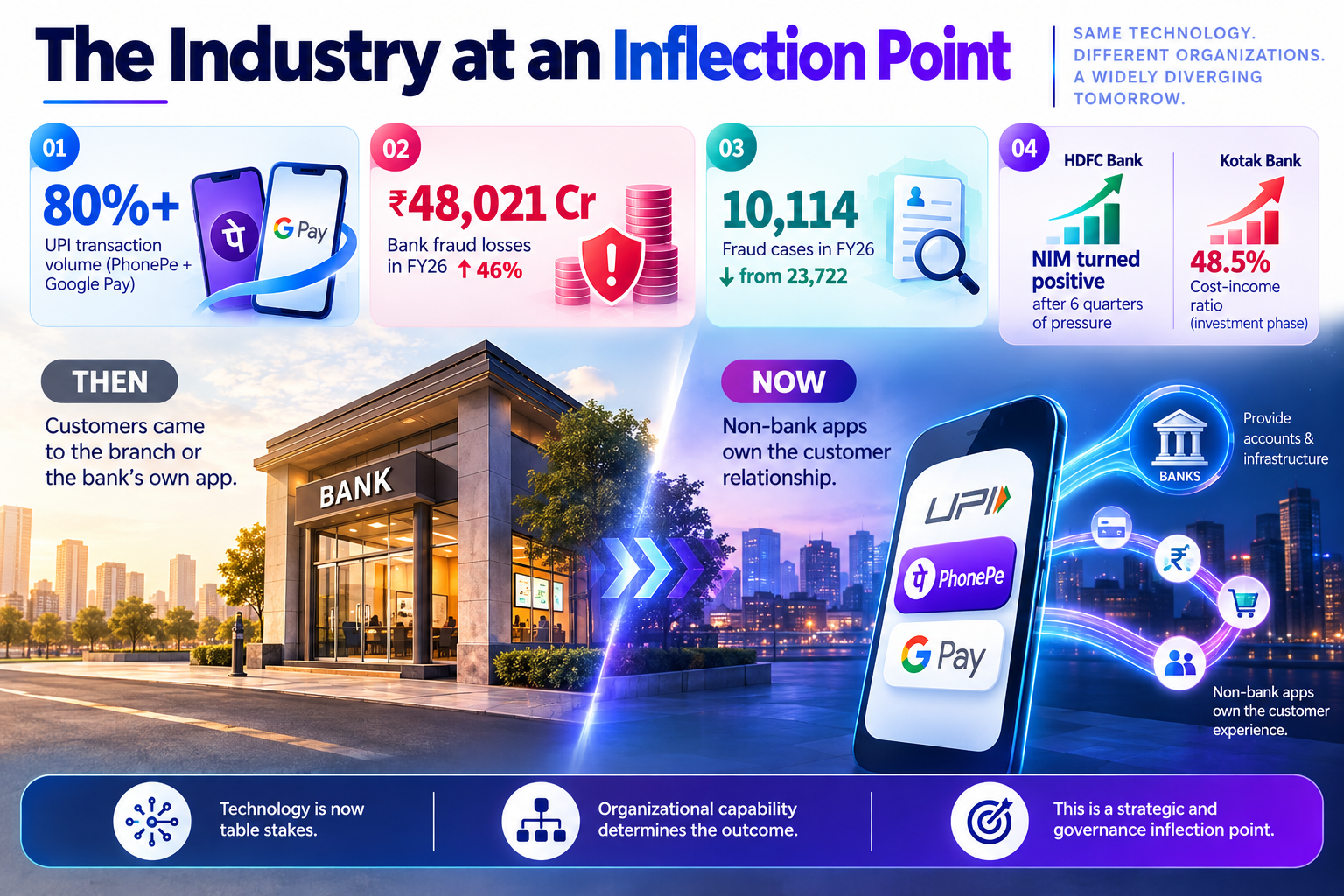
For decades, Indian retail banking operated on a dependable assumption: customers came to the branch, or at minimum, to the bank’s own app. That assumption is breaking. PhonePe and Google Pay alone now handle more than 80% of India’s UPI transaction volume, the country’s dominant payment rail, meaning banks increasingly supply the underlying account and settlement infrastructure while non-bank apps own the customer-facing relationship. At the same time, RBI’s own FY26 annual report shows a paradox: bank fraud cases fell to 10,114 from 23,722 the year before, yet total losses surged to ₹48,021 crore, a 46% jump, because the fraud that remains has moved into loan origination, the part of the bank hardest to monitor in real time and the part sophisticated fraud now targets deliberately.
Neither shift is primarily a technology story. Every serious retail bank in India has comparable access to AI-enabled fraud detection, digital onboarding, and personalization tools. What diverged sharply in the same reporting week was the result: HDFC Bank’s net interest margin turned positive after six consecutive quarters of pressure, while Kotak Mahindra Bank’s cost-income ratio climbed to 48.5% as it accelerated digital-infrastructure investment without yet converting it into margin. Comparable technology access, sharply different organizational outcomes.
The Drivers Behind the Shift
Technology change, regulatory change, and shifting customer and market structures are not, themselves, the capability a bank needs. They are the forces that make building that capability urgent rather than optional. Eight drivers explain the pressure; the organizational capabilities further below explain what actually responds to it.
Driver | What’s Actually Changing |
AI and digital banking becoming core infrastructure | HDFC Bank reports approximately 98% of its financial transactions were conducted digitally in FY26, with digital channels contributing 20–60% across key customer journeys |
Regulatory tightening on AI-driven lending and collections | RBI’s Digital Lending Directions, issued May 2025, extend AI governance obligations across the full loan lifecycle, including collections and recovery, not just origination |
Data sovereignty requirements tightening | RBI’s data localization mandate, in full effect from April 2026, requires all borrower data to be stored on servers within India |
Fraud shifting into loan origination, away from digital payments | RBI’s FY26 annual report: fraud cases fell to 10,114 from 23,722, yet total losses surged to ₹48,021 crore, 85% concentrated in advances fraud |
Fintech and non-bank apps owning the customer interface | PhonePe and Google Pay together handle more than 80% of UPI transaction volume; NPCI’s proposed 30% market-share cap has been delayed repeatedly, now to December 31, 2026 |
NBFC credit share expanding | NBFC credit is now approximately 16.7% of nominal GDP and 27% of scheduled commercial bank credit; NBFC loan originations climbed from 20.7% to 31.6% of the market in a single year |
Capability investment diverging sharply by outcome | In the same reporting week, HDFC Bank’s net interest margin turned positive after six quarters of pressure while Kotak Mahindra Bank’s cost-income ratio rose to 48.5% on digital investment not yet converted to margin |
Digital lending scaling faster than oversight capacity | India’s digital lending market now serves more than 40 million borrowers and exceeds ₹5.2 lakh crore, up from a much smaller base |
Six Organizational Capabilities for a Future-Ready Retail Bank
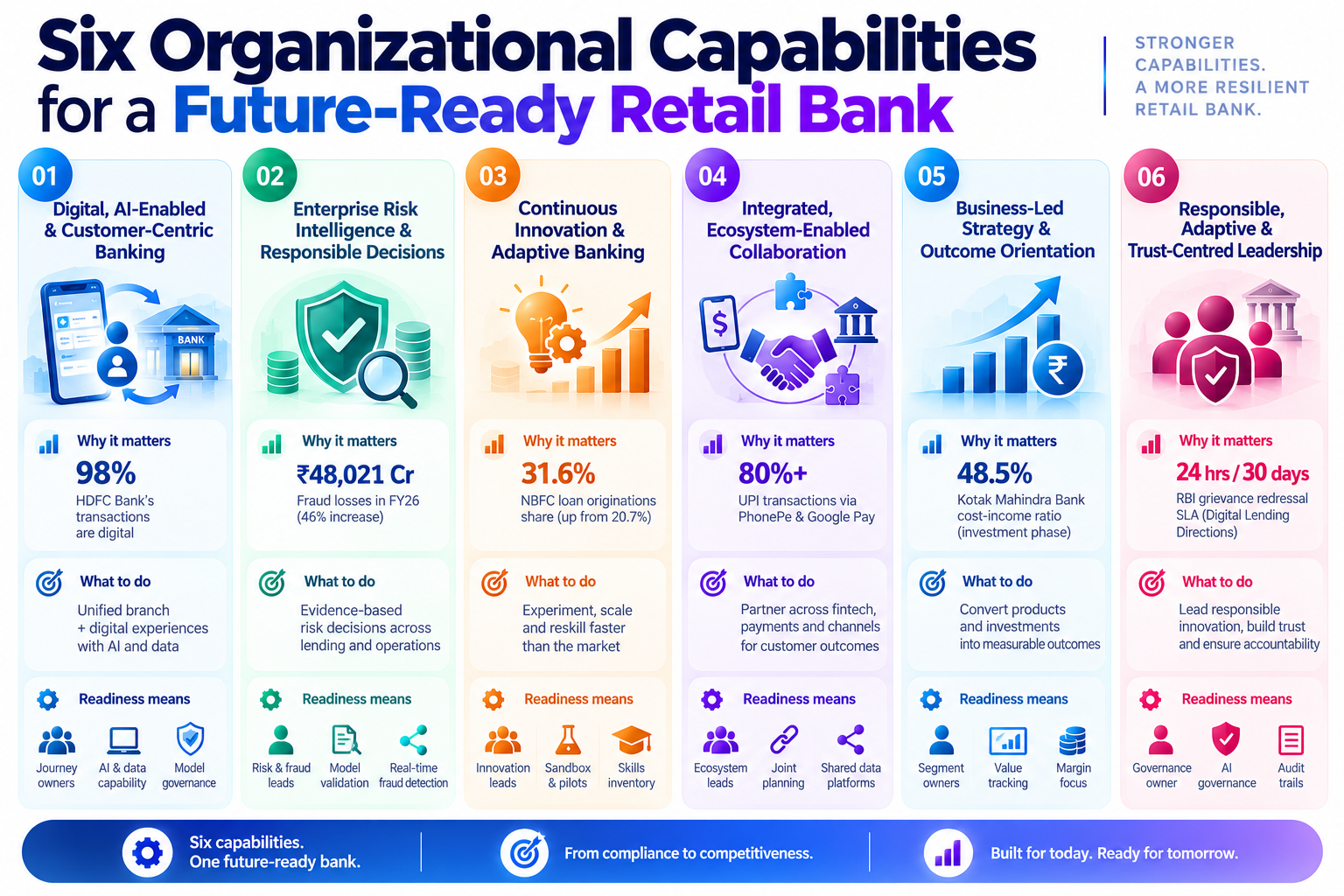
The drivers above explain why the ground is moving. They do not, on their own, tell a bank what to build. That is a question of organizational strategy and governance, not technology adoption, and it resolves into six capabilities. Each is described in the same three terms: why it matters, what the organization must actually be able to do, and what readiness means in practice, the specific roles, competencies, processes, governance, and technology that make the capability real rather than aspirational.
1. Digital, AI-Enabled & Customer-Centric Banking Capability
Why it matters: HDFC Bank reports approximately 98% of its financial transactions now conducted digitally, with digital channels contributing 20 to 60% across key customer journeys, evidence the channel shift is now structural, not incremental. RBI’s Digital Lending Directions extend AI governance obligations across the full loan lifecycle, meaning a bank’s digital capability now carries direct regulatory exposure, not just competitive stakes.
What the organization must be able to do: Combine digital platforms, AI, customer insight, and workforce capability to deliver differentiated, secure, personalized banking experiences consistently, with branch and digital functioning as one integrated ecosystem rather than competing channels.
What readiness means: Digital-journey owners and AI-led personalization leads as standing roles, not project hires. Competencies in digital literacy, AI-enabled service design, and responsible data use. Processes that design branch and digital journeys jointly rather than as separate workstreams. Governance through a model inventory covering every AI and scoring system that touches a customer decision, with documented approval history, the 2026 regulatory baseline. Technology that lets branches function as advisory centers powered by data and AI, not just transaction counters, the direction HDFC Bank’s own disclosures describe.
2. Enterprise Risk Intelligence & Responsible Decision-Making Capability
Why it matters: RBI’s FY26 annual report shows bank fraud cases fell to 10,114 but total losses surged to ₹48,021 crore, a 46% jump, with 85% concentrated in loan and advances fraud that cleared origination review before the loss was recorded. A roughly ₹950 crore irregularity uncovered in February 2026 across Chandigarh branches of IDFC First Bank, AU Small Finance Bank, and Kotak Mahindra Bank shows even well-regarded institutions absorb real losses when decision and control processes have gaps.
What the organization must be able to do: Build a culture of evidence-based decision-making, proactive risk identification, and responsible AI and data use across lending, operations, compliance, and customer service.
What readiness means: Credit risk officers, fraud-detection leads, and named model-validation owners as standing roles. Competencies in scenario analysis, evidence synthesis, and risk-based judgment. Processes requiring documented alternative-evaluation before major credit decisions and behavioral, network-based fraud monitoring rather than threshold-only rules, since threshold-based systems were built for a fraud pattern that is shrinking, not the one that is growing. Governance through the RBI-mandated model inventory, with validation evidence for every AI system touching a lending or recovery decision. Technology in the form of real-time behavioral and network-pattern detection, not transaction-amount flags alone.
3. Continuous Innovation & Adaptive Banking Capability
Why it matters: NBFC loan originations climbed from 20.7% to 31.6% of the market in a single year, evidence of how fast competitive structure is shifting underneath retail banks. A bank still testing and scaling new products at the pace it did two years ago is already behind a market where non-bank lenders are capturing origination share every quarter.
What the organization must be able to do: Establish structures, leadership practices, and cultural mechanisms that let the bank experiment with new financial products, technologies, and operating models continuously, and scale what works while managing risk, before existing offerings lose relevance.
What readiness means: Innovation and experimentation leads, plus a named reskilling program owner, as standing roles. Competencies in product and service innovation, digital experimentation, and continuous reskilling. Processes built around a standing technology-sensing cycle rather than an annual review, with funded pilot-to-scale pathways and clear go or no-go criteria. Governance that ring-fences innovation investment from quarterly cost-cutting, with one named accountable owner for the pipeline. Technology in the form of sandboxed experimentation environments and a tracked skills inventory showing where the workforce actually stands against emerging needs.
4. Integrated, Ecosystem-Enabled & Customer-Responsive Collaboration Capability
Why it matters: PhonePe and Google Pay together handle more than 80% of UPI transaction volume, meaning banks increasingly supply the underlying account and settlement rails while non-bank apps own the customer-facing relationship. NPCI’s proposed 30% market-share cap on individual apps has been delayed repeatedly, most recently to December 31, 2026, so banks cannot assume regulatory intervention will restore that relationship on their behalf.
What the organization must be able to do: Design cross-functional teams, integrated workflows, and partnership models that connect branches, digital channels, operations, technology, risk, and external ecosystem partners around customer outcomes, so the bank can resolve complex customer needs no single channel or partner could solve alone.
What readiness means: Partner and ecosystem orchestration leads, plus relationship managers with real cross-functional authority, as standing roles. Competencies in cross-functional collaboration, customer journey management, and stakeholder coordination. Processes built around joint planning with fintech and payment-ecosystem partners, not one-way integration. Governance that treats NPCI and fintech partners as coordination partners for joint customer outcomes, not only as disintermediation risk to be managed defensively. Technology in the form of shared data and journey-management platforms that make cross-channel handoffs seamless to the customer.
5. Business-Led Banking Strategy & Outcome-Oriented Service Capability
Why it matters: In the same Q1 FY27 reporting week, HDFC Bank’s net interest margin turned positive after six consecutive quarters of pressure, while Kotak Mahindra Bank’s cost-income ratio climbed to 48.5% as it accelerated investment in digital infrastructure and branch expansion into Tier-2 cities. Same industry, same quarter, sharply different conversion of investment into margin.
What the organization must be able to do: Align strategy, products, customer segments, operating models, performance systems, and workforce capability so that changing customer and market needs convert into differentiated products, sustainable growth, and measurable business outcomes, not just delivered scope.
What readiness means: Segment and product strategy owners, plus commercial and value-realization leads, as distinct roles from operations management. Competencies in market understanding, customer lifetime value management, and financial and commercial acumen. Processes that track value realization and customer outcomes as a standing discipline, not a one-time business case. Governance that reviews margin conversion from digital and product investment at the same scrutiny as headline growth. Technology in the form of value and performance-tracking systems tied to specific product and segment decisions.
6. Responsible, Adaptive & Trust-Centred Banking Leadership Capability
Why it matters: RBI’s Digital Lending Directions require every regulated entity to maintain a registered grievance redressal officer, with complaints acknowledged within 24 hours and resolved within 30 days, escalatable to RBI’s ombudsman scheme, real, personal accountability requirements leadership cannot delegate away. The February 2026 Chandigarh case, affecting three separate banks at once, shows how quickly a control gap becomes a trust and governance problem, not merely an operational one.
What the organization must be able to do: Develop leaders, governance mechanisms, and organizational cultures that support responsible innovation, workforce transformation, customer trust, and accountability for outcomes, not just delivery of activity.
What readiness means: A named grievance and governance accountability owner, succession-planned leadership pipeline, and a designated technology and AI governance owner as standing roles. Competencies in digital transformation leadership, responsible AI governance, and ethical decision-making. Processes that treat leadership succession and governance review as standing disciplines, with real authority to intervene, not advisory status. Governance built around clear, named accountability for every regulated obligation, from grievance redressal to model validation. Technology in the form of audit-trail systems that make governance and AI decisions traceable to the accountable leader, satisfying both internal accountability and RBI’s external obligations.
What This Means Through 2035
None of the eight drivers above resolves on its own, and none of the six capabilities substitutes for the others. A bank strong in digital and AI capability but weak in decision intelligence builds personalization and lending tools it cannot defend when a regulator or a customer asks why a given decision was made. A bank strong in strategy-setting but weak in leadership accountability commits to customer outcomes no single owner can actually deliver against. The pattern already visible in HDFC Bank and Kotak Mahindra’s diverging Q1 FY27 results, comparable drivers, sharply different outcomes, will widen through 2035 as the drivers themselves compound: data sovereignty and AI governance moving from a 2026 deadline to a default compliance baseline, fintech and NBFC pressure narrowing the addressable relationship for banks that compete on rails rather than relationships, and the gap between banks that have built these six capabilities and those that have only announced a digital strategy growing larger, not smaller, with each reporting cycle.
Executive FAQs
Are the eight drivers themselves capabilities a bank needs to build?
No. The drivers, AI adoption, fraud pattern shifts, fintech disintermediation, and the rest, explain why building organizational capability is urgent. They are context and evidence, not the capability itself. The six organizational capabilities are what actually responds to them.
Why frame this around organizational capability rather than technology capability?
Because technology access is no longer the differentiator. Every serious retail bank in India has comparable AI and digital tooling available to it. HDFC Bank and Kotak Mahindra both invested heavily in digital infrastructure and produced sharply different Q1 FY27 results in the same week. What diverged was organizational strategy, risk discipline, and governance, not which vendor platform each bank licensed.
Is retail banking fraud actually getting worse?
The case count is falling, but the value lost is not. RBI’s FY26 annual report shows fraud cases dropped to 10,114 from 23,722, while total losses rose 46% to ₹48,021 crore, because the fraud that remains has concentrated in loan origination, harder to catch in real time and more sophisticated than the digital-payment fraud that is actually declining.
How should a bank CXO measure whether their organization is future-ready?
Against the six capabilities directly: does digital and AI delivery convert into disclosed margin, are lending and risk decisions evidence-based and reviewed, is innovation funded as a protected pipeline, does collaboration extend to fintech and payment-ecosystem partners, is customer value tracked as a standing discipline, and does every capability initiative have one accountable owner. Headcount and branch count measure presence, not readiness.
Where do fintechs and NBFCs fit if they are not capabilities?
They are two of the eight drivers, real, external forces reshaping the market that a bank does not control. Fintech dominance of UPI narrows the addressable customer relationship for banks that compete purely on rails; NBFC share gains narrow the addressable lending market. Both make building the six organizational capabilities more urgent, especially collaboration and business-led strategy, but neither is itself something a bank builds.
References
1. Reserve Bank of India, Annual Report, FY2025–26.
2. Reserve Bank of India, Digital Lending Directions, May 2025.
3. National Payments Corporation of India (NPCI), UPI market share and transaction data, 2026.
4. HDFC Bank Ltd, Form 6-K, fiscal year 2026, U.S. Securities and Exchange Commission filing.
5. HDFC Bank Ltd, Q1 FY2027 earnings results and investor presentation, July–August 2026.
6. Reporting on Kotak Mahindra Bank, ICICI Bank, and Axis Bank Q1 FY27 results, Indian financial media, August 2026.
7. CRIF High Mark, "How India Lends" report, May 2026.
8. Remarks by RBI Deputy Governor Shirish Chandra Murmu, industry summit, September 2026.
9. Reporting on the Haryana Government accounts fraud across Chandigarh bank branches, February 2026.
10. Reporting on RBI NBFC Fraud Risk Management Directions, 2026.
Organization Learning Labs
Research & Insights Division


