Future of IT Services Organizations: The 2035 Outlook

AI is decoupling IT services revenue from headcount. Explore the organizational capabilities that will define future-ready IT services and consulting firms through 2035.
Future of IT Services Organizations: The 2035 Outlook
Revenue and headcount have started moving in opposite directions. What separates the organizations pulling ahead isn’t the technology they’ve adopted, it’s the organizational strategy and governance capability built to direct it.
EVIDENCE AT A GLANCE
$315B India’s FY26 technology industry revenue, up 6.1% year on year Source: Nasscom Annual Strategic Review 2026 | 2.3% FY26 headcount growth against 6.1% revenue growth - the widest revenue-to-headcount gap the industry has recorded Source: Nasscom Annual Strategic Review 2026 | $2.6B TCS’s Q1 FY27 annualised AI revenue run rate, real evidence that capability investment, not just stated priority, is now producing disclosed results at scale Source: TCS Q1 FY27 results, reported August 2026 |
13.9% vs 1.5–3.5% TCS’s AI-driven Q1 FY27 revenue growth against Infosys’s full FY27 guidance range, sharply different disclosed outcomes across the same industry Source: TCS and Infosys Q1 FY27 / FY27 guidance disclosures, August 2026 | 1,750+ Global Capability Centers operating in India, a structural force reshaping client relationships alongside AI, not a downstream effect of it Source: Nasscom Strategic Review data | $10–12B Estimated FY26 AI revenue for India’s tech industry, still a small share of the $315B total, evidence that industry-wide AI monetization is early-stage relative to overall scale Source: Nasscom Annual Strategic Review 2026 |
180+ New entities added to the U.S. Bureau of Industry and Security Entity List since January 2025 Source: U.S. BIS Entity List, tracked in 2026 supply chain analysis | 12,000 / ~2% Roles TCS reduced in 2026, citing a structural skills mismatch rather than falling client demand Source: Reuters, TCS workforce restructuring coverage, July 2026 | 20–38% Salary premium Indian technology employers are paying for AI-literate hires Source: 1Finance data, reported via Business Standard, July 2026 |
The Industry at an Inflection Point
For three decades, the IT services and consulting industry operated on a dependable equation: more revenue required more people. That equation broke in FY26. India’s technology industry crossed $315 billion in revenue, growing 6.1% year on year, while headcount grew by just 2.3%, according to Nasscom’s Annual Strategic Review 2026. This is not a temporary anomaly. It is a structural decoupling, and it is the clearest signal yet that the industry’s foundational operating model is being rebuilt.
It is tempting to read that decoupling as a technology story: AI got good enough to replace headcount growth. The more accurate reading is an organizational one. Every serious competitor in the industry now has access to comparable AI tooling. What diverged sharply in the same quarter was the result: TCS closed Q1 FY27 with a $2.6 billion annualised AI revenue run rate and 13.9% revenue growth; Infosys guided FY27 growth of just 1.5% to 3.5%; Wipro reported profit growth of only 0.6% as AI investment costs outpaced returns. Three organizations, comparable technology access, sharply different outcomes. The difference sits in organizational strategy and governance capability, not in which AI tools each company licensed.
The Drivers Behind the Shift
Technology change, geopolitical change, and shifting client and market structures are not, themselves, the capability an organization needs. They are the forces that make building that capability urgent rather than optional. Eight drivers explain the pressure; the organizational capabilities further below explain what actually responds to it.
Driver | What’s Actually Changing |
AI moving from optional to core infrastructure | Nasscom’s own account of the year: AI shifted from optional to core infrastructure within a single year, with FY26 AI-specific revenue estimated at $10–12B |
Services shifting toward platform and IP | Nearly two-thirds of large digital engineering deals now center on a shift from services delivery to IP-led, platform-based engagement |
Semiconductor supply volatility | More than 180 entities added to the U.S. BIS Entity List since January 2025; licensing thresholds revised downward three times in 24 months; Honda absorbed a roughly $960M FY2026 hit from the Nexperia dispute |
Regulatory and sovereignty requirements tightening | The EU AI Act’s high-risk obligations, conformity assessments, database registration, human oversight, become binding on August 2, 2026 |
Client insourcing via GCC expansion | India already houses more than 1,750 Global Capability Centers, increasingly performing work that once defaulted to external providers |
Hyperscalers moving into delivery work | AWS launched a Professional Services Delivery Agent in November 2025, automating the first-mile consulting work IT services firms have always owned |
The workforce pyramid reshaping | TCS cut roughly 12,000 roles in 2026 citing a structural skills mismatch, even as Indian tech employers pay a 20–38% salary premium for AI-literate hires |
Capability investment diverging sharply by outcome | In the same quarter, TCS reported a $2.6B AI revenue run rate while Wipro’s profit growth slowed to 0.6% on comparable AI spending |
Six Organizational Capabilities for a Future-Ready IT Services and Consulting Organization
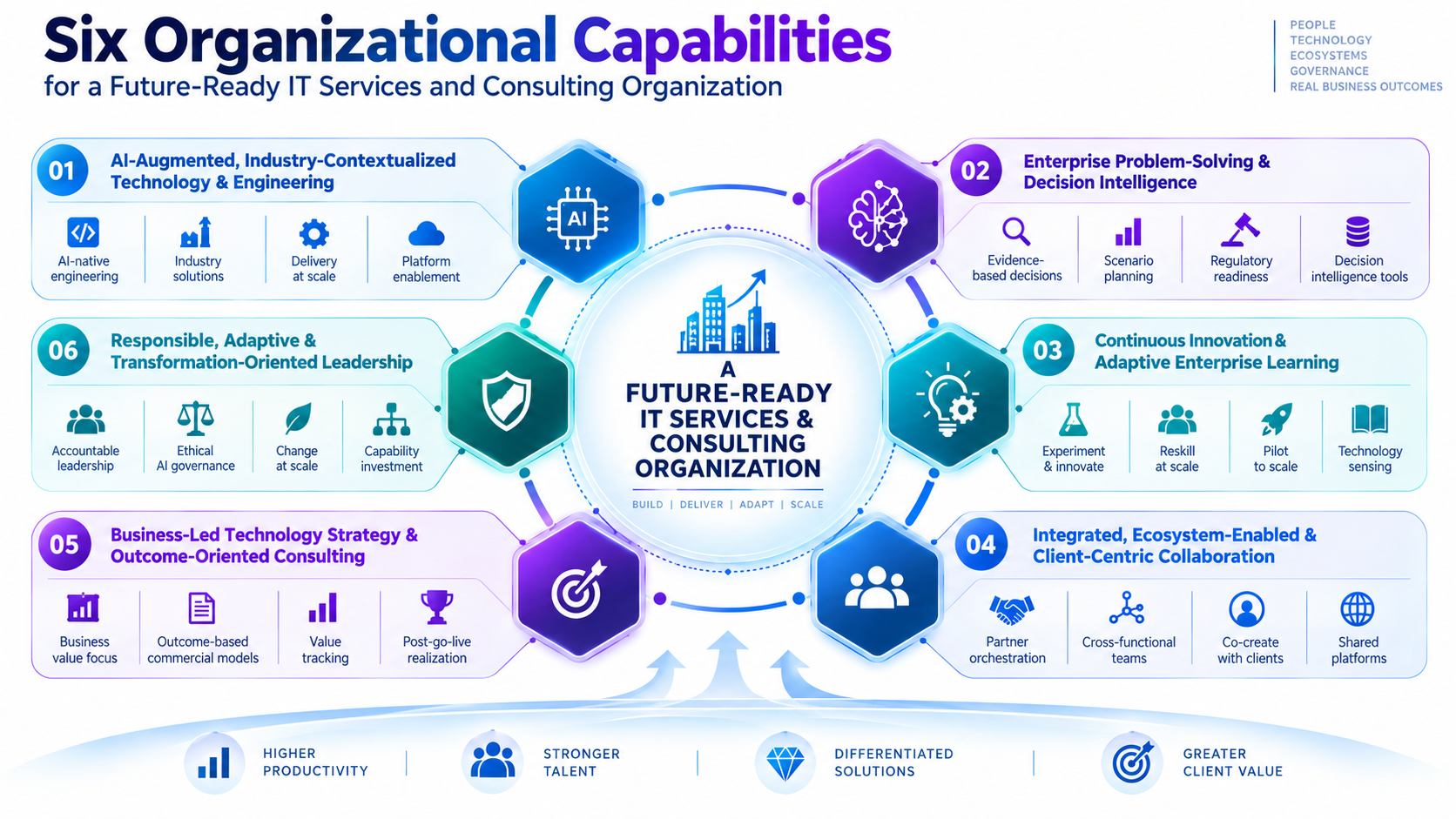
The drivers above explain why the ground is moving. They do not, on their own, tell an organization what to build. That is a question of organizational strategy and governance, not technology adoption, and it resolves into six capabilities. Each capability below is described in the same three terms: why it matters, what the organization must actually be able to do, and what readiness means in practice, the specific roles, competencies, processes, governance, and technology that make the capability real rather than aspirational.
1. AI-Augmented, Industry-Contextualized Technology & Engineering Capability
Why it matters: AI shifted from optional to core infrastructure within a single year, per Nasscom, and hyperscalers are now automating the first-mile engineering work IT services firms have always owned, AWS’s Professional Services Delivery Agent, launched November 2025, is one live example. TCS’s $2.6 billion AI revenue run rate against Wipro’s flat profit growth from comparable investment shows engineering capability, not technology access, is now the differentiator.
What the organization must be able to do: Combine deep technology expertise, industry-domain knowledge, and AI-enabled engineering practice to deliver differentiated client outcomes consistently, not as isolated pilots, with engineering teams that understand a client’s actual industry as fluently as the underlying technology stack.
What readiness means: AI-augmented engineers and industry-vertical solution architects as standing roles, not project-specific hires. Competencies in AI-assisted software engineering, distributed systems engineering, and industry-domain contextualization. Processes that integrate AI tooling into delivery pipelines by design rather than ad hoc adoption, with certification pathways and cross-account knowledge sharing. Governance through architecture review boards that vet AI-augmented delivery against client-specific standards. Technology platforms of the kind Infosys built with Topaz Fabric, reporting more than 80,000 employees on AI coding tools and AI revenue reaching 8.2% of total revenue by FY27, maintained against a current, complete systems inventory.
2. Enterprise Problem-Solving & Decision Intelligence Capability
Why it matters: Regulatory regimes like the EU AI Act require organizations to classify, document, and justify AI system decisions, not just deploy them. Supply chain volatility, Honda’s roughly $960 million FY2026 hit from a semiconductor dispute few organizations saw coming, punishes those without structured, evidence-based decision processes. Export control thresholds revised three times in 24 months make pattern-matching against last year’s playbook actively dangerous.
What the organization must be able to do: Build a culture of critical thinking, evidence-based decision-making, and collaborative problem-solving that lets teams diagnose ambiguous client and enterprise problems, evaluate real alternatives, and recommend defensible solutions rather than default answers.
What readiness means: Enterprise architects and business analysts trained in decision science as named roles, with a scenario-planning lead accountable for stress-testing major bets. Competencies in systems thinking, structured problem-solving, and scenario analysis. Processes requiring documented alternative-evaluation before major commitments and post-decision reviews that feed learning back into the next decision, not single-approver sign-off. Governance through a standing forum with real authority to require evidence before capital commitments above a set threshold. Technology in the form of decision-support and scenario-modeling tools built on a data foundation decision-makers can query directly, not request reports against.
3. Continuous Innovation & Adaptive Enterprise Learning Capability
Why it matters: Nasscom’s own account of the industry describes a shift from AI experimentation to industrialisation within a single year, the strategic categories worth building a practice around are being rewritten faster than most organizations retrain a workforce. More than 80,000 Infosys employees now work on AI coding tools that were not a mainstream practice three years earlier.
What the organization must be able to do: Establish structures, leadership practices, and cultural mechanisms that let the organization experiment with new services, technologies, and business models continuously, and scale what works before existing offerings lose relevance.
What readiness means: Innovation and incubation leads, emerging-technology scouts, and a named reskilling program owner as standing roles. Competencies in solution innovation, technology sensing, rapid prototyping, and continuous reskilling. Processes built around a standing technology-sensing cycle rather than an annual review, with funded pilot-to-scale pathways and clear go or no-go criteria. Governance that ring-fences innovation investment from quarterly cost-cutting, with one named owner accountable for the pipeline. Technology in the form of sandboxed experimentation environments and a tracked skills inventory showing where the workforce actually stands against emerging needs, not where it stood last year.
4. Integrated, Ecosystem-Enabled & Client-Centric Collaboration Capability
Why it matters: More than 1,750 Global Capability Centers now operate in India alone, increasingly performing work that once defaulted to external providers, competing against a client’s own captive center requires a different relationship than competing against another vendor. Hyperscalers are simultaneously becoming infrastructure supplier and delivery competitor, which makes ecosystem orchestration a genuine capability rather than a courtesy.
What the organization must be able to do: Design cross-functional teams, integrated workflows, and partnership models that connect delivery, technology, risk, and external ecosystem partners around client outcomes, so the organization can solve problems no single function or vendor relationship could solve alone.
What readiness means: Partner and ecosystem orchestration leads, client relationship executives with real cross-functional authority, and co-creation leads embedded directly with clients. Competencies in cross-functional collaboration, partner orchestration, and conflict resolution. Processes built around joint planning cadences with clients and partners, not one-way status reporting, with shared outcome metrics spanning internal functions and external partners alike. Governance that treats a client’s GCC as a coordination partner for joint delivery, not only a competitive threat to be managed. Technology in the form of shared collaboration and knowledge-management platforms that partners and clients can actually access, not internal-only tooling.
5. Business-Led Technology Strategy & Outcome-Oriented Consulting Capability
Why it matters: TCS, Infosys, and Wipro each disclosed an AI-first strategy within the same reporting period, and each produced a sharply different Q1 FY27 result: a $2.6 billion AI revenue run rate, guidance of 1.5% to 3.5% growth, and 0.6% profit growth, respectively. The same industry, the same quarter, the same stated priority. The difference sits in whether strategy converts into commercially real, priced, delivered outcomes.
What the organization must be able to do: Align strategy, roles, performance systems, and workforce capability so that technology and consulting services consistently translate client business priorities into measurable business value, not just delivered scope.
What readiness means: Technology-to-business translators as a distinct role from technical account leads, plus commercial and value-realization owners. Competencies in business and industry strategy, value translation, and commercial acumen. Processes that make outcome-based contracting a standing commercial motion rather than a deal-by-deal exception, with benefits tracking that continues after go-live. Governance that reports the share of revenue actually priced on outcomes at the same level of scrutiny as headline revenue. Technology in the form of value-tracking and benefits-realization systems tied directly to the contract, not a spreadsheet reconstructed after the fact.
6. Responsible, Adaptive & Transformation-Oriented Leadership Capability
Why it matters: Accountability for capability investment typically sits split across business unit heads, geography leaders, and a central technology function, when an initiative crosses more than one of these boundaries, it frequently has no single leader with authority to fund it end to end, which is exactly how a stated AI-first strategy turns into a Wipro-shaped result: money spent, capability not built. The EU AI Act’s August 2026 obligations add personal accountability for governance decisions a spreadsheet used to obscure.
What the organization must be able to do: Develop leaders, governance mechanisms, and organizational cultures that support responsible transformation, workforce development, and accountability for outcomes, not just delivery of activity.
What readiness means: Single-threaded capability owners, Amazon’s own model, documented by former Amazon executives Colin Bryar and Bill Carr in Working Backwards, assigns one accountable leader per initiative specifically to eliminate the cross-team dependencies that stall decisions, plus a succession-planned leadership pipeline and a named technology governance owner. Competencies in transformation leadership, responsible AI governance, and workforce planning. Processes that treat leadership succession as a standing discipline and give governance reviews real veto authority, not advisory status. Governance built around single-threaded ownership per capability initiative, with budget and headcount authority spanning business units rather than stopping at one. Technology in the form of governance and audit-trail systems that make AI and technology decisions traceable to the accountable leader, satisfying both internal accountability and external obligations like the EU AI Act.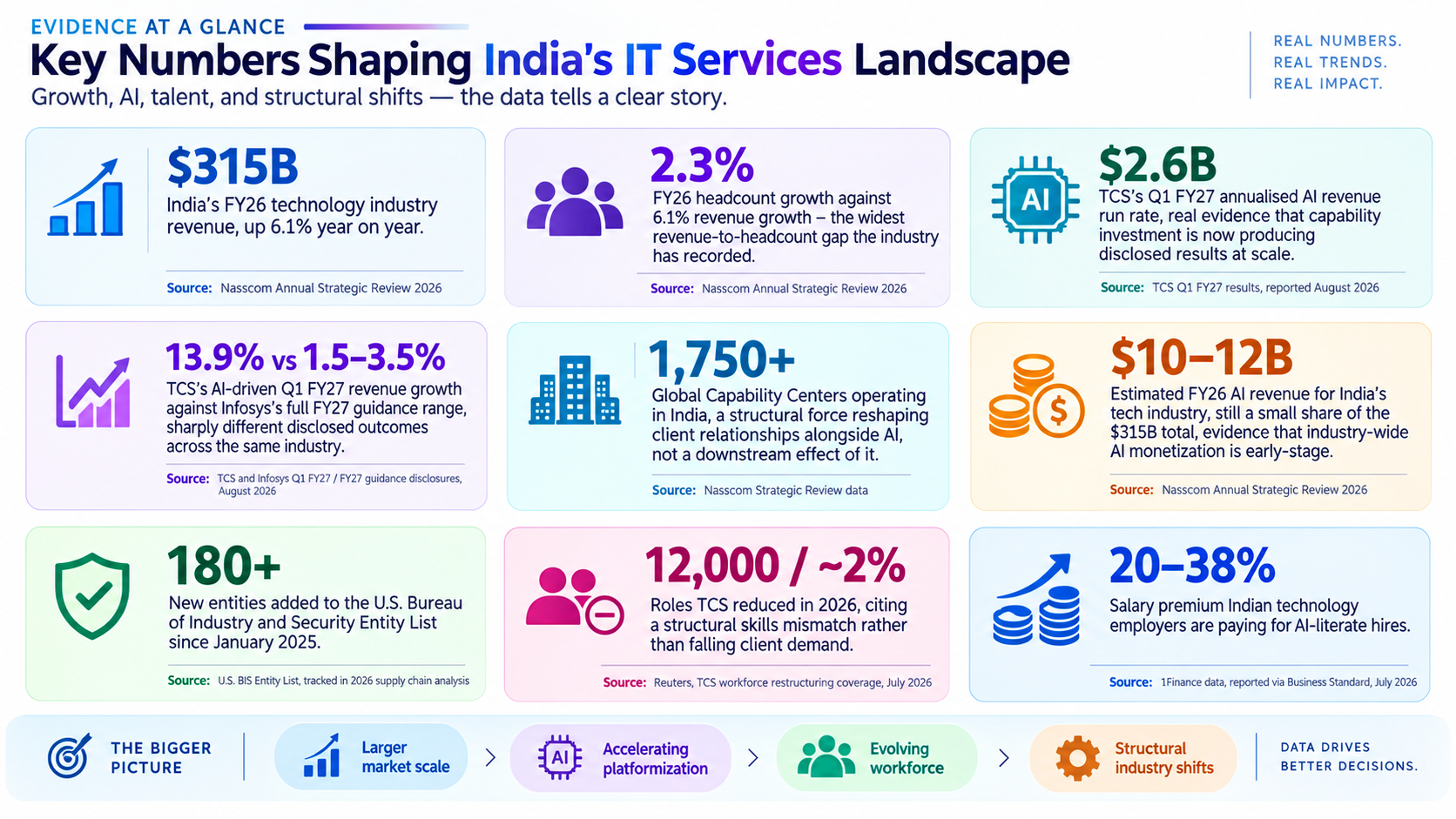
What This Means Through 2035
None of the eight drivers above resolves on its own, and none of the six capabilities substitutes for the others. An organization strong in engineering capability but weak in decision intelligence builds AI-augmented delivery it cannot defend when a regulator or a client asks why a given system reached a given conclusion. An organization strong in strategy-setting but weak in leadership accountability writes an outcome-based commercial pitch no single owner can actually deliver against. The pattern already visible in TCS, Infosys, and Wipro’s diverging Q1 FY27 results, comparable drivers, sharply different outcomes, will widen through 2035 as the drivers themselves compound: sovereignty and governance requirements moving from regional exception to default procurement criteria, GCC and hyperscaler pressure narrowing the addressable market for organizations competing on capacity rather than capability, and the AI revenue gap between organizations that have built these six capabilities and those that have only announced a strategy growing larger, not smaller, with each reporting cycle.
Executive FAQs
Are the eight drivers themselves capabilities the organization needs to build?
No. The drivers, AI adoption, semiconductor volatility, GCC expansion, and the rest, explain why building organizational capability is urgent. They are context and evidence, not the capability itself. The six organizational capabilities are what actually responds to them.
Why frame this around organizational capability rather than technology capability?
Because technology access is no longer the differentiator. Every major competitor in this industry has comparable AI tooling available to it. TCS, Infosys, and Wipro each stated an AI-first strategy in the same period and produced three different results in the same quarter. What diverged was organizational strategy, decision-making discipline, and governance, not which AI platform each company licensed.
Will AI shrink the overall size of the IT services industry?
The FY26 data does not support that conclusion. Nasscom’s Annual Strategic Review 2026 shows the industry still growing at 6.1% to $315 billion, with continued fresher hiring at scale. What is shrinking is the reliance on headcount growth as the primary lever of revenue growth.
How should a CXO measure whether their organization is future-ready?
Against the six capabilities directly: does engineering delivery convert into disclosed revenue, are decisions evidence-based and reviewed, is innovation funded as a protected pipeline, does collaboration extend to ecosystem partners and client GCCs, is outcome-based pricing a standing motion, and does every capability initiative have one accountable owner. Headcount and utilization measure activity, not readiness.
Where do Global Capability Centers and hyperscalers fit if they are not capabilities?
They are two of the eight drivers, real, external forces reshaping the market that an organization does not control. GCC expansion narrows the addressable market for organizations competing on capacity; hyperscaler encroachment automates commoditized delivery work. Both make building the six organizational capabilities more urgent, especially collaboration and business-led strategy, but neither is itself something the organization builds.
References
1. Nasscom, "Technology Sector in India: Strategic Review 2026," February 2026.
2. Nasscom, "Technology Sector in India: Strategic Review 2025," GCC and digital engineering deal data, February 2025.
3. Amazon Web Services, "Accelerate Enterprise Solutions with Agentic AI-Powered Consulting: Introducing AWS Professional Service Agents," AWS blog, November 2025.
4. Reuters, reporting on Tata Consultancy Services workforce restructuring, July 2026.
5. Indian technology sector hiring disclosures (TCS, Infosys, Wipro, HCLTech), as reported in Indian financial media, 2026.
6. Reporting on Tata Consultancy Services and Infosys Q1 FY27 results and FY2027 guidance, Indian financial media, August 2026.
7. Reporting on Wipro Q1 FY27 results, Indian financial media, August 2026.
8. Infosys Ltd, Form 6-K, Q1 fiscal year 2027 results, U.S. Securities and Exchange Commission filing.
9. U.S. Bureau of Industry and Security, Entity List additions, tracked in 2026 semiconductor supply chain analysis.
10. European Union, Artificial Intelligence Act, high-risk obligation provisions and enforcement timeline (Articles 9–17, 26).
11. Colin Bryar and Bill Carr, Working Backwards: Insights, Stories, and Secrets from Inside Amazon, St. Martin’s Press, 2021.
12. 1Finance salary premium data for AI-literate technology roles, reported via Business Standard, July 2026.
Organization Learning Labs
Research & Insights Division


