Future F&B Skills for Chefs & Managers 2035

Discover the future-ready skills chefs, managers, and frontline F&B staff need for 2035. Data-driven, sustainability-literate, AI-fluent hospitality talent.
Future-Ready F&B Skills: What Chefs, Managers, and Frontline Staff Must Learn Next
Executive Summary
The Food & Beverage industry is at an inflection point not seen since the industrialization of food service in the mid-twentieth century. Cloud kitchens, AI-assisted operations, sustainability mandates, and hyper-personalization are not incremental changes to the existing model. They are structural redesigns that render entire categories of traditional F&B skills insufficient -- and create urgent demand for new capability profiles across every role level. This article presents a role-based future skills framework for F&B organizations, grounded in projections from McKinsey, Deloitte, the World Economic Forum, and sector-specific research from KPMG and NITI Aayog. It argues that organizations failing to systematically build next-generation capabilities across frontline, kitchen, and management roles by 2028 will face a compounding competitive disadvantage through 2035 that cannot be closed by technology investment alone.
The Forces Reshaping F&B Skill Requirements
Force 1: The Cloud Kitchen and Digital-First Delivery Revolution
Cloud kitchens are not simply a new venue type. They are an entirely different operational model that requires an entirely different skill architecture. In traditional dine-in environments, chefs develop expertise in presentation, service timing, and face-to-face quality recovery. In cloud kitchen environments, these skills are irrelevant. What matters instead is packaging integrity, delivery window management, portion consistency at speed, and quality degradation analysis across 30 to 45-minute transport windows.
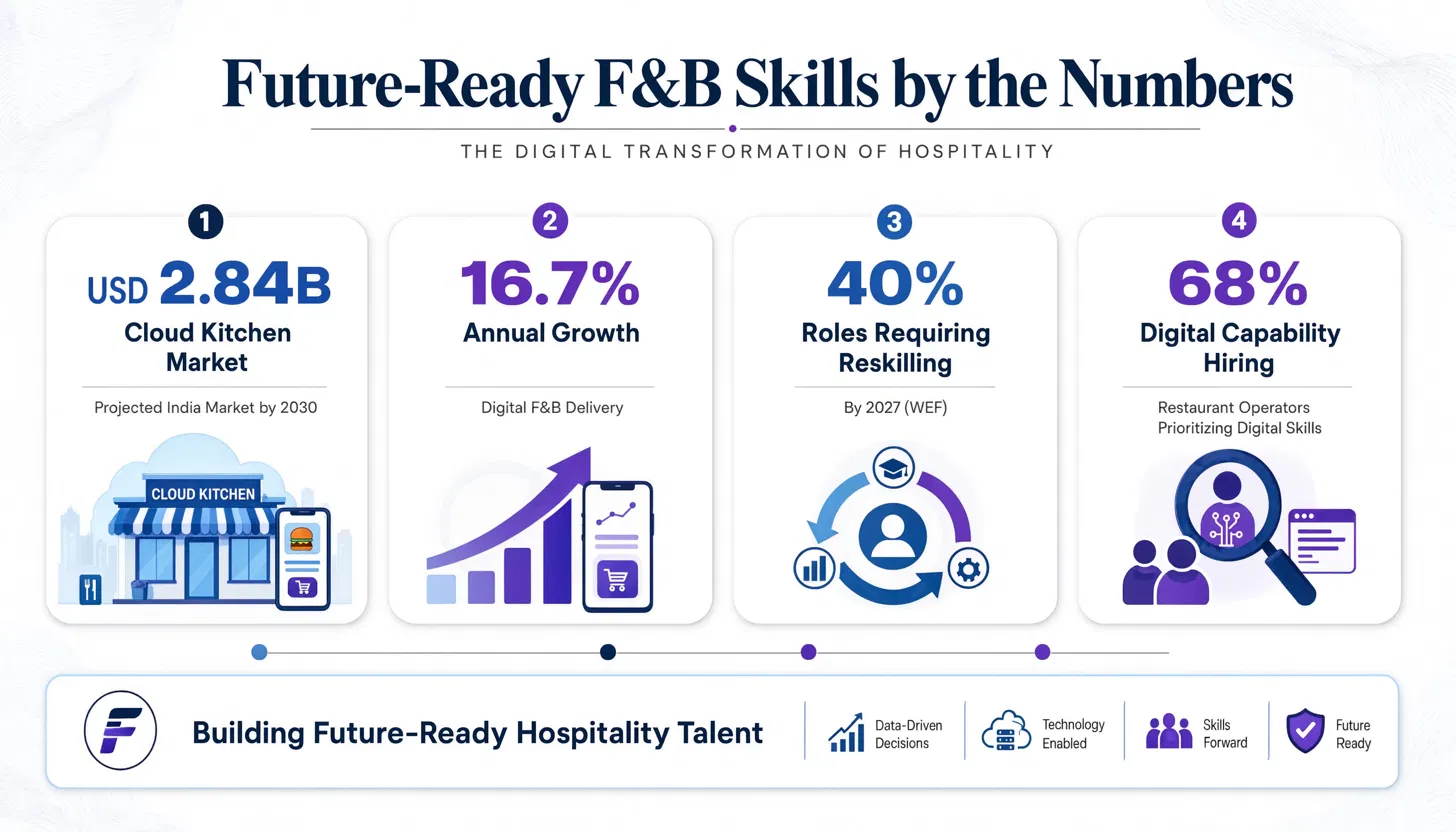
NITI Aayog's 2024 cloud kitchen sector report projects that India's cloud kitchen market will reach USD 2.84 billion by 2030, growing at 16.7 percent annually from a base of USD 1.13 billion in 2024. Globally, McKinsey's 2024 Food Service Industry Report projects digital-first F&B delivery channels to account for 20 to 25 percent of total food service revenue in major markets by 2028. Organizations whose chefs, kitchen staff, and operations managers lack the specific technical and systems competencies required for cloud operations will be excluded from the fastest-growing segment of the industry.
Force 2: AI, IoT, and Data-Driven Operations
The F&B kitchen is becoming a technology platform. IoT sensors track temperatures, monitor inventory in real time, and trigger predictive waste alerts. AI systems handle phone orders, generate menu recommendations based on historical preference data, and analyze customer sentiment from review platforms. Kitchen display systems coordinate order flow across multiple concurrent channels.
Gartner's 2024 Technology in Hospitality report identifies AI literacy as the fastest-emerging capability gap in F&B management. Managers who cannot interpret data dashboards, understand algorithmic recommendations, or know when to override automated systems are at a growing disadvantage relative to digitally fluent peers. But AI literacy is not a purely managerial capability requirement -- frontline staff who understand how digital tools support their work, rather than viewing them as threats or obstacles, deliver measurably better service outcomes. Gartner's research shows that F&B teams with structured digital fluency training outperform unstructured counterparts by 31 percent on composite service quality metrics.
Force 3: Sustainability as Operational and Regulatory Imperative
Food waste in the Indian food service sector represents an estimated 40 percent of total food production, according to the Ministry of Food Processing Industries 2024 report. Globally, the UN Food and Agriculture Organization estimates food service waste at USD 990 billion annually. Regulatory pressure is intensifying: the EU Sustainable Food Systems Framework, India's extended producer responsibility regulations, and ESG reporting requirements from institutional investors are making sustainability competency a board-level capability requirement, not a marketing initiative.
For F&B professionals at every level, sustainability literacy means understanding the financial and operational dimensions of waste -- not just the ethical ones. Kitchen staff who understand yield optimization, menu engineers who design for waste reduction, and procurement managers who evaluate supply chain sustainability are building capabilities that create both compliance value and margin improvement.
Force 4: Hyper-Personalization and Emotional Intelligence Premium
As AI takes over transactional service elements, human staff are increasingly valued for capabilities that technology cannot replicate: emotional attunement, cultural competency, contextual judgment, and genuine relationship-building. Deloitte's 2024 Consumer Experience in Hospitality report finds that 72 percent of high-value hospitality customers identify human connection quality as the primary determinant of brand loyalty, outranking price, menu variety, and even food quality. The future of frontline F&B value creation is relational, which means emotional intelligence is not a soft skill -- it is a core revenue-generating capability.
"The chefs and hospitality leaders who will matter most in 2035 are not those who mastered the techniques of 2015. They are those who can learn continuously, adapt intelligently, and lead teams through environments that do not yet exist."
-- Rene Redzepi, Co-founder, Noma, on the Future of Culinary Leadership
Role-Based Future Skills Framework: The Capability Profiles F&B Organizations Must Build
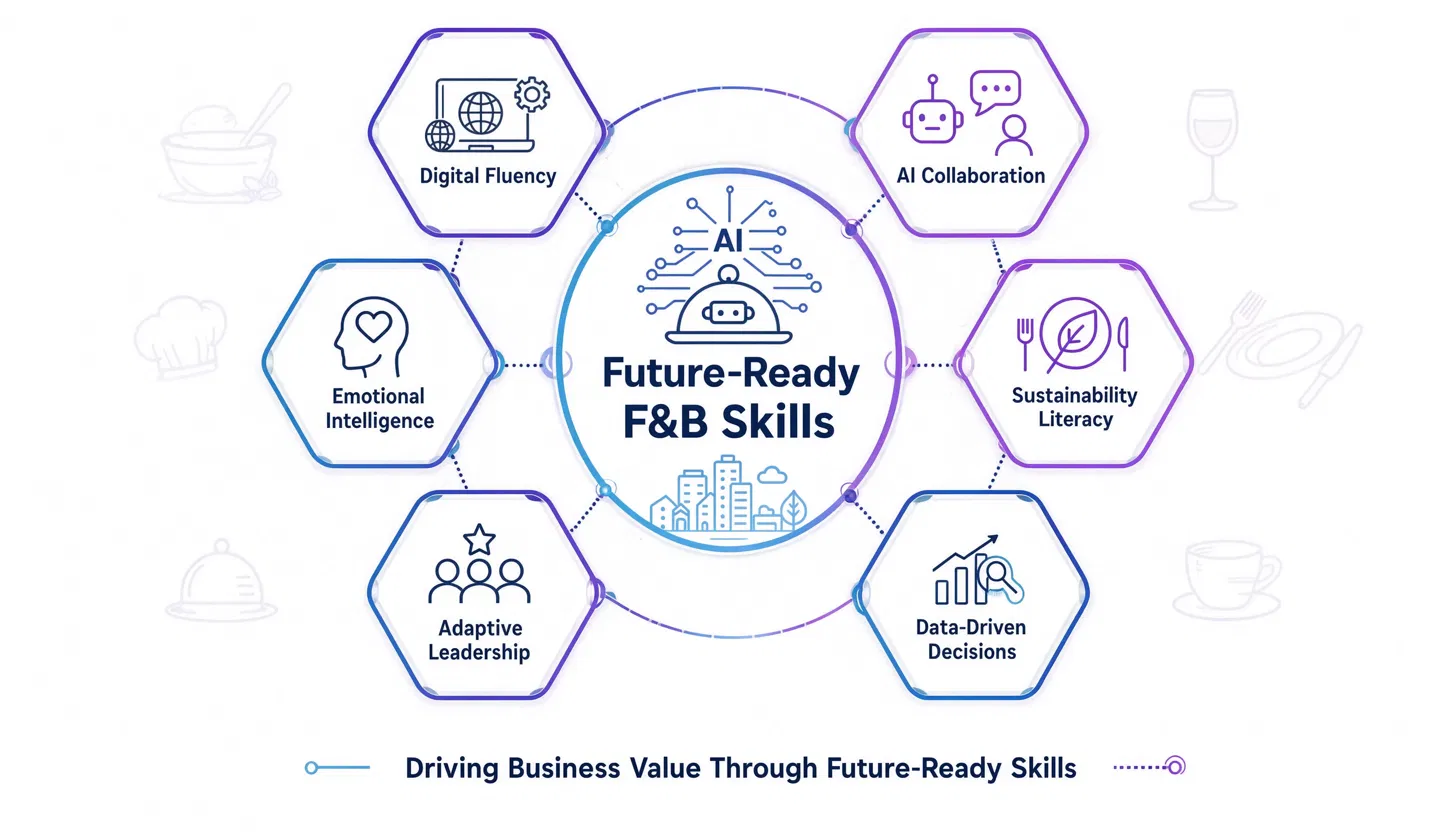
Frontline Staff: The Relational Intelligence and Digital Fluency Profile
Unlock the Full Research
Create a free account or sign in to access the complete methodology, deep-dive analysis, and key implementation frameworks.
Don't have an account? It's free to join.
Organization Learning Labs
Research & Insights Division


Comments