Fusion Skills Healthcare: Blending Clinical, Digital & Human

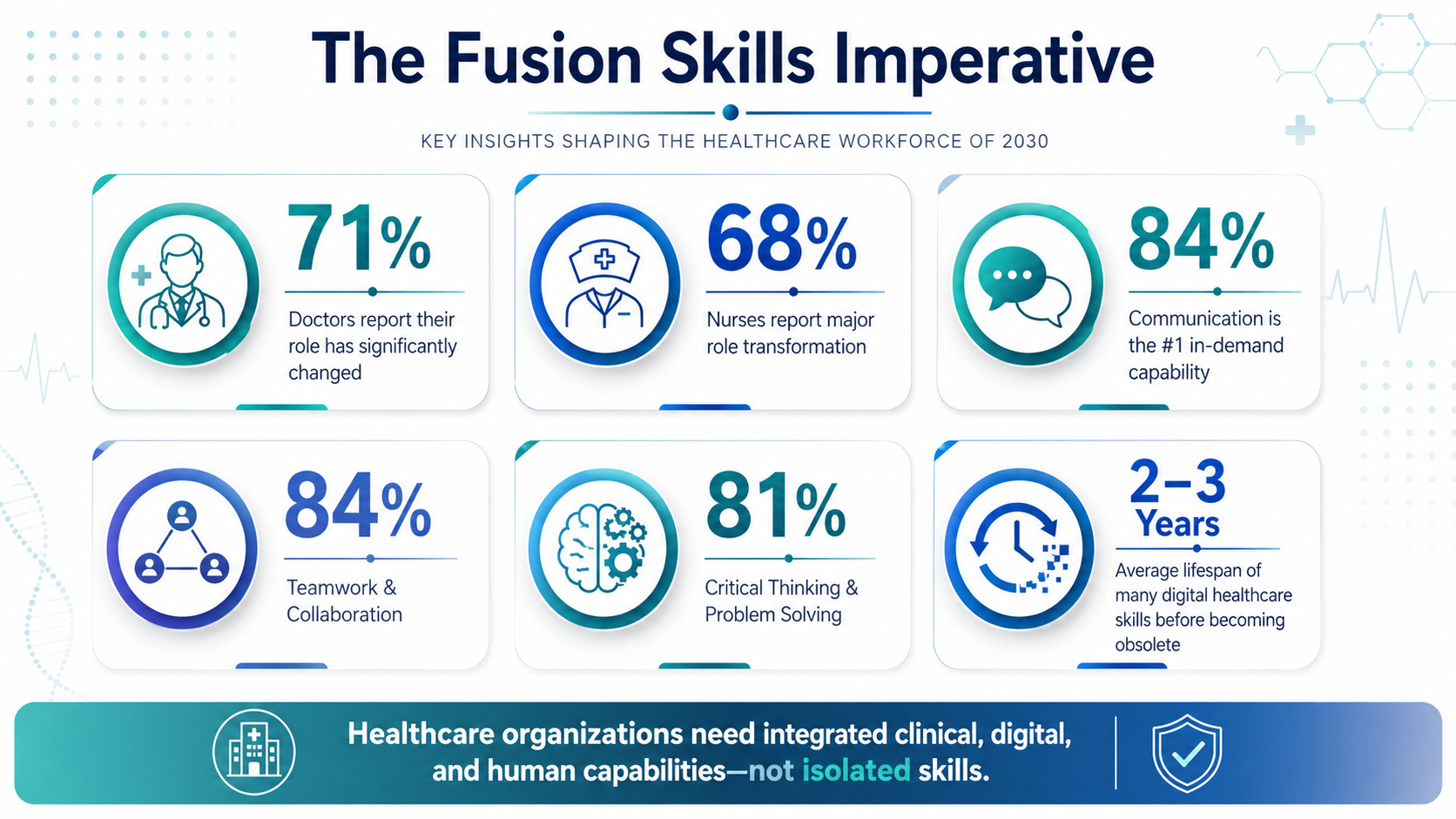
71% of doctors say the job has fundamentally changed. The healthcare professionals who will thrive in 2030 are those who master fusion skills—integrating clinical expertise, digital fluency, and human-centred capabilities.
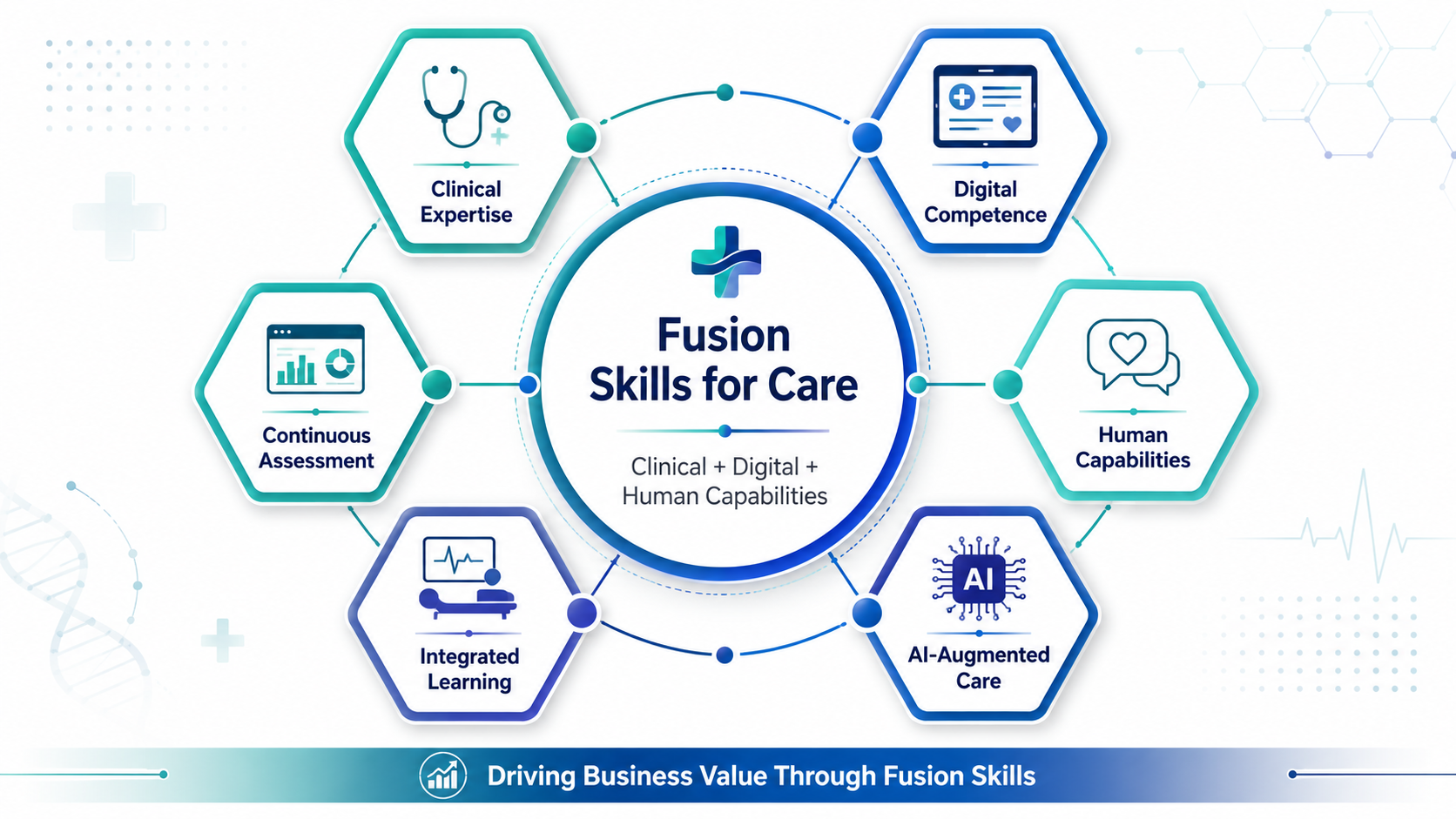
Fusion Skills for Care: Blending Clinical, Digital, and Human Capabilities in the Healthcare Workforce
ABSTRACT
Healthcare's transformation is producing a professional competency crisis: 71% of doctors and 68% of nurses report that their roles have changed considerably over the past decade, yet education and development systems have not kept pace. This article introduces the Fusion Skills Framework—an evidence-based integration of clinical expertise, digital competence, and social-emotional capability—and argues that this integration, not isolated domain mastery, is the defining workforce development challenge of the decade. Drawing on OECD Skills 2030 research, Hays 2025 Skills Report data, NHS digital health competency frameworks, and healthcare simulation research, the article maps role-specific fusion skill profiles, examines effective integration-oriented curricula, and proposes a multi-method assessment architecture. It further examines the specific fusion skills required for AI-augmented healthcare practice. Strategic implications for healthcare CLOs, medical education leaders, and workforce development professionals are addressed throughout.
1. The Convergence Problem: Why Isolated Domain Mastery Is No Longer Enough
Healthcare has always required multiple forms of knowledge. But the pace of technology change has created a qualitatively new challenge: professionals must now integrate capabilities that were previously the province of separate professions, developed through separate education pathways, and rewarded by separate performance frameworks.
According to Hays 2025 Skills Report, the top three skills hiring managers identify as most important across sectors are all human capabilities: communication (84%), teamwork and collaboration (84%), and critical thinking and problem-solving (81%). Yet 41% of organizations report gaps in communication and 50% report inadequate critical thinking in their workforces. In healthcare specifically, these soft skill gaps interact with technology adoption pressures to create a compound competency crisis: professionals competent in their clinical domain who lack the digital fluency to leverage new tools, or who have digital proficiency but have not developed the human-centred capabilities that make technology serve patients rather than processes.
KEY STATISTICS: THE FUSION SKILLS IMPERATIVE • 71% of doctors and 68% of nurses report their roles have changed considerably in the past decade (Global Health Education, 2025) • Top 3 in-demand skills identified by hiring managers: communication (84%), teamwork (84%), critical thinking (81%) — all human capabilities (Hays 2025) • 41% of organizations report communication skill gaps; 50% report critical thinking gaps (Hays 2025) • Digital skills are among the most rapidly obsolete — some technical competencies become outdated within 2–3 years (OECD Skills 2030) • Healthcare professionals with strong fusion skills demonstrate better patient outcomes, higher team performance, and greater career adaptability |
2. The Three Pillars: Clinical, Digital, and Human Capabilities
2.1 Clinical Expertise: The Non-Negotiable Foundation
Clinical competency—assessment, diagnosis, intervention, and outcome evaluation—remains the irreducible foundation of healthcare practice. But the nature of clinical expertise is evolving. When a clinician uses an electronic health record, they simultaneously exercise clinical judgment and digital literacy. When diagnosing a patient's symptoms, they may cross-reference AI decision-support outputs with clinical reasoning. When planning discharge for an elderly patient, they coordinate care through digital platforms while assessing emotional readiness and social support. Clinical expertise increasingly demands integration with other ways of knowing.
2.2 Digital Competence: Beyond IT Proficiency
Healthcare digital competence has evolved far beyond basic IT skills. It now encompasses: foundational digital literacy (confident navigation of EHRs, digital communication platforms, basic troubleshooting); domain-specific digital expertise (understanding how AI diagnostic tools work and what their limitations are, interpreting data visualizations to identify patient trends, using telehealth platforms to deliver care in virtual settings); and informatics literacy (ability to work with health data as both a clinical and strategic organizational asset).
The OECD's Skills for 2030 framework identifies digital competencies as particularly vulnerable to obsolescence—some technical skills become outdated within just a few years. This creates an imperative not to teach specific tools but to build the adaptive mindset, curiosity, and learning agility that enable continuous competency renewal as technology evolves.
2.3 Human Capabilities: The Differentiator That Technology Cannot Replace
Emotional intelligence, communication, cultural responsiveness, empathy, and ethical reasoning are not supplementary capabilities—they are the differentiating professional dimension that technology cannot replicate. In healthcare specifically, research demonstrates that how care is delivered is as important as what is delivered in determining patient satisfaction and outcome. A clinician who masterfully navigates digital systems but struggles to create psychological safety in their team creates conditions for communication breakdown and medical error. A professional who excels at technical procedures but cannot explain options in ways patients understand systematically undermines informed consent and treatment adherence.
Unlock the Full Research
Create a free account or sign in to access the complete methodology, deep-dive analysis, and key implementation frameworks.
Don't have an account? It's free to join.
Organization Learning Labs
Research & Insights Division


Comments