From Traffic to Trust: Data and Personalization CX Capability

Why personalization capability, not martech spend, drives revenue and trust. McKinsey and Gartner evidence, governance models, and a 2035 roadmap for CXOs.
From Traffic to Trust
Building Data and Personalization Capability That Powers E-Commerce Customer Experience
Introduction: Data Abundance, Personalization Scarcity
Most retail and e-commerce organizations do not have a data shortage. They have a data-to-decision gap. Nearly every commerce organization now collects behavioural, transactional, and identity data at a scale that would have seemed extraordinary a decade ago, yet McKinsey's long-running personalization research shows fast-growing companies still generate roughly 40 percent more revenue from personalization than their slower-growing peers, a gap that has persisted for years despite near-universal data collection. The difference is not access to data. It is the capability to turn that data into experiences customers actually trust and value, at the speed commerce now demands.
The stakes of getting this wrong have risen sharply. Gartner's 2025 research found that 53 percent of customers now experience negative outcomes from traditional, poorly executed personalization, and those customers are 3.2 times more likely to regret a purchase as a result. Personalization done badly is now measurably worse than no personalization at all, which reframes the strategic question CXOs must answer. It is no longer simply whether to invest in personalization. It is whether the organization has built the data, analytics, design, and governance capability required to personalize well, because the alternative is actively corrosive to customer trust.
The Data and Analytics Capability Stack
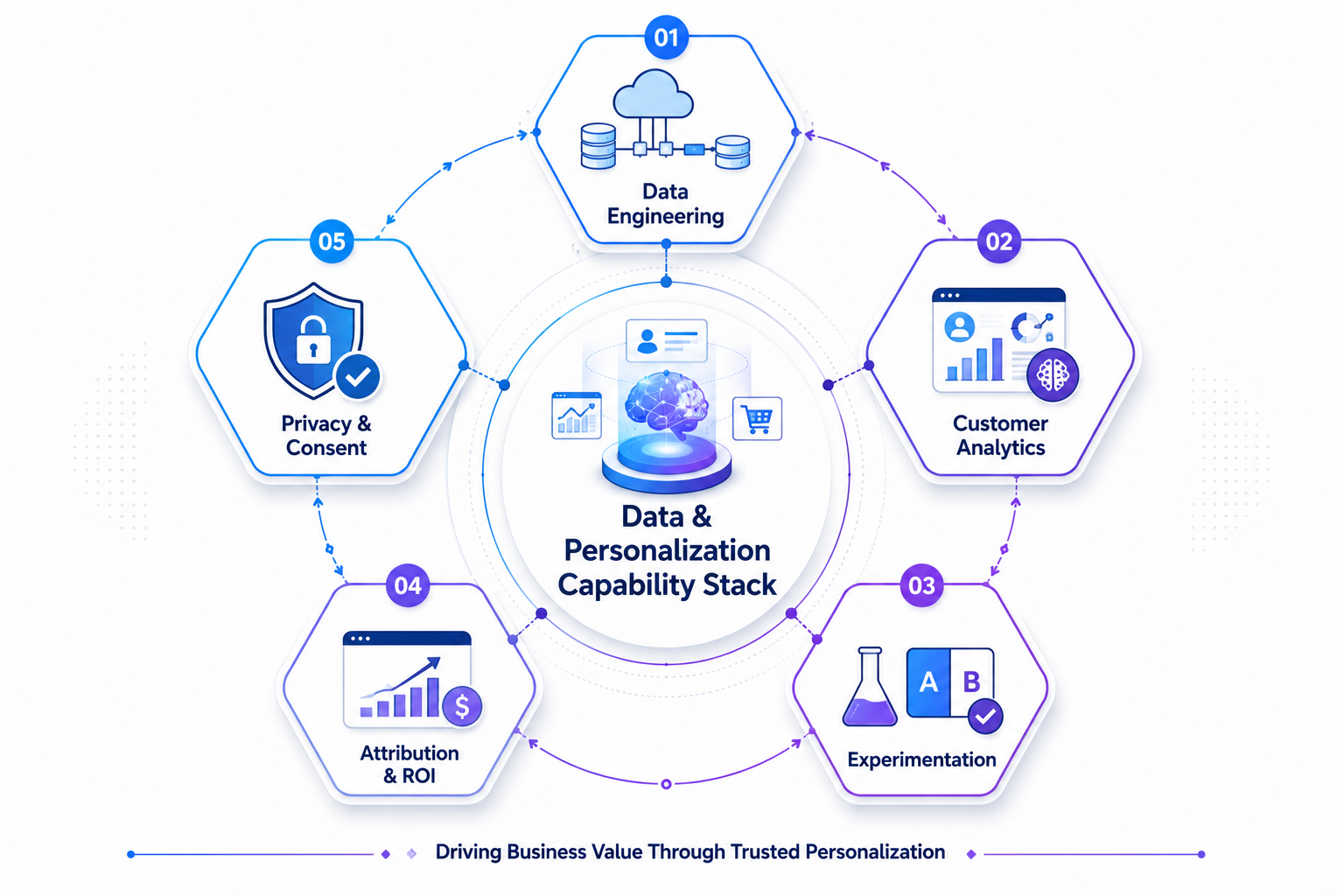
Personalization capability rests on five layers that must function together, not on any single tool. Data engineering builds and maintains the pipelines that make behavioural, transactional, and identity data usable in near real time, rather than trapped in disconnected systems that update overnight or not at all. Customer analytics turns that data into segments, propensity models, and lifetime value estimates that are accurate enough to act on. Experimentation infrastructure allows the organization to test personalization decisions against a control group rather than assume they work, since McKinsey research shows personalization most often drives a 5 to 15 percent revenue lift and a 10 to 30 percent improvement in marketing spend efficiency, but only when experimentation confirms which specific interventions are actually responsible for the gain.
Attribution connects personalization activity back to commercial outcomes with enough rigor to guide investment decisions, a capability many organizations still lack: even among sophisticated marketers, a meaningful share report difficulty tracking personalization ROI accurately. Privacy and consent management is the fifth layer, and increasingly the layer that determines whether the other four can operate at all, given the trust findings above and an expanding set of active enforcement regimes including GDPR, CPRA, and India's Digital Personal Data Protection Act.
Where the Real Returns Concentrate
Not all personalization investment returns equally. Product recommendation engines alone can account for up to 31 percent of e-commerce revenue in sessions where customers engage with them, with Amazon attributing 35 percent of total revenue to algorithmic recommendations, the benchmark most direct-to-consumer platforms are now chasing using large language models for semantic search and conversational shopping. Fashion and beauty categories show particularly strong personalization lift, with roughly half of fashion purchases now influenced by personalization and beauty brands reporting sales boosts in the vast majority of cases, while electronics retailers report double-digit profit increases alongside meaningful marketing cost reduction. The pattern across sectors is consistent even where the magnitude varies: personalization capability compounds, and organizations that build it early accumulate a data and experimentation advantage that is difficult for later entrants to close quickly.
Personalization and CX Roles
The roles that make personalization work sit deliberately at the intersection of data, design, and psychology, which is precisely why they are hard to source through conventional marketing or engineering hiring pipelines. The CX or product owner holds the end-to-end journey and makes the trade-off calls between relevance and intrusiveness that no algorithm can make alone. The data scientist builds and maintains the propensity and recommendation models, but increasingly needs enough product and customer-experience fluency to know when a technically accurate model produces an experience that feels wrong. The content strategist ensures personalized experiences remain coherent and on-brand across thousands of algorithmically assembled variations, preventing the kind of generic, over-automated feel that erodes the very trust personalization is meant to build. The UX designer translates data signals into interface decisions that feel helpful rather than surveilled, a distinction customers demonstrably notice.
• The CRM manager increasingly owns trust as a design constraint, not just a compliance checkbox: 84 percent of consumers want control over personalization settings, and only 15 percent absolutely trust brands with their data, meaning transparency and user control are prerequisites for the data supply that makes personalization work at all, not optional extras layered on afterward.
• Cross-functional collaboration is the exception, not the norm, and that gap is measurable: Only around 35 percent of organizations report that multiple teams collaborate effectively to execute a holistic personalization strategy across digital channels, which means the organizational design of these roles matters as much as the individual skill each role brings.
Behavioural Norms for Data-Driven CX
Unlock the Full Research
Create a free account or sign in to access the complete methodology, deep-dive analysis, and key implementation frameworks.
Don't have an account? It's free to join.
Organization Learning Labs
Research & Insights Division


Comments