Franchise 2030: Capability Systems for Brand Growth

Discover how franchise leaders build integrated capability systems for hyper-scalable, brand-consistent growth by 2030. Strategic guide for CXOs and brand heads.
Franchise 2030: The Capability Imperative That Will Separate Winners from Laggards
In a global franchise ecosystem projected to surpass $826 billion in economic output by 2028 (International Franchise Association, 2025), the decisive competitive variable is no longer the brand itself. It is the system that consistently delivers that brand -- at scale, across geographies, formats, and franchisee types.
The franchises that will dominate the next decade will not win on location count or marketing spend. They will win on execution consistency. And execution consistency, at the scale modern franchise networks demand, can only be achieved through one mechanism: a robust, integrated capability system.
"The single biggest source of franchise underperformance is not poor brand strategy. It is the gap between what the franchisor intends and what the franchisee delivers at the customer touchpoint." -- Franchise Business Review, 2025 |
Why This Matters Now: The Scale Problem Franchise Training Was Never Built For
Franchise training was designed for a simpler era. In-person bootcamps, printed operations manuals, and occasional field visits were adequate when networks were small, markets were homogeneous, and customer expectations were stable. None of those conditions hold today.
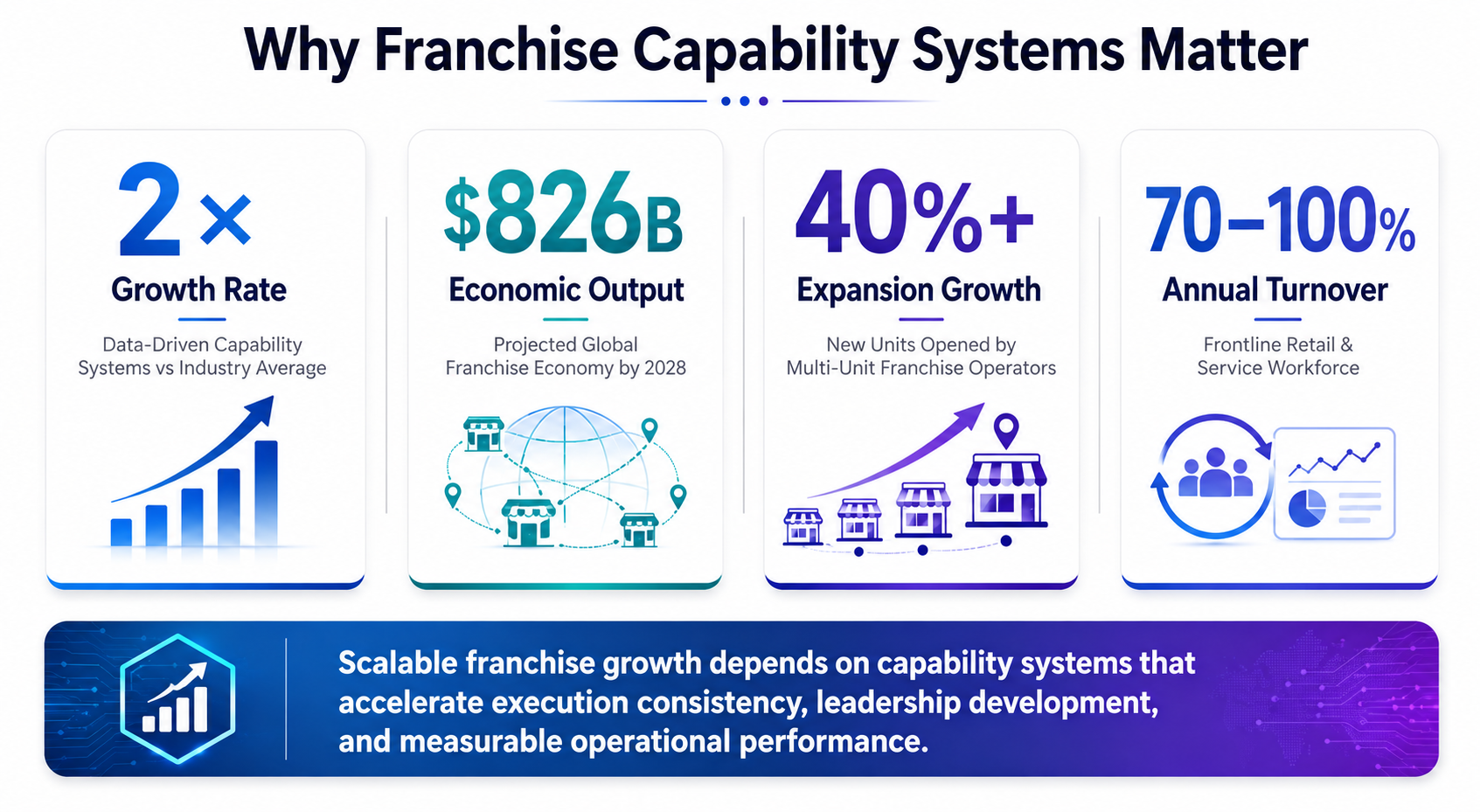
Four structural forces are rendering legacy training models obsolete:
1. Velocity of Expansion
Modern franchise networks open locations continuously, often in markets with distinct regulatory environments, consumer demographics, and competitive dynamics. Manual onboarding cannot scale at this pace. Each month a new franchisee spends below operational benchmark represents direct revenue loss and brand dilution.
2. Endemic Labour Churn
Frontline turnover in franchise retail and service environments regularly exceeds 70 to 100 percent annually (CareerPlug, 2025). The financial cost of replacing a single frontline employee ranges from 0.5x to 2x their annual salary when recruitment, training, and productivity loss are factored in. Without systems-level capability infrastructure, every turnover cycle resets hard-won service standards from zero.
3. Local Interpretation Drift
Absent standardized frameworks, franchisees interpret brand standards through their own operational lens. Service philosophies fragment. Product launch execution becomes uneven. Online reviews capture the variance. In a reputation economy, inconsistency compounds at speed and scale.
4. Training Disconnected from Outcomes
Many franchise systems have invested heavily in training content but retain almost no mechanism to connect that investment to operational performance. When training completion cannot be tracked, linked to KPIs, or tied to certification status, learning becomes an administrative exercise rather than a business driver.
The Architecture of a Franchise Capability System
Leading franchise systems are making a structural shift: from training events to capability architectures. This reflects a fundamentally different model of how competence is built, maintained, and operationalized at scale. A capability system operates across three interdependent levels:
Franchisee and Owner Capabilities
The modern franchisee is a business leader managing multiple locations, talent pipelines, local marketing, and financial performance. Required capabilities include:
• People leadership and coaching in high-churn environments
• Financial acumen: unit economics, P&L interpretation, and capital allocation
• Data-driven decision making across store and network performance
• Change navigation: technology adoption, new formats, system updates
• Local market strategy within defined brand guardrails
Frontline and Supervisory Staff Capabilities
Every customer-facing interaction is a brand expression. Staff capability must include:
• Brand service standards applied consistently and contextually
• Operational routines, compliance, and safety protocols
• Customer experience recovery and escalation judgment
• Digital and technology tool fluency
• Local adaptation within clearly defined brand guardrails
System-Level Organizational Capabilities
The franchisor organization itself must build capability in:
• Standardized curriculum architecture with role-based pathways
• Continuous content updating and version control across the network
• Feedback loops from high-performing locations to the broader system
• Accountability mechanisms tied to measurable operational outcomes
• Data infrastructure linking learning engagement to store-level KPIs
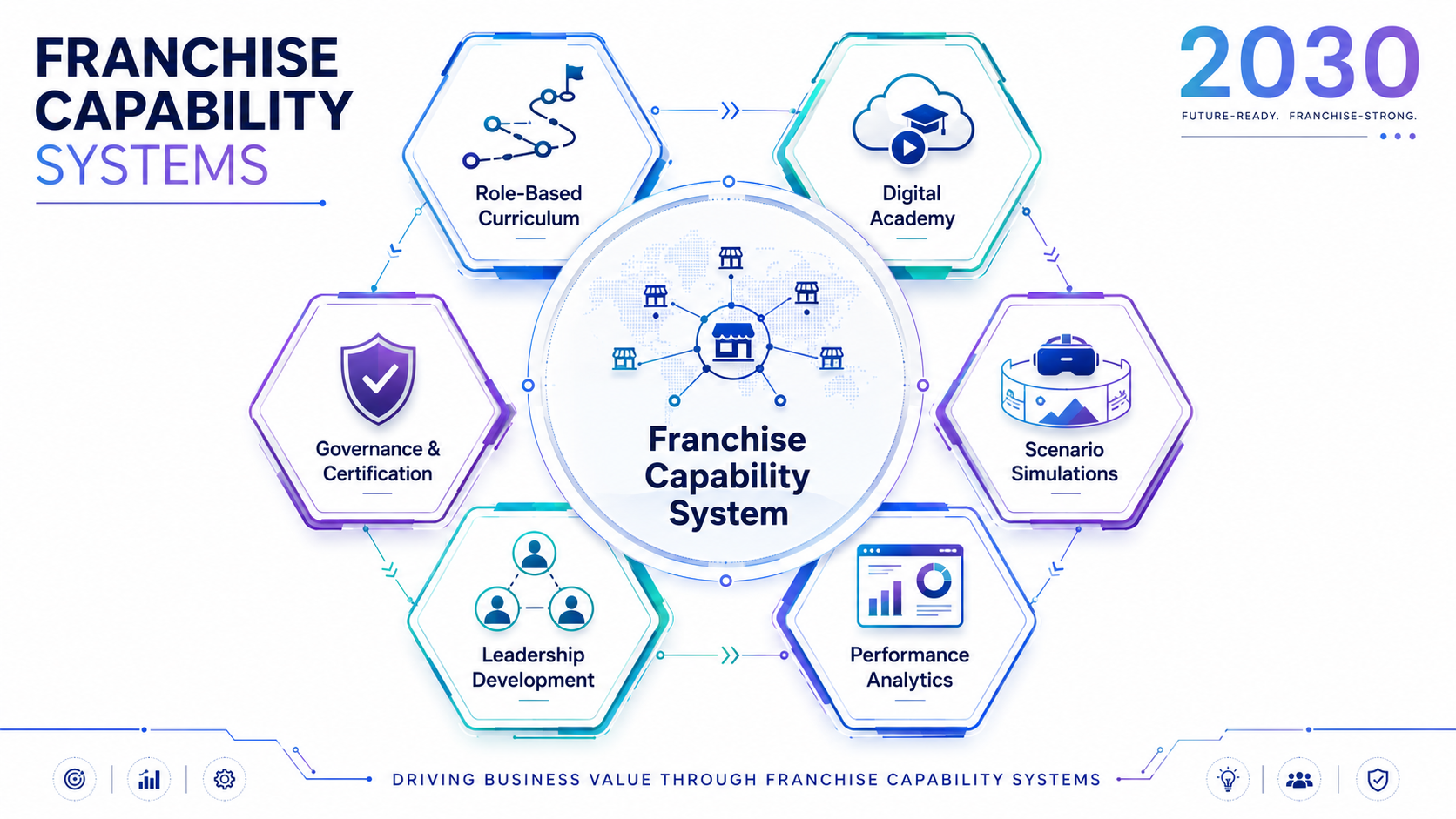
The Four Pillars of a High-Performance Franchise Capability System
Pillar 1: A Standardized, Role-Mapped Core Curriculum
The franchise curriculum becomes the brand's single source of operational truth. It must be modular, role-mapped, and continuously updated. Core coverage spans brand fundamentals, operational and compliance standards, customer experience philosophy, people leadership, and financial management. Critically, it must be globally accessible and locally adaptable -- standardizing the what and why while permitting franchisee judgment in the how.
Unlock the Full Research
Create a free account or sign in to access the complete methodology, deep-dive analysis, and key implementation frameworks.
Don't have an account? It's free to join.
Organization Learning Labs
Research & Insights Division


Comments