Food Safety Traceability: Building the Behaviour That Sticks

Blockchain and IoT can trace contamination in seconds, but food safety still depends on human behaviour. A capability guide for FSMA 204 and beyond.
Bulletproof Food Safety: Turning Traceability Technology into Everyday Behaviour and Capability
Blockchain, IoT sensors, and next-generation testing can trace contamination in seconds, but only if the humans across the value chain change how they work
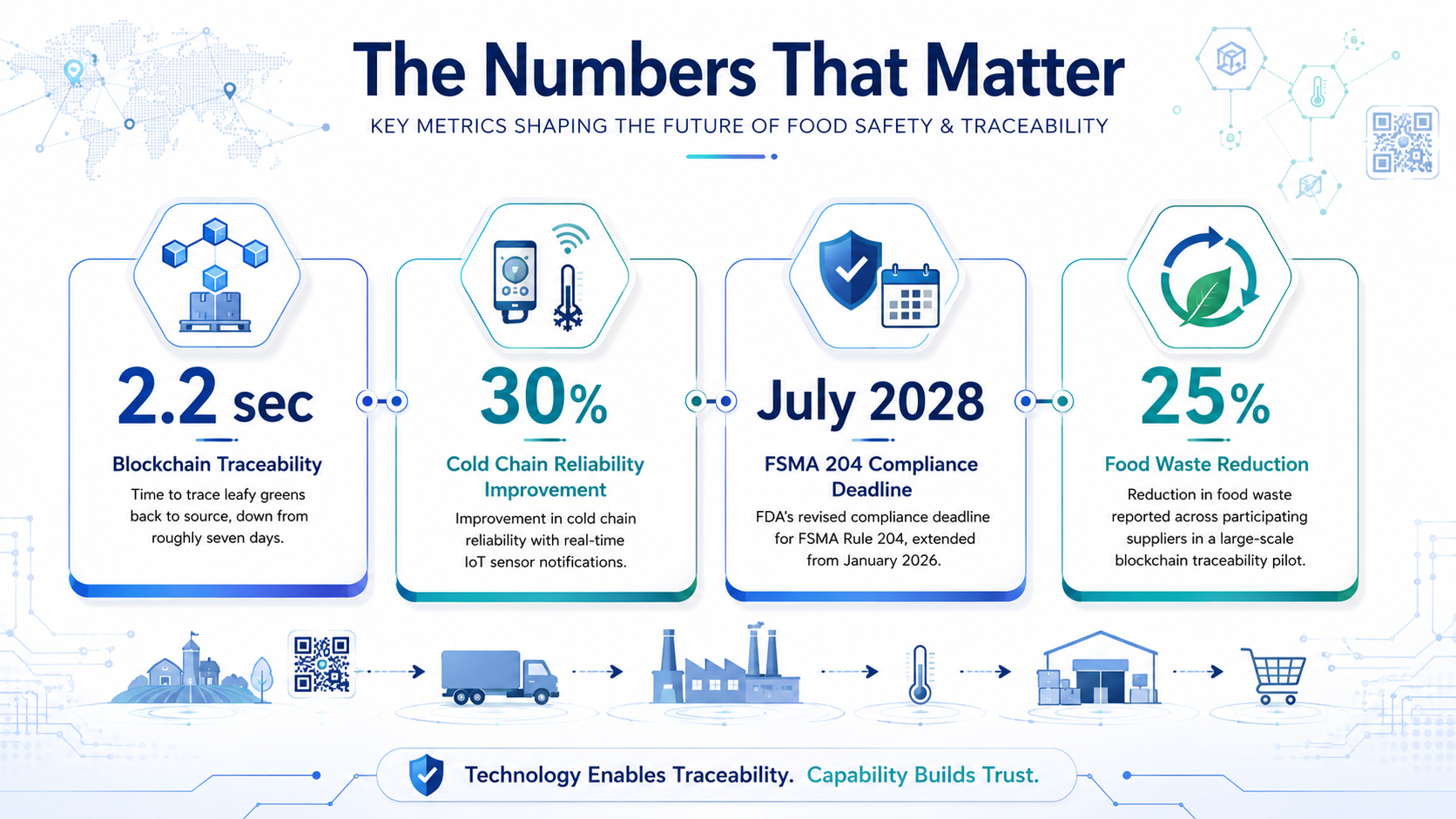
Technology Has Solved Tracing. It Has Not Solved Trust.
Food safety technology has advanced faster in the past five years than in the previous twenty. Blockchain ledgers now create tamper-proof batch records that regulators, insurers, and trading partners can trust without relying on a single company's word. IoT sensors log temperature, GPS position, and handling events automatically rather than through a clipboard someone may or may not have filled in accurately. Rapid diagnostic tests and next-generation sequencing can identify a pathogen in hours instead of the days or weeks legacy lab methods required. On paper, the tools now exist to make foodborne illness outbreaks a rare, quickly contained event rather than a recurring headline.
Yet outbreaks keep happening, recalls keep spreading further than they should before detection, and the gap between what the technology can do and what actually happens on a given shift, at a given facility, remains stubbornly wide. The reason is not a shortage of sensors or software. It is that food safety has always been, and remains, a behavioural system dressed up as a technical one. A blockchain ledger is only as accurate as the person scanning the pallet. An IoT temperature alert only protects consumers if someone reads it and acts within minutes rather than at the end of a shift. The next chapter of food safety leadership is not about buying better technology. It is about building the human capability and daily discipline to use the technology that already exists.
The New Food Safety Capability Stack
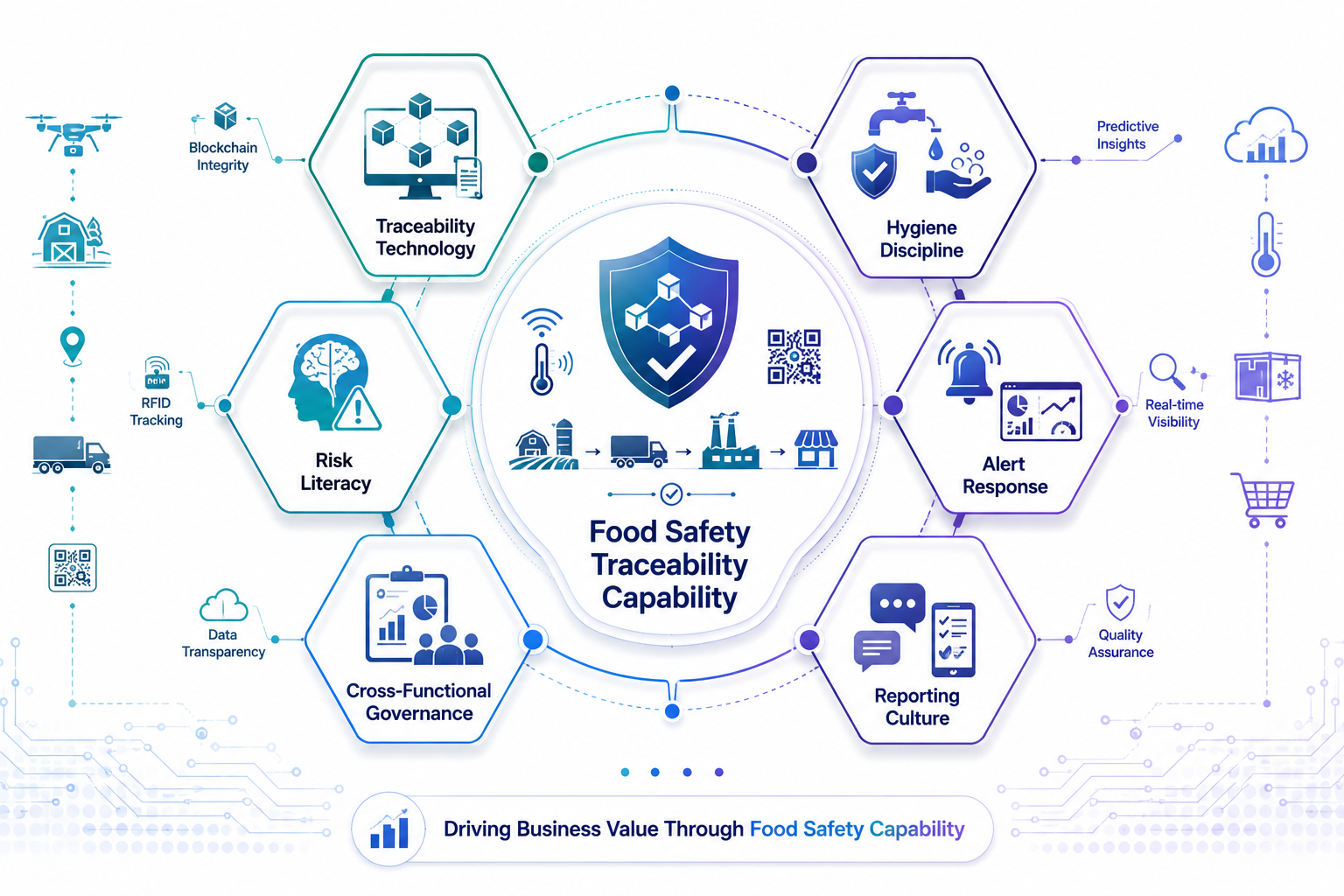
Two distinct capability layers now sit beneath food safety performance, and most organizations have built only one. The first is analytical and technical: the ability to operate traceability platforms, interpret sensor dashboards, and translate a stream of Critical Tracking Event data into an operational decision. This layer has absorbed the majority of recent capital investment across the industry, driven largely by the FDA's FSMA Rule 204, which requires enhanced traceability records for a defined list of high-risk foods including leafy greens, shell eggs, and certain ready-to-eat items.
The second layer, chronically underinvested relative to the first, is human: risk literacy among frontline workers, hygiene discipline that holds up under production pressure, and a genuine willingness to report incidents rather than quietly correct them and move on. Compliance teams often assume that once the technical layer is built, the behavioural layer will follow automatically. It does not. A facility can have a fully instrumented cold chain and still suffer a contamination event because a worker under time pressure chose not to flag a temperature excursion that felt, in the moment, like it probably would not matter.
Behavioural Gaps: Why Good Systems Still Fail
The behavioural gaps that undermine even well-instrumented food safety systems tend to cluster around a small number of recurring patterns. Under-reporting is the most consequential: workers who fear blame for a deviation are less likely to log it, which means the exact data the system depends on for early detection goes missing at the moment it matters most. Cutting corners under speed pressure is closely related, particularly in high-throughput environments where the incentive structure implicitly rewards keeping the line moving over pausing to investigate an anomaly. Ignoring alerts, whether from alarm fatigue or simple habituation, is a third pattern that grows more common precisely as sensor density increases, since more alerts without better triage training simply teaches staff to tune them out.
Underneath all three patterns sits a cultural dynamic that technology alone cannot fix: a workplace where flagging a problem is treated as an accusation rather than as the system working as intended. Building a food safety culture where reporting a deviation is rewarded rather than quietly penalized is, in practical terms, a leadership and management capability problem, not an engineering one.
STRATEGIC INSIGHT Before investing further in sensor density, audit whether your existing alerts are actually acted on. Alarm fatigue, not sensor coverage, is now the more common failure point in mature traceability deployments. |
Designing Learning That Actually Changes Food Safety Behaviour
Traditional food safety training, built around annual certification refreshers and static modules, was designed for a compliance environment, not a behaviour-change one. It verifies that a worker once knew the correct answer to a hygiene question. It does little to ensure that worker behaves correctly at two in the morning during a chaotic shift six months later. Scenario-based training that simulates an actual outbreak investigation, coupled with short, high-frequency micro-drills embedded into daily shift routines rather than annual events, has shown far more durable behaviour change across the operators now piloting it.
Unlock the Full Research
Create a free account or sign in to access the complete methodology, deep-dive analysis, and key implementation frameworks.
Don't have an account? It's free to join.
Organization Learning Labs
Research & Insights Division


Comments