F&B Talent Crunch: Capability Building Strategy

Discover why capability building outperforms hiring alone in solving the F&B talent crisis. Proven frameworks reducing 75% turnover and building 2035-ready teams.
Solving the F&B Talent Crunch: Why Capability Building Beats Hiring Alone
Executive Summary
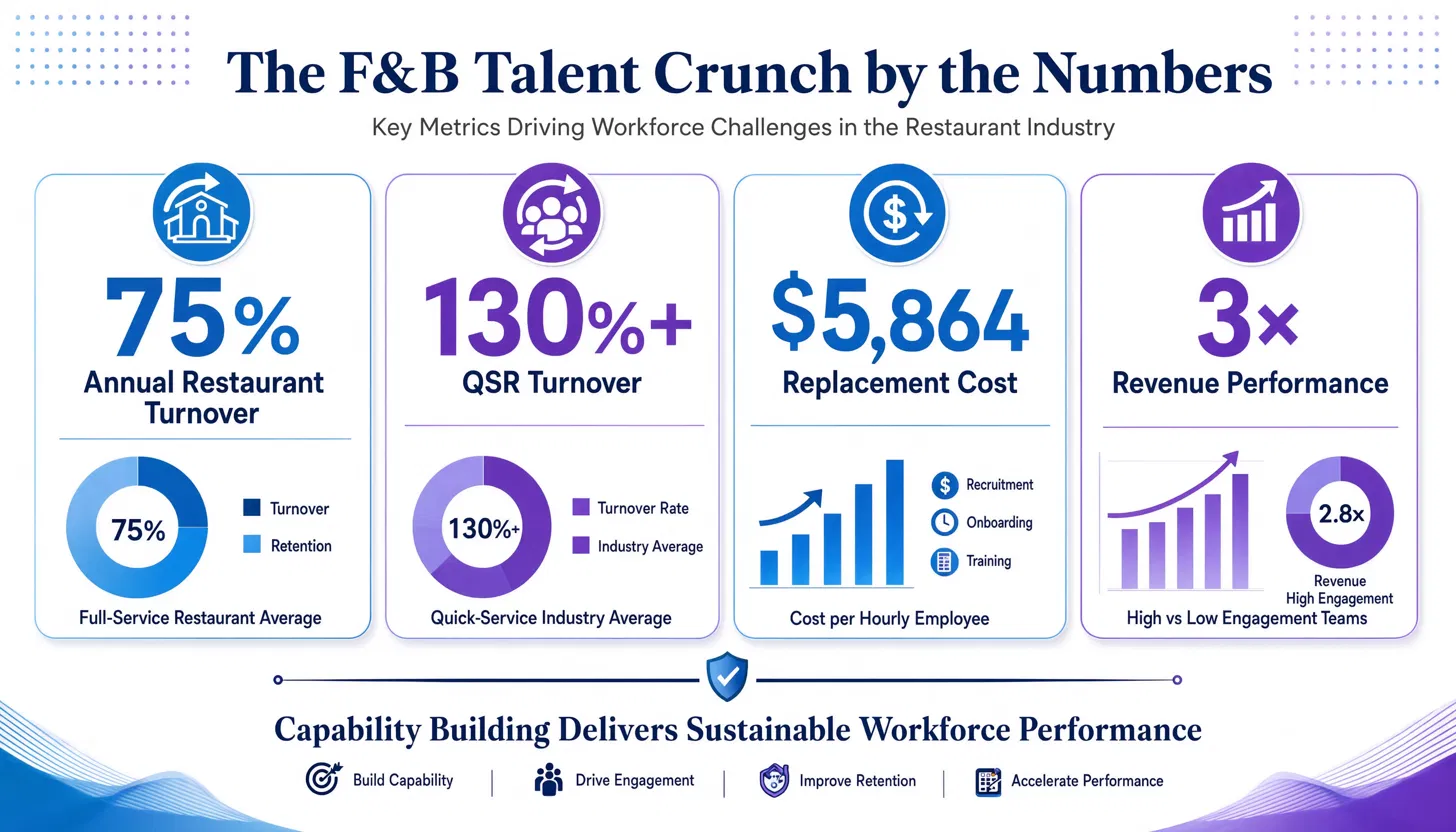
The F&B industry's talent crisis is not a recruiting problem. It is a retention and capability problem that has been misdiagnosed as a recruitment challenge for decades, leading organizations to invest heavily in hiring infrastructure while the underlying causes of attrition remain unaddressed. The result: average annual turnover rates of 75 percent for full-service restaurants and above 130 percent for quick-service operations, replacement costs of USD 5,864 per hourly employee, and an accelerating cycle of operational disruption, service quality erosion, and cultural degradation. This article presents a reframed strategic response. Drawing on evidence from McKinsey, Gallup, Cornell, the National Restaurant Association, and global hospitality operators, we argue that capability building -- structured onboarding, peer mentorship, microlearning, and visible career progression -- is the definitive retention lever, outperforming compensation increases, recruitment spend, and operational restructuring in its impact on voluntary attrition rates and long-term organizational performance.
Reframing the Problem: The Talent Crunch Is a Capability and Culture Deficit
The hospitality industry's discourse on talent consistently conflates two distinct challenges: recruitment -- attracting people into F&B roles -- and retention -- keeping capable people engaged and invested once they arrive. Most organizational energy and investment has historically been directed at the former, with the implicit assumption that adequate supply is the primary constraint.
The evidence consistently contradicts this assumption. McKinsey's 2024 global hospitality workforce study found that the primary drivers of voluntary F&B attrition are not compensation (ranked fourth by departing employees) but the absence of clear advancement pathways (ranked first), lack of meaningful skill development (ranked second), and a perceived absence of organizational investment in their future (ranked third). These are capability and culture deficits, not compensation deficits.
Gallup's 2024 State of the Global Workplace report found that only 23 percent of hospitality workers globally report being actively engaged at work -- the lowest engagement rate of any major industry sector. The financial consequences of this engagement deficit are significant: Gallup estimates that low engagement costs the global hospitality industry approximately USD 1.1 trillion annually in lost productivity, turnover, and service quality degradation. Critically, Gallup's research identifies manager behavior and development opportunity as the two most powerful drivers of engagement change -- both of which are addressed directly by capability building programs.
"The restaurants and hotel companies that have cracked the retention code are not necessarily paying the most. They are providing the most -- in terms of purpose, growth, and the daily experience of being seen as a capable professional rather than a replaceable pair of hands. That is what capability building delivers."
-- Anthony Bourdain, Chef and Author, from 'Medium Raw: A Bloody Valentine to the World of Food and the People Who Cook' (2010)
The True Cost Architecture of F&B Turnover: What Leaders Are Not Measuring
The USD 5,864 average replacement cost per hourly F&B employee, documented by the Cornell Center for Hospitality Research, captures only the directly visible costs: recruiting advertising, interviewing time, background checking, and initial training delivery. It does not capture the full cost architecture of turnover, which Cornell's expanded analysis estimates at 50 to 200 percent of annual salary depending on role complexity.
The hidden cost components include: revenue loss during the performance gap of a new hire learning the role (typically 4 to 8 weeks at 40 to 60 percent of experienced performance); overtime costs paid to remaining staff covering the vacancy; guest experience deterioration from reduced service capacity, manifesting in lower satisfaction scores, reduced return visit rates, and negative review generation; supervisor time diverted from revenue-generating activities to new hire management; and organizational culture erosion as existing high performers observe high turnover as a signal of inadequate organizational investment.
A mid-scale F&B operation with 30 staff and 75 percent annual turnover is managing approximately 22 replacement cycles per year. At the full-cost replacement estimate of USD 11,000 per cycle (Cornell expanded model), that represents USD 242,000 in annual turnover cost -- in an operation that may generate less than USD 2 million in annual revenue. Turnover, measured fully, represents a 12 percent revenue drag that virtually no F&B operator would accept if it were presented as an explicit line item rather than an aggregate of distributed costs.
The Hiring Myth: Why Faster Recruitment Perpetuates the Cycle
When turnover spikes, the instinctive response is to accelerate recruitment. More job postings, faster interview processes, lower hiring standards to fill immediate vacancies. This response is understandable and provides short-term operational relief. It does not address -- and in many cases exacerbates -- the underlying drivers of attrition.
The hospitality talent pipeline is under structural strain globally. The International Labour Organization's 2024 Hospitality Sector Analysis projects that the supply of workers willing to enter food service at current compensation and working condition levels will not meet projected demand in major markets through 2030. This supply-demand imbalance means that the marginal cost of recruiting is increasing year over year, while the quality of candidates available at entry-level market rates is declining.
Simultaneously, organizations that respond to turnover primarily through accelerated hiring create cultural dynamics that accelerate further attrition among their existing high performers. When a team of experienced staff observes a constant churn of inadequately screened new hires who require intensive support, make service errors, and frequently do not survive probation, their own engagement and retention suffers. The cycle is self-reinforcing. Breaking it requires addressing root causes rather than symptoms.
The Four Capability Building Levers That Actually Solve the Talent Crunch
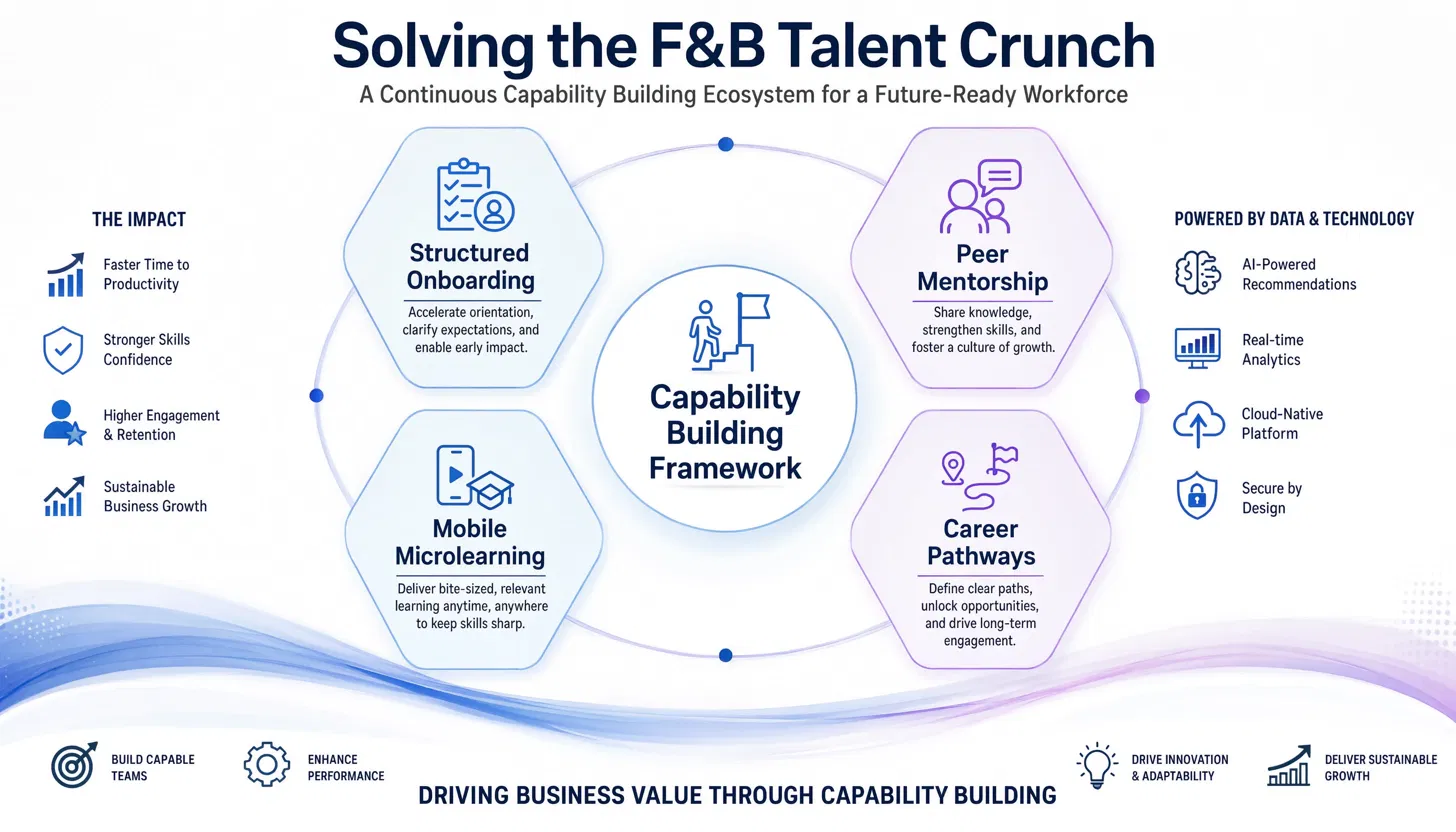
Lever One: Pre-Boarding and Structured Onboarding
The onboarding period -- the first 30 to 90 days of employment -- is the highest-risk and highest-leverage period in an F&B employee's tenure. Research from the Society for Human Resource Management (SHRM) shows that employees who experience a structured onboarding program are 58 percent more likely to remain with the organization after three years than those who undergo minimal or unstructured onboarding. In F&B, where 40 percent of voluntary departures occur within the first 90 days, this is a structurally significant retention lever.
Best-practice onboarding for F&B organizations begins before day one. Pre-boarding communications -- a personalized welcome from the hiring manager, an overview of what the first week will involve, answers to logistical questions, and an early introduction to colleagues -- reduce first-day anxiety and increase psychological commitment before the employee has made their first service error. The organizational signal is: you chose us, and we chose you, and that matters to us.
Unlock the Full Research
Create a free account or sign in to access the complete methodology, deep-dive analysis, and key implementation frameworks.
Don't have an account? It's free to join.
Organization Learning Labs
Research & Insights Division


Comments