F&B Sustainability Capability: Beyond the Carbon Pledge

Food systems drive a quarter of global emissions. A leadership guide to building the sourcing, waste and behavioural capability decarbonization actually requires.
Decarbonizing the Menu: Building Sustainability Capability and Everyday Behaviour in F&B Enterprises
Clean labels and carbon pledges are marketing. Decarbonizing a food system requires capability and behaviour change at every stage, from the farm to the checkout counter
Sustainability Beyond the Label
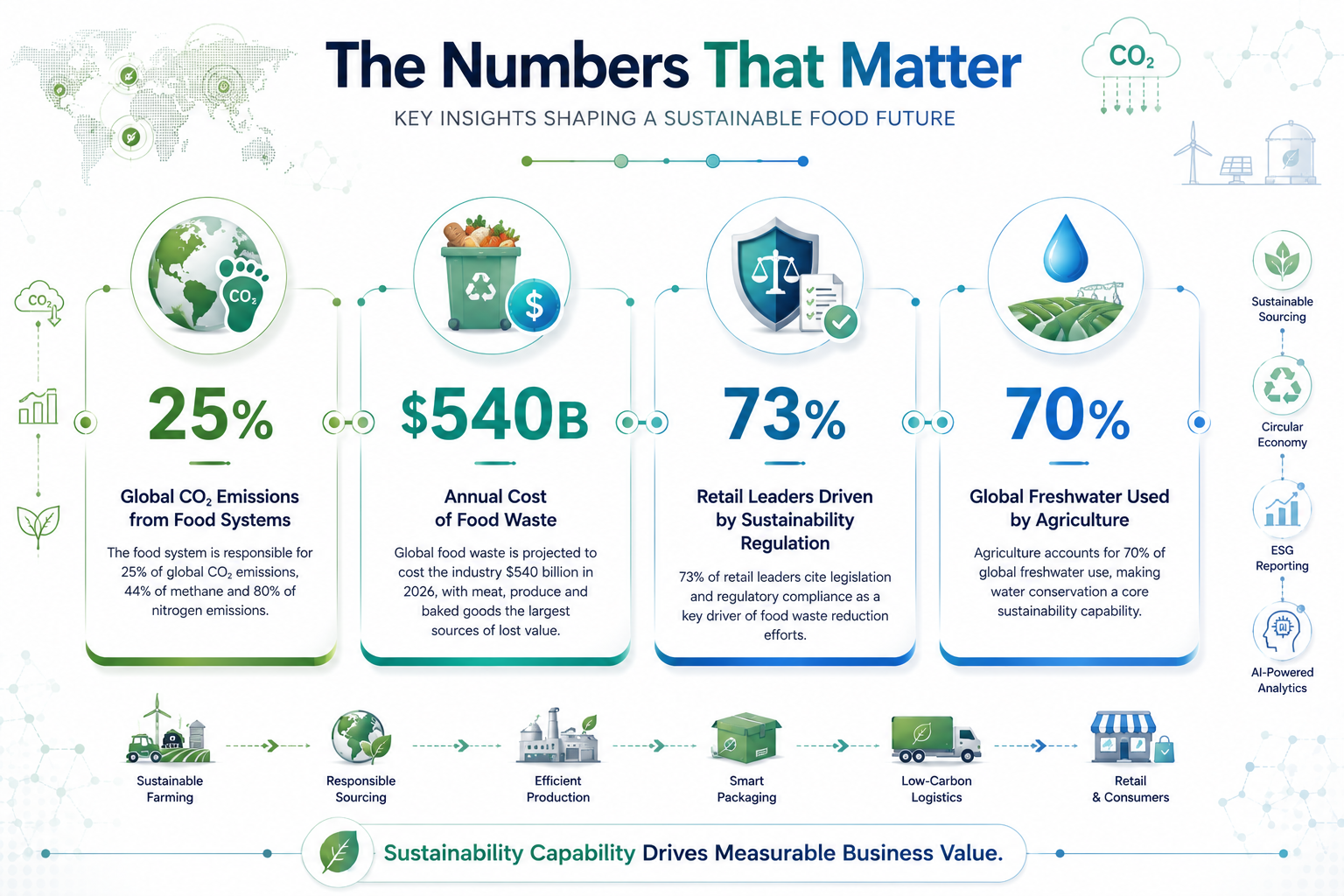
Clean label claims, responsible sourcing statements, and carbon-neutral pledges have become standard features of food and beverage marketing, but the underlying operational reality has not kept pace with the messaging in most organizations. Today's food system is responsible for roughly a quarter of global carbon dioxide emissions, nearly half of global methane emissions, and the large majority of global nitrogen emissions, figures that make food and beverage one of the most consequential sectors in the entire climate transition, not a peripheral contributor managing a reputational issue.
The risk facing F&B leadership teams is treating sustainability as a marketing and communications function rather than an operational capability spanning sourcing, production, packaging, and retail. A pledge without the sourcing intelligence, waste analytics, and behavioural discipline to deliver it is not a strategy. It is a liability waiting for a regulator, an investor, or an increasingly well-informed consumer to notice the gap between the claim and the operating reality behind it.
The Sustainability Capability Stack in F&B
Sourcing and supply chain intelligence forms the technical foundation of genuine sustainability capability, requiring visibility into supplier practices, land use, and emissions data that most procurement functions were never originally built to capture. Waste analytics and energy management sit alongside it as operational disciplines, translating abstract sustainability goals into the specific, measurable decisions a plant manager or store operator makes daily about portioning, inventory, and equipment scheduling.
Sustainable packaging design and menu design, increasingly shaped by carbon and water footprint considerations rather than cost and shelf appeal alone, complete the technical layer. Consumer research consistently shows recyclability and circularity now rank among the top factors shoppers use to judge whether packaging is genuinely sustainable, which means packaging decisions previously owned almost entirely by procurement and design functions now carry direct sustainability capability requirements those functions were rarely built to hold.
STRATEGIC INSIGHT Food production and processing account for roughly 15% of global annual fossil fuel use. Energy management capability inside a plant, not just supplier-level carbon accounting, is a material and often underinvested lever for genuine decarbonization progress. |
Behavioural Shifts at Every Stage of the Value Chain
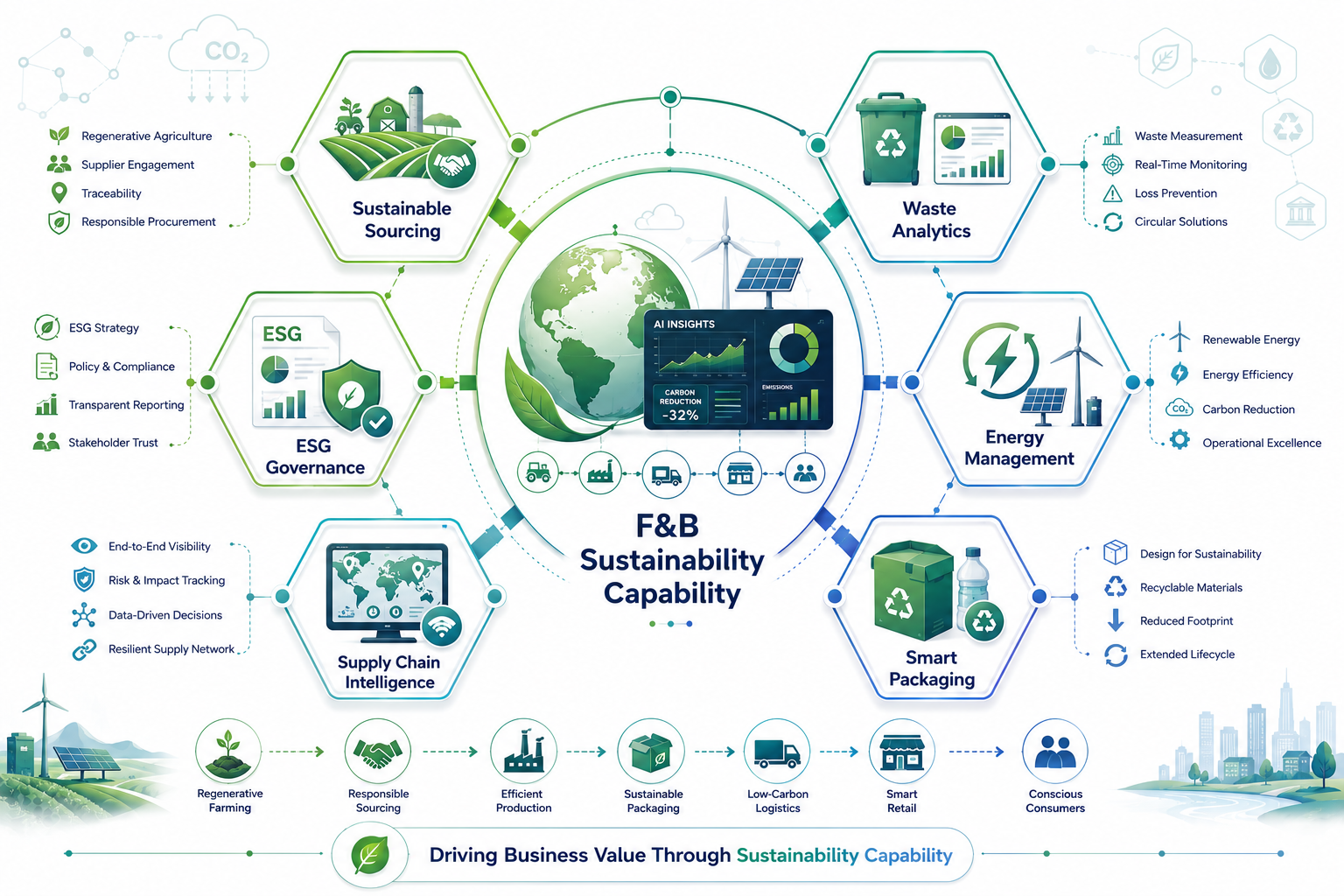
Sustainability capability fails or succeeds based on behaviour at every link in the value chain, not on strategy documents at headquarters. Farmers and suppliers need genuine incentive and capability to share data transparently, since sourcing intelligence is only as good as the willingness of upstream partners to provide it accurately rather than selectively. Plant teams need to internalize waste-aware decision-making as a daily habit rather than a periodic audit exercise, recognizing in real time when a production run is generating avoidable loss rather than discovering it in a monthly waste report.
Retail and restaurant staff carry perhaps the most consumer-visible behavioural responsibility: portioning decisions, inventory management discipline, and how clearly they communicate sustainability information to customers all shape both actual waste outcomes and consumer trust simultaneously. Global food waste is projected to cost the industry roughly five hundred forty billion dollars in 2026 alone, with meat, fresh produce, and baked goods representing the largest categories of lost value, and the overwhelming majority of that loss traces back to specific, correctable behavioural and process decisions rather than unavoidable spoilage.
Learning Systems for Sustainability Capability
Sustainability academies that combine technical training on waste analytics and energy management with cross-functional projects spanning procurement, operations, and retail have proven considerably more effective at driving behaviour change than standalone sustainability awareness modules, which tend to build knowledge without building the specific operational habits that actually reduce waste and emissions. Metrics dashboards visible directly in stores and plants, not just in quarterly sustainability reports reviewed by a small specialist team, help translate abstract sustainability goals into the daily decisions frontline staff and managers actually control.
Unlock the Full Research
Create a free account or sign in to access the complete methodology, deep-dive analysis, and key implementation frameworks.
Don't have an account? It's free to join.
Organization Learning Labs
Research & Insights Division


Comments