F&B Capability Academies: Design for Scale

Learn how to design centralized F&B capability academies that maintain service excellence at scale, reduce 155% turnover, and build leadership pipelines.
Service Excellence at Scale: Designing F&B Capability Academies for Sustainable Competitive Advantage
Executive Summary
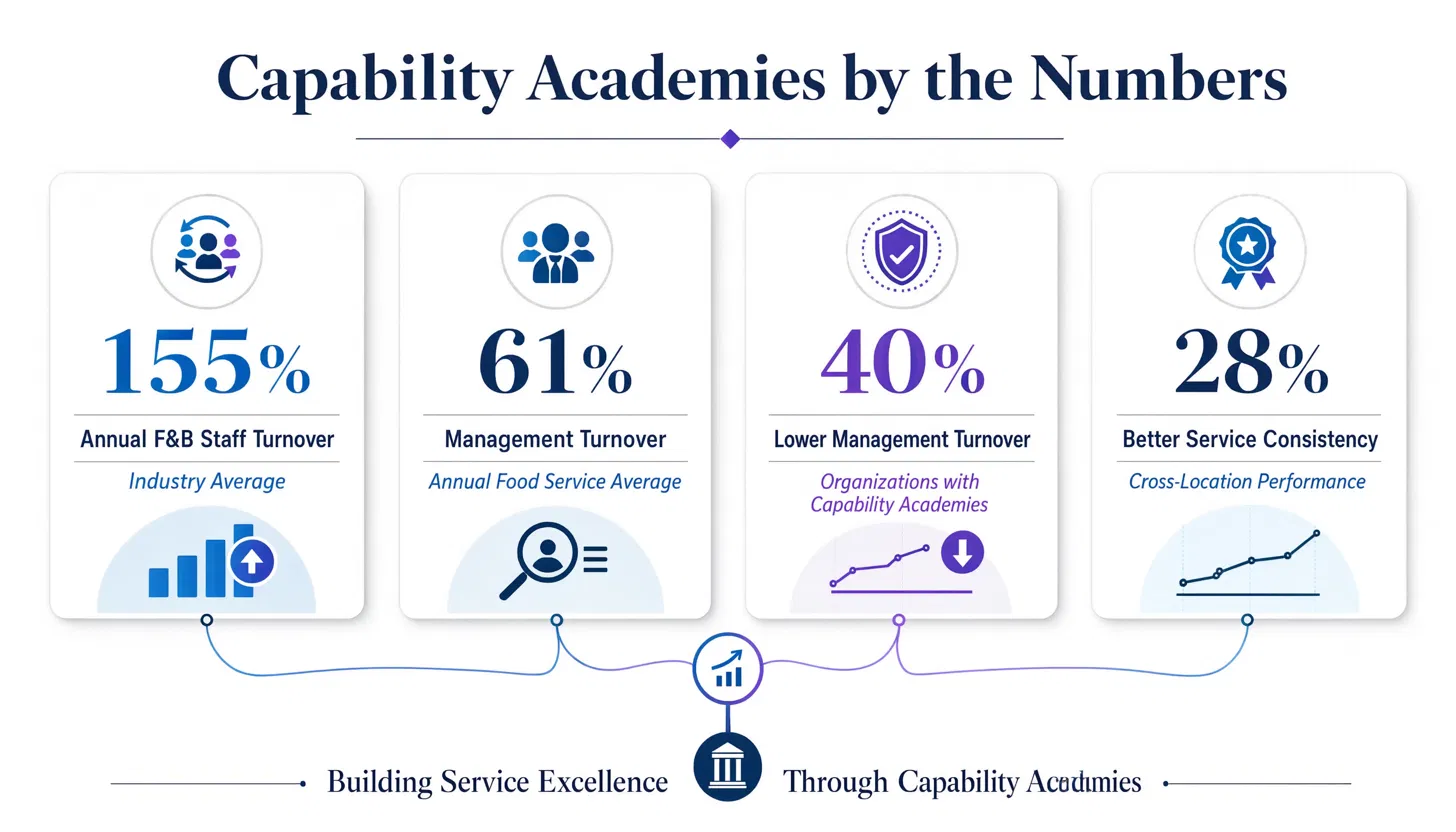
As F&B organizations scale across locations, channels, and formats, the central tension of growth emerges: how do you maintain the service excellence, cultural coherence, and quality consistency that define a brand while multiplying the number of people, geographies, and contexts in which that brand is delivered? This article presents the strategic case for centralized F&B capability academies as the definitive architecture for scaling excellence without sacrificing distinctiveness. Drawing on evidence from McKinsey, KPMG, the Cornell Center for Hospitality Research, and leading global F&B brands, we demonstrate that organizations with formal capability academy infrastructure achieve 40 percent lower management turnover, 28 percent better customer satisfaction consistency across locations, and a 35 percent faster time-to-performance for new site openings. More critically, capability academies are the mechanism through which F&B organizations convert operational procedures into organizational culture -- the difference between a brand that can be scaled and a brand that should be.
The Scaling Problem That Manual and Procedures Cannot Solve
Every F&B organization that has attempted rapid multi-location expansion has encountered a version of the same crisis: what worked brilliantly in the original location, under the founder's or founding team's direct oversight, becomes inconsistent, diluted, and eventually unrecognizable as the organization adds locations, staff, and complexity.
The instinctive response is procedural: write clearer SOPs, implement tighter audit systems, enforce standards more rigorously. McKinsey's 2024 Operations in Food Service report documents why this response is necessary but insufficient. Procedural compliance produces behavior in the presence of oversight. It does not produce judgment in the absence of it. And multi-location F&B operations cannot achieve supervisory density sufficient to maintain oversight across every service interaction. The math simply does not work.
KPMG's 2024 Hospitality Brand Analysis found that 73 percent of multi-location F&B brands identify service consistency as their primary operational challenge, outranking food quality, pricing, and supply chain management. Of those organizations, the ones achieving the highest cross-location consistency scores share a common structural characteristic: they have invested in centralized capability development infrastructure rather than relying on location-level training.
The distinction is fundamental. Location-level training produces staff who know the procedures of their specific outlet. Centralized capability academies produce staff who understand the principles of the brand -- why quality matters in the way it does for this organization, what service means in terms of the values this brand embodies, how problems should be solved in ways consistent with the culture this organization has chosen to build. Principled understanding scales. Procedural compliance fragments.
"The brands that truly scale are not those with the tightest standard operating procedures. They are those with the deepest culture. Culture is what travels when the founder is not in the room. Capability academies are how you institutionalize culture."
-- Patrick Doyle, former CEO, Domino's Pizza, on Scaling Brand Culture Through Learning
Why F&B Brands Invest in Capability Academies: The Evidence Base
Consistency at Scale Requires Shared Mental Models, Not Just Shared Manuals
The conceptual foundation of the capability academy model rests on the distinction between explicit knowledge (what can be written in a manual) and tacit knowledge (the judgment, intuition, and cultural understanding that governs decisions when no manual covers the situation). F&B service excellence overwhelmingly depends on tacit knowledge: how to read a guest's emotional state, when a quality shortcut is unacceptable even under operational pressure, what 'good enough' means in this brand's terms.
Tacit knowledge cannot be transferred through documentation. It is transferred through structured experience, mentorship, deliberate practice, and cultural immersion. The capability academy is the physical and programmatic architecture through which tacit knowledge is transmitted at scale -- turning individual expertise into organizational capability that persists across locations, turnover cycles, and leadership changes.
The Talent Retention and Career Development Imperative
The 155 percent annual turnover documented in food service is not uniformly distributed. A Deloitte 2024 analysis of F&B talent retention found that turnover rates at organizations with formal capability development programs are 35 to 45 percent lower than at organizations without them. The mechanism is clear: employees who see visible, structured pathways from frontline entry to supervisory to management roles -- and who are actively invested in at each stage -- make different career decisions than those who see only a transactional employment relationship.
The business mathematics of talent retention in F&B are straightforward. A 50-location F&B operation with 155 percent annual turnover across a combined workforce of 500 staff is replacing 775 people annually. At an average replacement cost of USD 5,864 (Cornell Center for Hospitality Research, 2024), that represents USD 4.5 million in annual turnover expenditure. Reducing turnover from 155 to 100 percent through capability academy investment -- a documented outcome for academy-equipped operators -- eliminates 275 replacement cycles and saves approximately USD 1.6 million annually. The capital cost of building and operating a capability academy for a 50-location operation rarely exceeds USD 800,000 in year one, making the financial case self-evident.
The Modern F&B Capability Academy: Architectural Principles and Design Elements
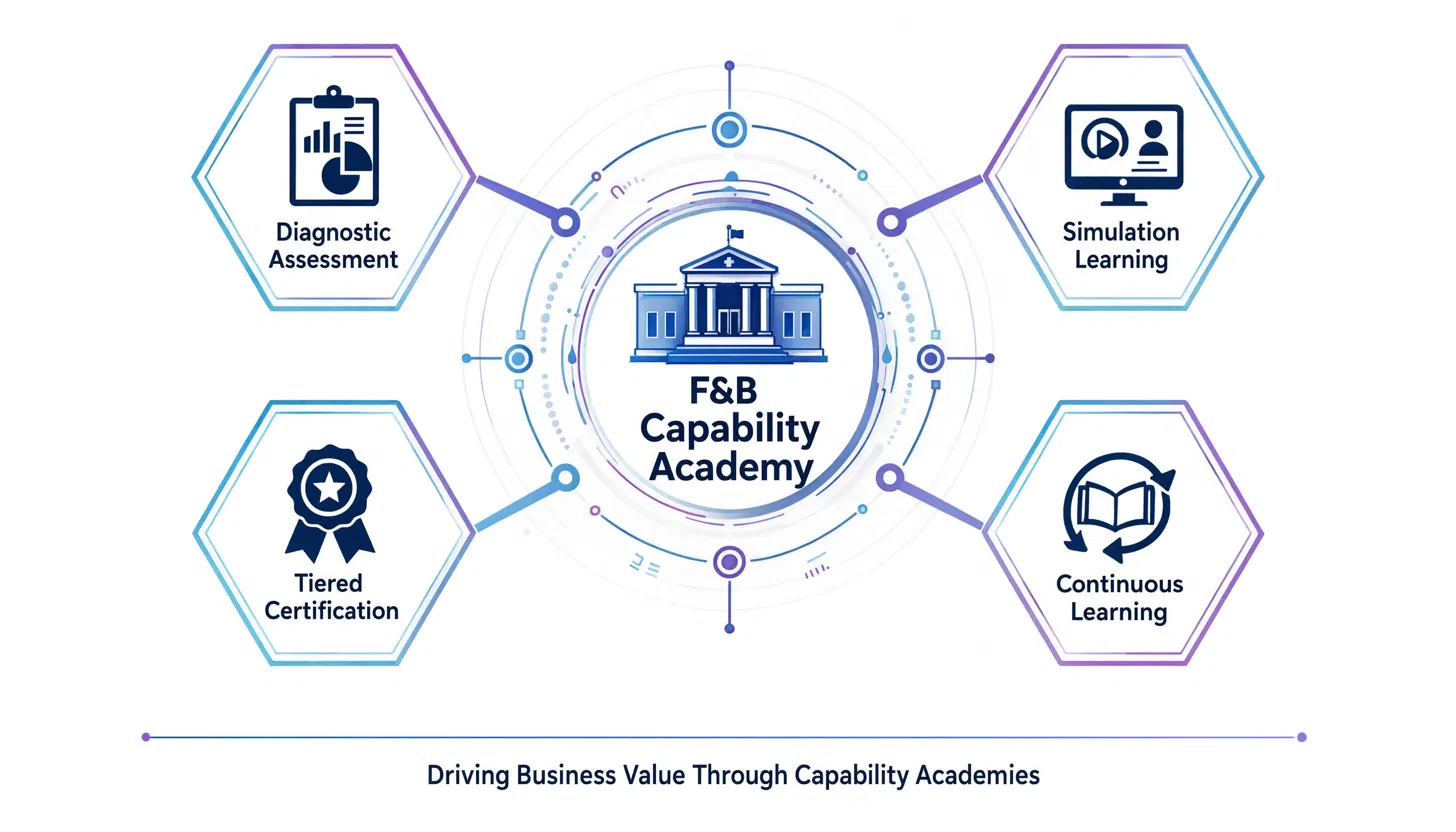
Pillar One: Diagnostic Assessment Infrastructure
Unlock the Full Research
Create a free account or sign in to access the complete methodology, deep-dive analysis, and key implementation frameworks.
Don't have an account? It's free to join.
Organization Learning Labs
Research & Insights Division


Comments