Experiential Learning Labs for F&B Teams

Learn how experiential learning labs transform F&B frontline performance, cut complaints 40%, and build 2035-ready hospitality capability.
From Training to Transformation: Experiential Learning Labs for F&B Frontline Teams
Executive Summary
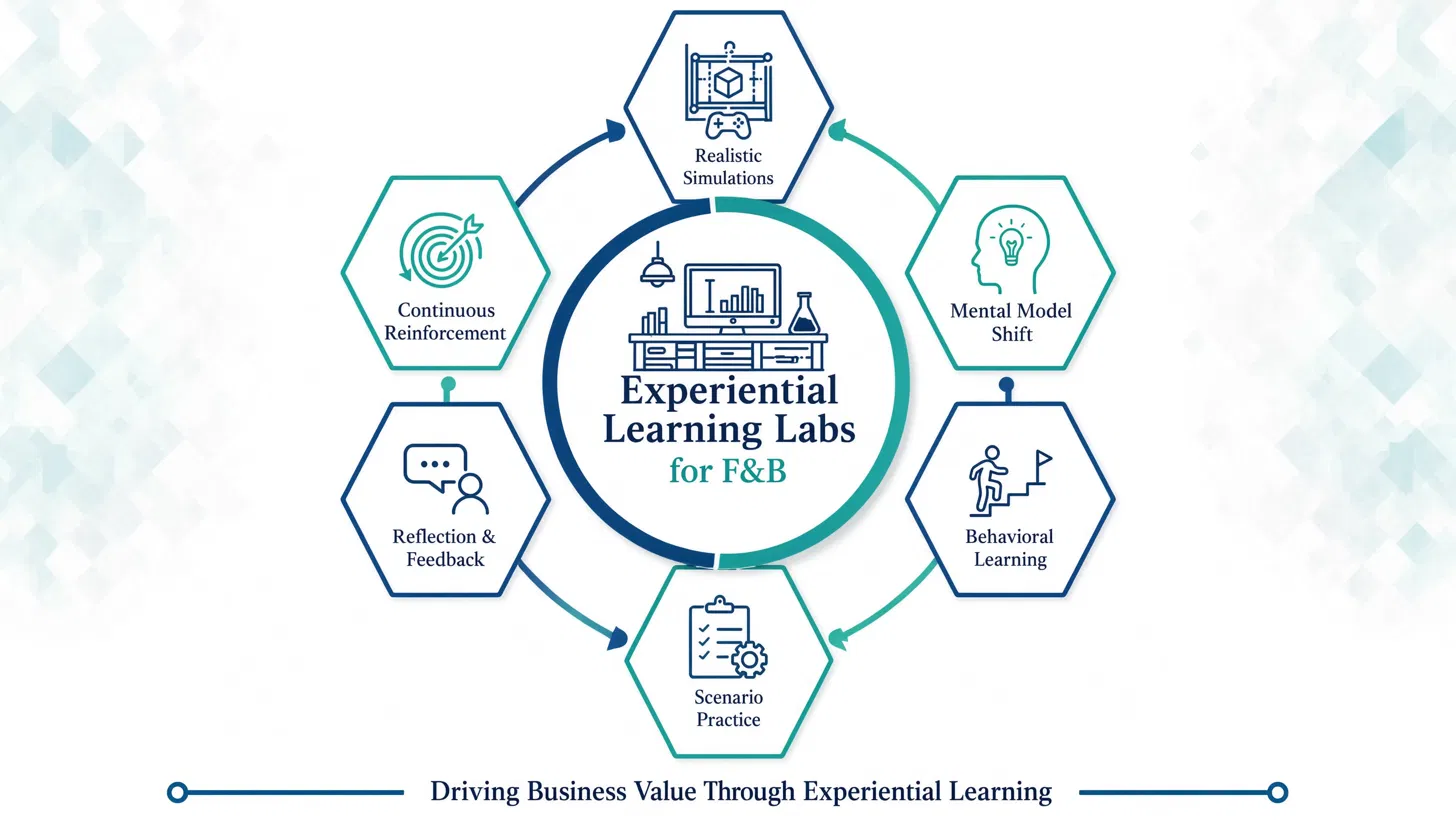
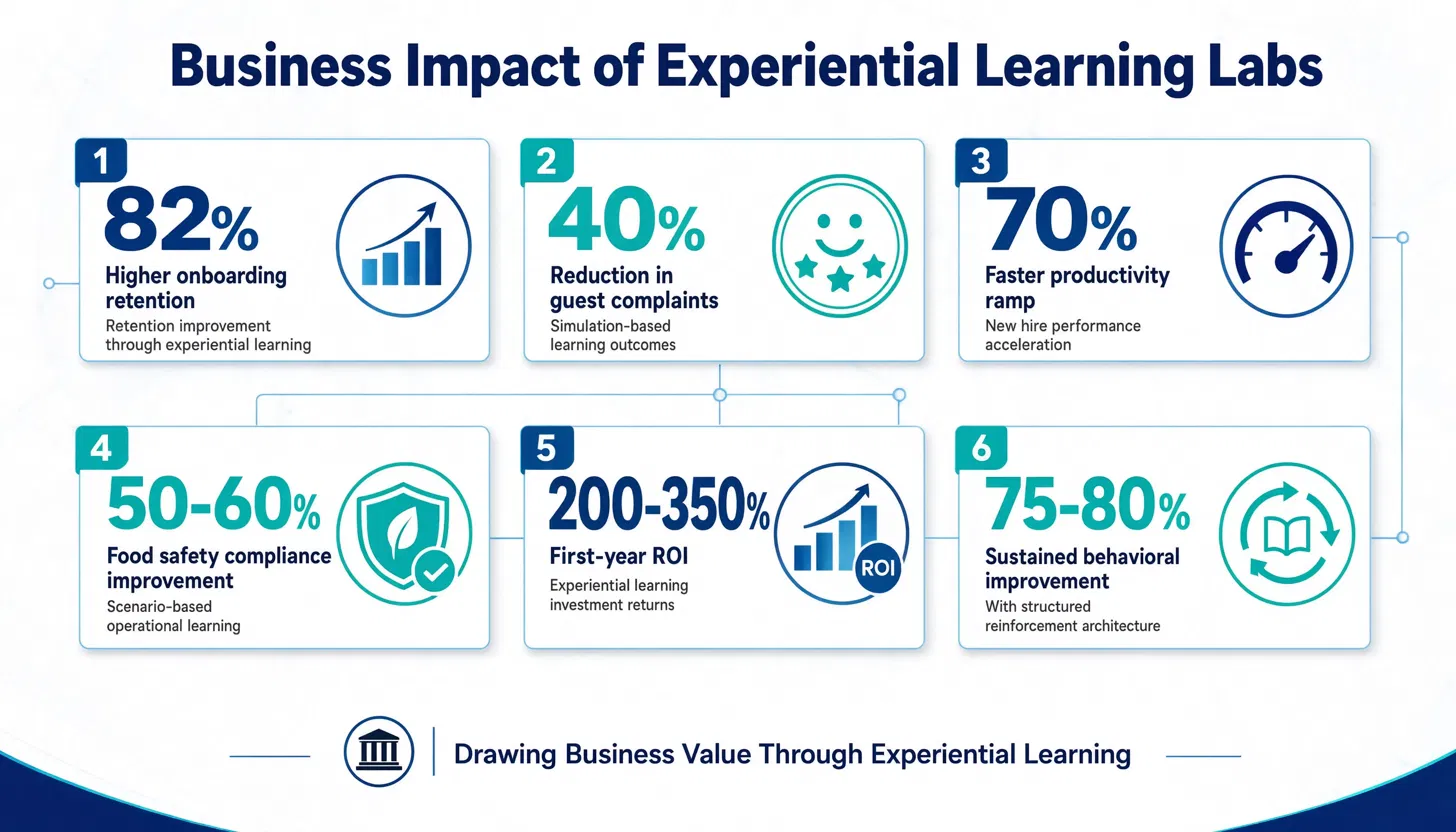
The global F&B industry spends billions annually on frontline staff training, yet service inconsistency, compliance failures, and retention crises persist at alarming rates. The problem is not investment. It is methodology. Traditional compliance-oriented, lecture-based training transfers information but rarely transforms behavior. This article presents the strategic and operational case for experiential learning labs -- simulation-based, reflection-driven learning environments that develop not just procedural knowledge but the mental models that govern decision-making under pressure. Drawing on evidence from McKinsey, Gartner, the Cornell Hospitality Research Center, and global hospitality operators, we demonstrate that organizations deploying experiential learning methodologies achieve 82 percent improvements in retention, 30 to 40 percent reductions in guest complaints, and 50 to 70 percent faster productivity ramp for new hires. More critically, experiential learning builds the adaptive human capability that will define competitive differentiation in F&B operations through 2035 and beyond.
The Diagnosis: Why F&B Training Investments Fail to Produce Behavioral Change
The hospitality training industry is built on a paradox: organizations invest significantly in learning programs while simultaneously experiencing the service failures those programs are designed to prevent. Industry data reveals that 45 to 50 percent of hospitality frontline staff report feeling inadequately prepared for their roles despite having completed onboarding training. Guest complaint rates in mid-scale restaurant segments have increased 12 percent over the past three years, even as training spend has grown.
Gartner's 2024 Learning and Development Effectiveness Report identifies the core problem: most corporate training programs are designed around information transfer rather than behavioral change. Information transfer -- delivering content that participants can recall in testing conditions -- is a relatively tractable problem. Behavioral change -- ensuring that learning manifests in improved decision-making under real-world pressure -- is fundamentally more difficult and requires fundamentally different methodology.
In F&B environments, the gap between information transfer and behavioral change is especially consequential. A server who can recite food safety protocols in a training room but cuts corners during a Saturday rush is not an outlier. They are the norm, and they represent a systemic training design failure rather than an individual character deficit.
The McKinsey Center for Organizational Performance's 2023 analysis of learning effectiveness across service industries found that traditional classroom-and-handbook training produces measurable knowledge retention for 7 to 10 days post-training before decay begins. Without reinforcement, fewer than 25 percent of trained behaviors persist after 30 days. In high-turnover F&B environments where new staff enter service within days of training completion, this retention timeline is not merely suboptimal. It is operationally dangerous.
"The future of learning in hospitality is not about delivering more content. It is about creating conditions where people discover, through experience, why the principles matter -- and carry that discovery with them onto the floor."
-- David Sherwyn, Professor, Cornell School of Hotel Administration, on Experiential Learning in Hospitality
The Mental Model Problem: What Training Must Change to Actually Work
To understand why experiential learning is necessary, organizations must first understand what traditional training fails to address: the mental models that govern frontline decision-making.
A mental model, in cognitive psychology, is the internal framework through which an individual interprets situations and selects responses. Mental models are formed through experience, not instruction. They operate automatically, below the level of conscious deliberation -- which is precisely why they determine behavior under pressure, when cognitive bandwidth is limited and deliberate reasoning is unavailable.
Consider the mental model that drives a common F&B service failure: 'speed is the primary driver of guest satisfaction.' A server operating from this mental model, during a Saturday rush, will prioritize delivery speed over communication, emotional attunement, and proactive problem-solving. They are not being careless. They are executing their mental model's logic. Traditional training that instructs them to 'always communicate with guests during peak hours' is adding information to a mental model that overrides that information the moment pressure is applied.
Experiential learning addresses mental models directly. By placing learners in realistic scenarios where their existing mental models produce visible failures, and then guiding structured reflection on why those failures occurred, experiential learning creates the conditions for genuine model revision. The server who experiences, in simulation, that a guest's frustration escalated because they felt abandoned during a wait -- not because the wait was too long -- revises their mental model from 'speed solves guest problems' to 'communication plus speed solves guest problems.' This revision is durable because it was produced by experience, not instruction.
The Experiential Learning Lab Model: Architecture and Mechanics
What an Experiential Learning Lab Is (and Is Not)
An experiential learning lab is not a role-play session grafted onto a compliance training module. It is a purpose-designed learning environment where realistic scenarios unfold, consequential decisions are made, outcomes are experienced, and structured reflection produces durable insight. The key design principle is psychological safety: participants must be able to make mistakes, observe their consequences, and analyze their causes without fear of judgment, performance evaluation, or customer impact.
Unlock the Full Research
Create a free account or sign in to access the complete methodology, deep-dive analysis, and key implementation frameworks.
Don't have an account? It's free to join.
Organization Learning Labs
Research & Insights Division


Comments