Experiential Learning in Hospitality

How simulation-based experiential learning is transforming hotel staff capability, reducing onboarding time 30%, and building service excellence at scale.
Experiential Learning in Hospitality: Why Simulations Are the New Standard for Service Excellence
There is a gap that has defined hospitality training for decades. Organizations invest in orientation programs, compliance checklists, and service manuals. Staff complete them and return to the floor. Then the first genuinely difficult guest situation arrives, and everything learned from slides and scripts disappears. The gap between knowing and doing is where most hospitality capability programs fail.
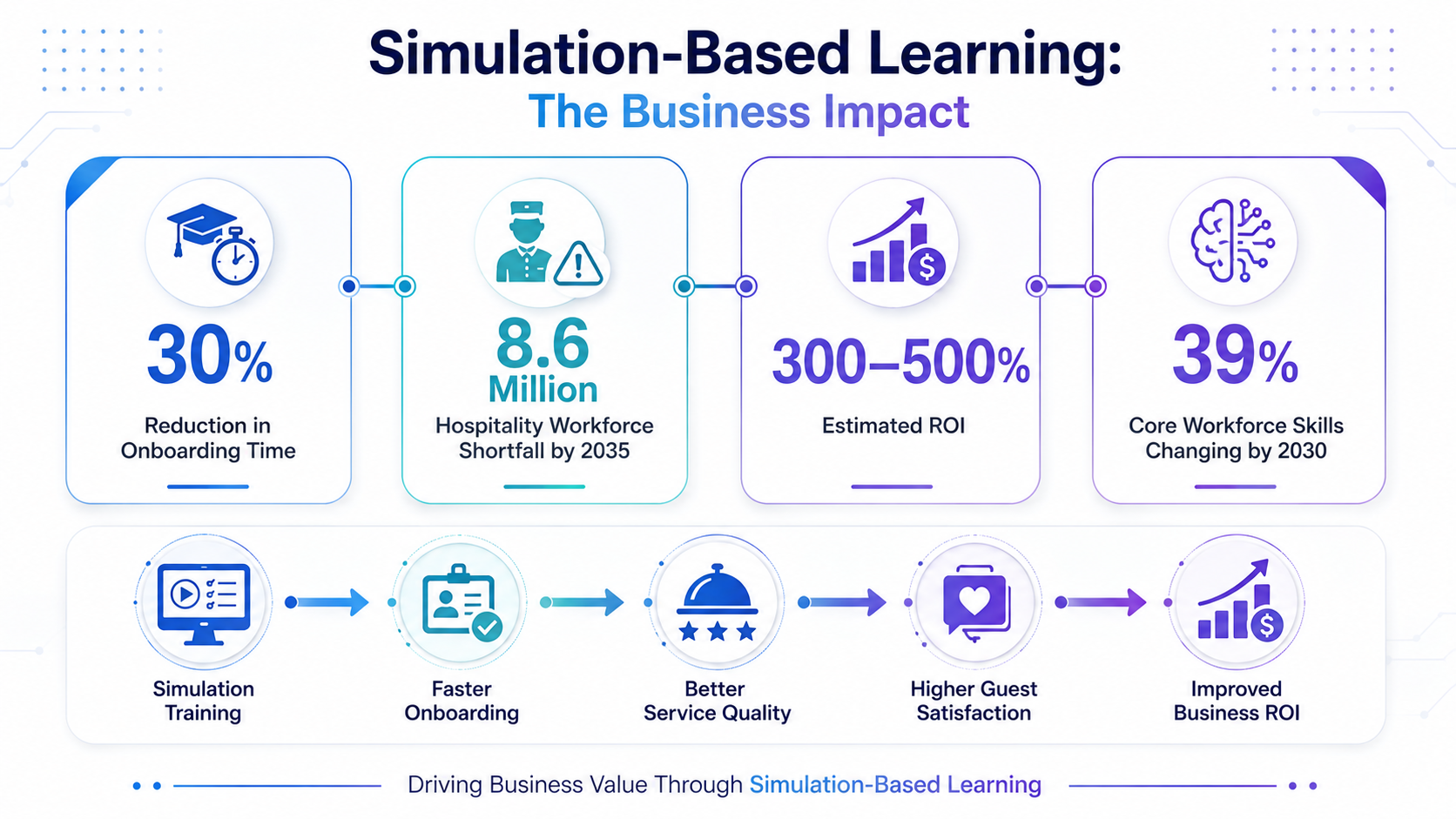
Forward-thinking hotel groups have begun closing that gap through a fundamentally different approach: experiential learning anchored in simulation. The evidence is no longer preliminary. Hilton reported a 30% reduction in onboarding time after deploying gamified simulation modules. Marriott International documented measurable improvements in guest satisfaction ratings through its mobile-based simulation platform. Accor Hotels found that employees who completed role-play simulations demonstrated higher problem-solving proficiency and stronger team engagement than those trained through conventional methods.
This article examines why simulation-based experiential learning works, what the evidence tells us about its strategic value, and how hospitality leaders can architect programs that turn capability development into a sustained competitive advantage through 2035 and beyond.
Why Does This Topic Matter Now?
The hospitality industry is operating in a structurally different talent environment. The World Travel and Tourism Council (WTTC) projects that the global sector will face a shortfall of 43 million workers by 2035, with the hospitality sub-sector alone running 8.6 million positions below required staffing levels -- approximately 18% below need. At the same time, the World Economic Forum's Future of Jobs Report 2025 notes that 39% of core workforce skills will be transformed or obsolete by 2030, with resilience, adaptability, and interpersonal capability rising as the most critical differentiators between growing and declining roles.
In this environment, traditional training models -- built for stable workforces, predictable guest demographics, and slower technology cycles -- are structurally inadequate. What hospitality organizations need is not more training volume. They need training that creates durable behavioral change at speed. That is exactly what well-designed simulation programs deliver.
"The talent gap we face will not naturally reduce. Lifelong learning is becoming a key part of employers' value proposition toward their employees." -- Sommet Education Business Solutions, 2025
The Neuroscience Behind Why Simulations Work
Experiential learning is not a pedagogical preference. It is grounded in how the human brain encodes, retains, and retrieves knowledge under pressure. Research across cognitive and behavioral science identifies several mechanisms through which simulation outperforms passive instruction:
• Active processing: The brain encodes experiential memories significantly more durably than passive reception. Doing requires decision, and decision requires genuine cognitive engagement.
• Emotional encoding: Simulation-induced emotional activation -- the mild stress of handling an angry guest persona -- produces stronger memory formation than abstract discussion, consistent with research on arousal-enhanced memory consolidation (Kahneman, 2011).
• Tight feedback loops: Immediate, specific feedback after each simulation attempt accelerates skill acquisition beyond what delayed or periodic feedback cycles can achieve.
• Repetitive attempt structures: Service recovery proficiency rarely emerges from a single practice event. Simulations allow multiple attempts with iterative adjustment, building genuine automaticity rather than conscious recall.
• Cognitive scaffolding: Simulations create mental frameworks that pattern-match to real situations. When a staff member encounters an actual overbooking crisis, their brain recognizes the structure and routes toward practiced responses.
Peter Senge's concept of mental model evolution is directly relevant here. Deeply ingrained assumptions about what guests want, what good service looks like, and how complaints should be handled drive behavior below conscious awareness. Simulations surface these models by revealing them in action, then create conditions for staff to test and revise them through direct experience and structured reflection.
Strategic Evidence: What the Data Shows
The data emerging from early adopters of simulation-based learning across global hotel groups provides a consistent strategic picture:
Faster Onboarding at Lower Cost
Hilton's gamified simulation modules cut onboarding time by 30% while simultaneously increasing new-hire confidence and reducing early-tenure attrition. For a sector where replacing a single position can cost thousands in lost productivity and recruitment expenses, the compounding financial value of accelerated competence is significant.
Measurable Service Quality Gains
Marriott's Moxie platform demonstrated that interactive task simulations translate directly into improved guest satisfaction ratings -- not because staff know more, but because they have practiced more. The critical distinction is behavioral readiness, not knowledge retention.
Unlock the Full Research
Create a free account or sign in to access the complete methodology, deep-dive analysis, and key implementation frameworks.
Don't have an account? It's free to join.
Organization Learning Labs
Research & Insights Division


Comments