EV Workforce Strategy India 2030: Jobs, Skills & Reskilling

Comprehensive guide to India's EV workforce transformation: 500,000 jobs by 2030, critical skills gaps, reskilling roadmap, training infrastructure, and strategic actions for OEMs, service networks, and policymakers.
India's EV Workforce Imperative: The Scale, the Stakes, and the Strategic Opportunity
India is in the midst of an automotive workforce transformation unlike anything the industry has encountered before. The country is targeting 30% EV penetration in new vehicle sales by 2030 -- a target that, if achieved, would place tens of millions of electric vehicles on Indian roads within the decade. This is not merely a technology transition. It is an employment earthquake with far-reaching consequences for manufacturing, service, supply chain, and software capabilities across the world's third-largest automotive market.
The scale is arresting. India's automotive sector currently employs approximately 28-30 million people across manufacturing, supply chain, service, sales, and support functions. Studies from iFOREST (2025) estimate that approximately 31% of these roles will be materially affected by the EV transition -- with roughly 14% facing potential obsolescence and 17% requiring significant reskilling. Simultaneously, the EV economy is projected to create approximately 500,000 direct new jobs and 1.5-2 million indirect jobs across the value chain by 2030, according to eMobility Academy and government projections.
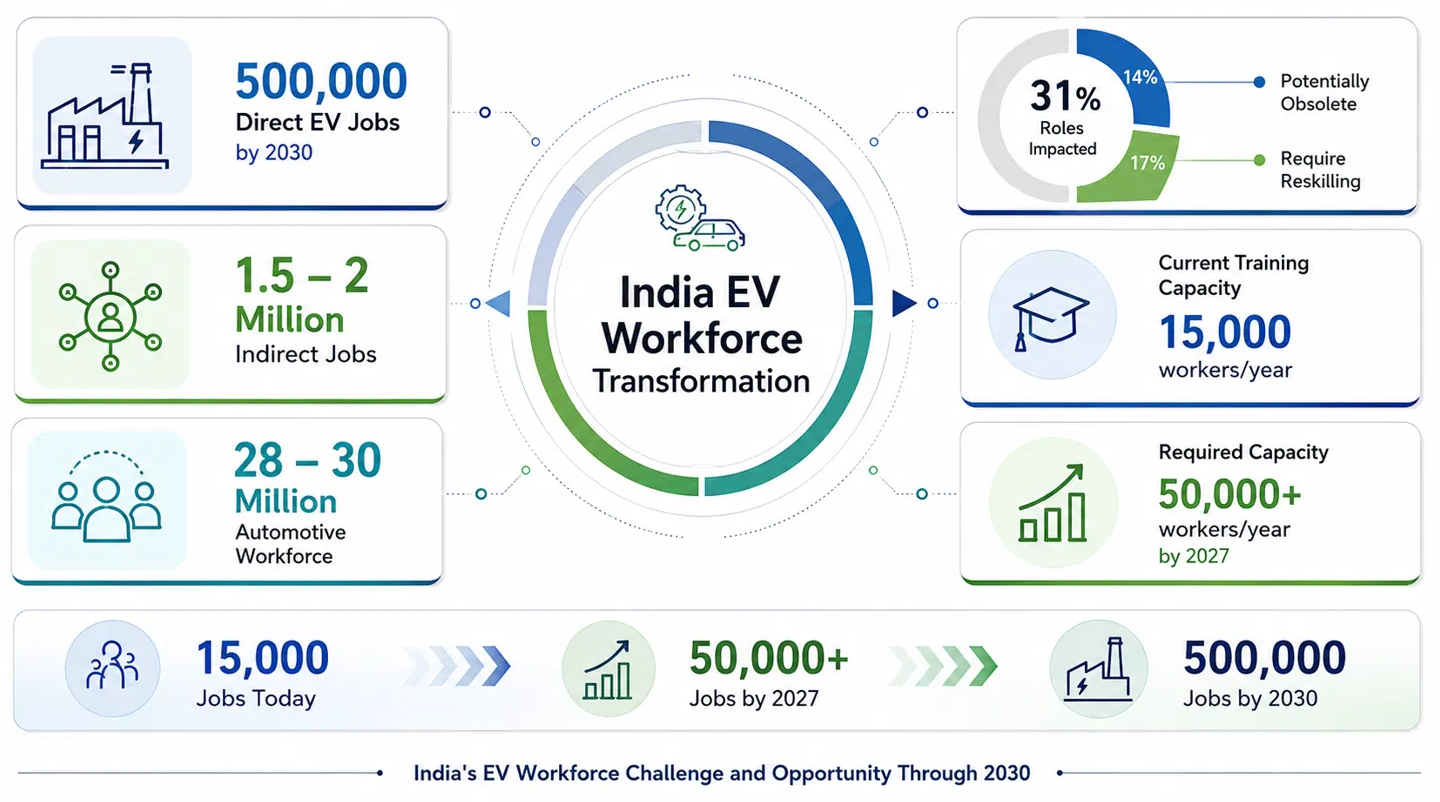
The confluence of disappearing ICE roles and emerging EV roles creates both a crisis and an opportunity. The crisis: current EV training capacity in India is approximately 15,000 workers per year -- against a projected annual need of 30,000-50,000 by 2027. The opportunity: for an organization, a sector, or a government that invests now in closing this gap, India's EV workforce transition could be a competitive leapfrog moment -- building a domestic talent ecosystem that is world-class in EV engineering, battery manufacturing, software development, and service capability.
"India has a unique opportunity not just to manage the EV transition, but to lead it. That opportunity will be won or lost in workforce development, not in technology policy alone." -- TERI / Vasudha Foundation, Skilling the Workforce for EV Transition, 2025 |
How Large Is India's EV Skills Gap -- and Where Is It Most Acute?
The 500,000 projected direct EV jobs by 2030 are not uniformly distributed across the economy. Understanding the segmentation of this demand is prerequisite to designing effective workforce strategy. Five segments define the opportunity landscape:
OEM Vehicle Manufacturing: ~125,000 Jobs by 2030
OEM manufacturing is the most visible EV employment segment, driven by the Production Linked Incentive (PLI) scheme for automotive and advanced chemistry cells, which has accelerated EV assembly investment from Tata Motors, Mahindra, Ola Electric, and newer entrants. Critical emerging roles include battery assembly and testing technicians, quality control specialists with ISO 26262 and safety validation competency, manufacturing technologists (Industry 4.0 skills: robotics, IoT, digital factory systems), supply chain managers capable of managing local and global EV component sourcing, and production engineers with exposure to EV-specific assembly processes.
The gap: most engineering colleges produce graduates with minimal exposure to battery systems, power electronics, or electric drivetrain architecture. OEMs are consequently forced either to hire internationally (expensive and visa-dependent) or to run intensive on-the-job upskilling programmes that delay productive contribution. Geographic concentration in Pune, Chennai, Gurugram, and Bengaluru exacerbates access challenges for engineering graduates from Tier 2 and 3 cities.
Battery Manufacturing and Recycling: ~125,000 Jobs by 2030
India's government has committed Rs. 18,100 crore ($2.4 billion) through the PLI Advanced Chemistry Cell (ACC) scheme to build domestic battery manufacturing capability -- currently dominated by imports from China, Japan, and South Korea. This investment has the potential to create a globally competitive Indian battery manufacturing sector, but it requires a workforce with capabilities that barely exist domestically: cell manufacturing technicians (electrode coating, cell assembly, quality testing), battery pack engineers (integration, BMS design, thermal management), recycling and second-life technicians, and supply chain engineers for raw material sourcing and logistics.
Battery manufacturing is safety-critical, process-intensive, and requires rigorous quality systems. Most current Indian graduates -- even those with electrical or chemical engineering backgrounds -- lack exposure to lithium-ion cell chemistry, battery pack assembly, or the ISO and safety standards governing battery manufacturing environments.
Charging Infrastructure: ~85,000 Jobs by 2030
India is targeting 1-1.3 million public and semi-public charging stations by 2030 -- requiring installation of approximately 150,000 chargers per year from a current base of approximately 5,000 public stations. This represents a massive infrastructure employment programme requiring electricians and civil engineers with EV charging expertise, grid integration specialists (smart charging, load management, renewable energy integration), software engineers for charging network management and payment systems, and operations and maintenance technicians.
The charging infrastructure segment has an important distributional characteristic: unlike battery manufacturing (concentrated in a few industrial clusters), charging infrastructure jobs will be geographically distributed across urban metros, highway corridors, and eventually rural areas. This makes it one of the most accessible segments for workforce inclusion from Tier 2 and 3 cities. The skills required are largely within reach of India's existing electrical trades and IT workforce, with targeted repackaging for EV charging contexts.
After-Sales Service and Maintenance: ~80,000-100,000 Jobs by 2030
The after-sales service segment is potentially the single largest employer in the EV value chain by volume -- and the segment where India's 1.2 million informal mechanics represent both the greatest reskilling challenge and the greatest social opportunity. By 2030, millions of EVs on Indian roads will require diagnostics, repair, software updates, battery servicing, and eventual recycling. This volume of service demand cannot be met by authorized OEM networks alone. Independent service centres must be equipped and qualified.
The reskilling required is real but manageable for appropriately motivated candidates: high-voltage safety protocols (working safely around 400-800V systems); battery management system (BMS) diagnostics; software-based troubleshooting; telematics and remote diagnostics; and compliance with CMVR and SIAM safety standards. The service segment is also the most geographically distributed EV employment opportunity -- every city, town, and eventually rural area needs EV-competent technicians.
Software, Electronics, and AI: ~100,000 Jobs by 2030
India has approximately 5 million software engineers -- but very few with automotive software specialization. Embedded systems development, functional safety engineering (ISO 26262), automotive cybersecurity (ISO 21434), AI/ML for ADAS and predictive maintenance, and cloud architecture for vehicle data and OTA infrastructure are specialist domains that India's IT industry has historically not prioritized. Closing this gap requires significant investment in automotive software academies, university curriculum reform, and targeted industry-academia partnership -- but the payoff could be substantial: a globally competitive Indian automotive software sector offering cost-effective embedded development to OEMs worldwide.
Segment | Jobs by 2030 | Key Capability Gaps | Primary Geography |
OEM Manufacturing | 125,000 | Battery assembly, EV quality, Industry 4.0 | Pune, Chennai, Gurugram, Bengaluru |
Battery Mfg & Recycling Unlock the Full ResearchCreate a free account or sign in to access the complete methodology, deep-dive analysis, and key implementation frameworks. Don't have an account? It's free to join. O Organization Learning LabsResearch & Insights Division On this pageResearch DetailsIndustryAutomotive AuthorOrganization Learning Labs PublishedJul 18, 2026 You Might Also Be Interested In Information Technology Designing the future-ready digital engineering organization Banking, Financial Service And Insurance A Systematic, Empirical Framework for Capability Development in Retail Banking Banking, Financial Service And Insurance Why Capability Beats Strategy in Retail Banking Organizations |
Comments