EV & SDV Workforce Skills: Automotive Reskilling Guide

How automotive OEMs and suppliers can build EV and SDV workforce capability at scale -- from HV safety to embedded software, functional safety, and digital twins.
Why EV and SDV Workforce Transformation Is the Defining Strategic Challenge of the Automotive Decade
Walk into any automotive plant or service bay today and two realities coexist in uneasy tension. On one side: the familiar vocabulary of pistons, crankshafts, and gearboxes -- the inherited language of 130 years of mechanical innovation. On the other: a fast-expanding lexicon of inverters, battery management systems, OTA updates, ISO 26262, AUTOSAR, and automotive cybersecurity. By 2030, the second vocabulary will not be supplementary. It will be the work itself.
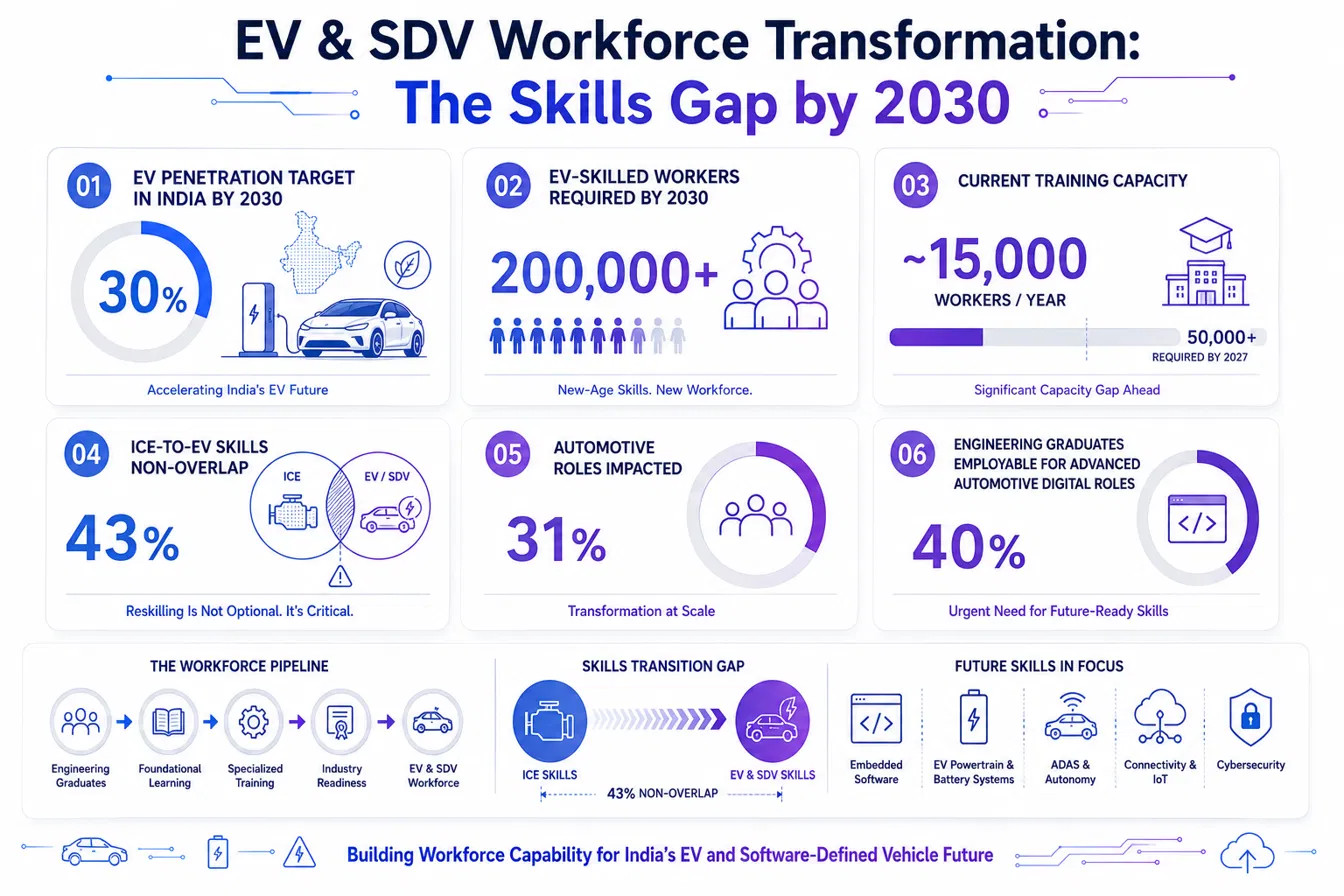
For India, the timeline is compressed. The country is targeting approximately 30% EV penetration in new vehicle sales by 2030, with industry estimates from the Society of Indian Automobile Manufacturers (SIAM) projecting demand for up to 200,000 EV-skilled workers to meet that goal -- against current training capacity of approximately 15,000 workers per year. Studies on India's ICE-to-EV transition indicate that approximately 43% of technical competencies between ICE and EV manufacturing show minimal overlap, meaning that large portions of today's skills portfolio are structurally insufficient for tomorrow's vehicles.
This is not primarily a technology story. It is a human capital story. And for automotive organizations -- OEMs, Tier-1 suppliers, service networks, and their leadership teams -- it is the most consequential workforce challenge they have faced in a generation.
"Workforce development is not a support function in the EV transition. It is a core competitive capability. Organizations that treat it as an HR programme rather than a strategic investment will find their technology ambitions constrained by human capital bottlenecks." -- World Economic Forum, Future of Jobs in the Energy Transition |
What Is Actually Changing? From Mechanical Complexity to Electro-Mechanical-Software Systems
For more than a century, automotive engineering and manufacturing were organized around mechanical complexity. Internal combustion engines with hundreds of moving parts, multi-speed transmissions, intricate fuel delivery systems, and exhaust after-treatment architectures defined the technical challenge. Mastery was rooted in thermodynamics, combustion chemistry, machining tolerance, and kinematics. A skilled engineer or technician could hear, feel, and diagnose the machine.
Electric vehicles and software-defined platforms relocate complexity from the mechanical to the electro-mechanical-software domain. The core technical architectures now governing automotive product are: battery packs and battery management systems (BMS) managing thousands of cells; high-voltage power electronics including inverters, converters, and onboard chargers; embedded software controlling torque delivery, thermal management, and energy recuperation; vehicle communication networks (CAN, LIN, Automotive Ethernet) connecting tens to hundreds of ECUs; over-the-air (OTA) infrastructure continuously modifying vehicle behaviour; and functional safety and SOTIF frameworks ensuring software-driven functions behave predictably under edge conditions.
A 2025 Global Market Insights analysis of automotive industry workforce requirements estimates that the software content of automotive vehicles will increase from approximately 10% of vehicle value in 2020 to 30--40% by 2030. The implications for every segment of the workforce -- engineering, manufacturing, after-sales, and supply chain -- are profound.
Mapping the Three Critical Skill Clusters for the EV and SDV Era
Rather than cataloguing individual job titles, the most strategically useful lens for automotive workforce planning is skill clusters -- coherent domains of capability that will anchor EV and SDV competitiveness across the next decade. Three clusters define the agenda:
Cluster 1: EV Hardware -- High Voltage Meets Hands-On Proficiency
The EV hardware cluster encompasses the physical systems that define the electric vehicle's architecture: battery packs, high-voltage power electronics, inverters, charging systems, and electrified subsystems including braking and steering. For manufacturing and service workforces with ICE backgrounds, this cluster represents the most immediate and accessible transition pathway -- but it requires targeted, safety-centric upskilling.
High-voltage (HV) safety is the non-negotiable foundation. Modern EVs operate at 400 to 800 volts -- voltages at which a single de-energization error can be fatal. Lock-out/tag-out (LOTO) procedures, voltage verification protocols, specialist PPE, and emergency response competency are prerequisites for any HV-adjacent work. Battery handling competency encompasses cell and module architecture, state-of-charge and state-of-health diagnostics, safe storage, second-life assessment, and end-of-life disposal protocols. Power electronics literacy -- covering the fundamentals of DC-AC conversion, thermal management of inverter stages, and fault signature recognition -- extends the hardware skill set into the domain where electrical and mechanical engineering intersect.
Cluster 2: Software and Electronics -- The Brain and Nervous System of SDVs
Software-defined vehicles move the primary site of product differentiation from hardware to code. Features, performance characteristics, safety functions, and increasingly, business models (subscriptions, feature unlocks, data services) are implemented in software. The workforce skill implications of this architectural shift are among the most significant the automotive industry has confronted.
Embedded software development -- encompassing C/C++, model-based development, real-time operating systems, and AUTOSAR (both Classic and Adaptive variants) -- is the core competency requirement. Communication protocols (CAN, LIN, FlexRay, Automotive Ethernet) and network security architecture extend this into vehicle connectivity. Functional safety engineering, structured around ISO 26262 lifecycle requirements and ASIL determination, and SOTIF (ISO/PAS 21448) for ADAS and autonomous function validation, are non-negotiable for organizations involved in safety-critical system development. Automotive cybersecurity -- aligned to UNECE WP.29 regulatory requirements and ISO 21434 -- adds another layer as connected vehicles create expanded attack surfaces.
A 2025 Rajendran analysis in Scientific Reports on competitiveness in India's EV industry notes that only approximately 40% of engineering graduates are currently employable for advanced digital roles in automotive contexts, and fewer still for EV-specific embedded systems work. Without significant curriculum reform and industry-academia collaboration, the software talent pipeline will remain a binding constraint on SDV ambition.
Unlock the Full Research
Create a free account or sign in to access the complete methodology, deep-dive analysis, and key implementation frameworks.
Don't have an account? It's free to join.
Organization Learning Labs
Research & Insights Division


Comments