Energy Workforce 2035: Adaptable Talent for Net Zero

What does the energy workforce look like in 2035? Explore the capability architecture, talent strategies, and organisational models needed to build adaptable teams for a decarbonised, digitised energy value chain.
Building the Energy Workforce That 2035 Demands: Beyond Competencies to Adaptability
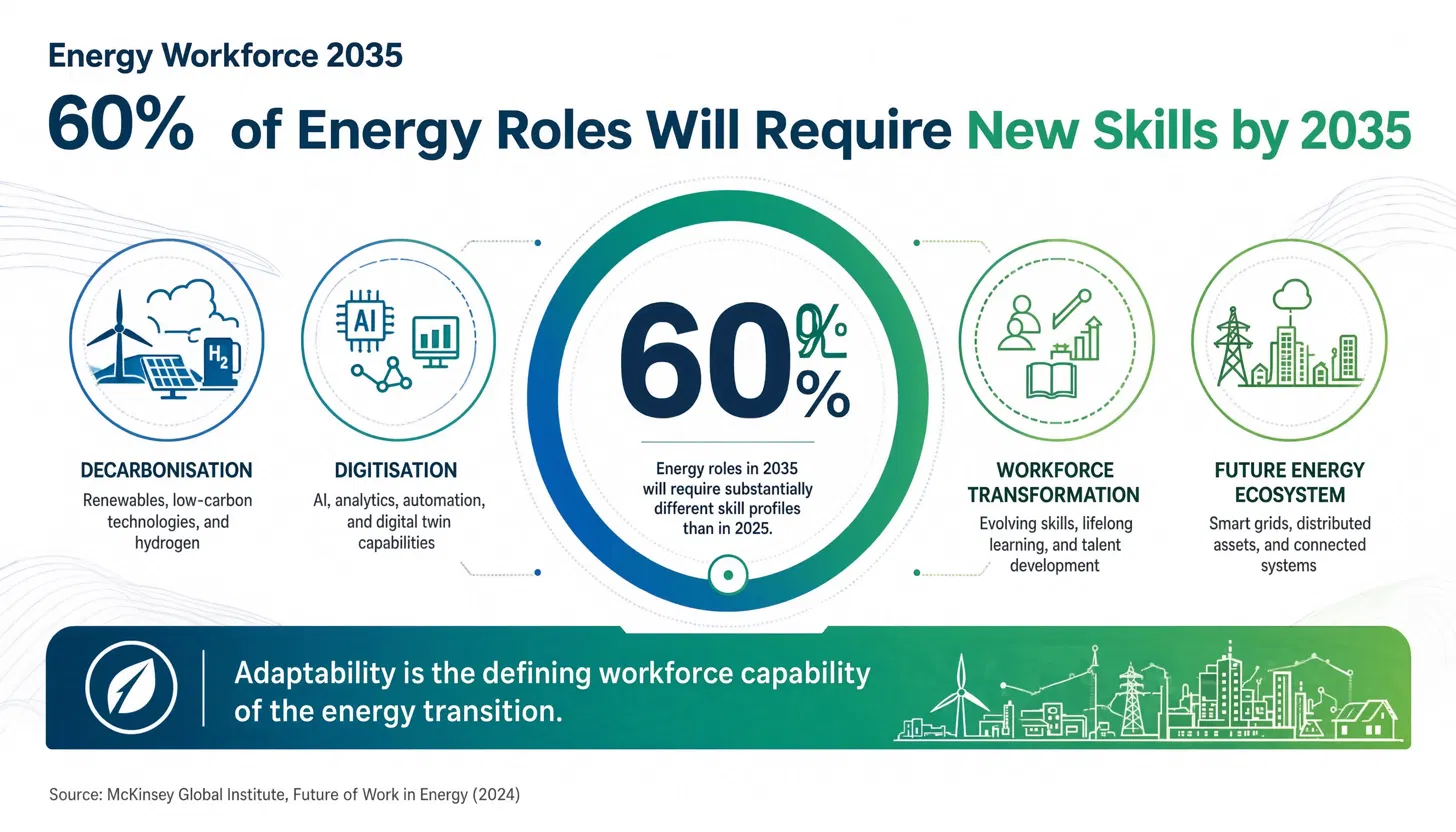
The energy workforce of 2035 will operate in conditions that are qualitatively different from anything the sector has historically experienced. Decarbonisation is restructuring the energy generation mix, retiring fossil fuel assets on compressed timelines, and creating entirely new energy vectors -- hydrogen, sustainable aviation fuels, power-to-X -- that barely existed a decade ago. Digitisation is transforming operations from physical to cyber-physical systems, moving decision-making from human intuition to human-AI collaboration, and creating data infrastructure requirements that demand new professional categories at scale.
Planning for a 2035 energy workforce on the basis of extrapolating current role categories is therefore strategically insufficient. The roles themselves are changing. The technologies they serve are changing. The operating models around them are changing. In this context, the most valuable workforce characteristic is not mastery of any specific current competency -- it is the capacity to acquire new competencies as circumstances require.
Adaptability -- at the individual, team, and organisational level -- is the defining workforce capability for the energy decade ahead. And it is a capability that must be deliberately designed and built, not assumed to emerge from traditional training investments.
How Decarbonisation Is Restructuring the Energy Value Chain -- and What It Means for Workforce
Decarbonisation is not a linear reduction in fossil fuel activity accompanied by equivalent growth in renewables. It is a structural transformation of every segment of the energy value chain simultaneously, creating discontinuous capability requirements at each stage.
Upstream: From Extraction to Multi-Vector Resource Management
Upstream energy operations are diversifying from hydrocarbon extraction to multi-vector resource management. Existing oil and gas production assets are being operated more efficiently while being planned for eventual decommissioning. Simultaneously, the same organisations are developing offshore wind, CCS, and hydrogen production capabilities -- often in the same geographic basins. This creates a bifurcated workforce requirement: specialists who can manage the efficient tail of conventional assets, and hybrid professionals who can develop genuinely new energy vectors.
Midstream: Digital Optimisation of a More Complex System
Midstream infrastructure -- pipelines, storage, shipping, terminals -- is being digitised for optimisation and being prepared for new molecules. Hydrogen transport infrastructure is being developed in parallel with conventional natural gas networks in many markets. LNG terminals are being repurposed or dual-purposed for ammonia. The midstream workforce must develop both digital operations capability and new-molecule technical fluency simultaneously.
Downstream: Electrification and Decentralisation
Downstream is experiencing the most visible transformation: electrification of end-use sectors, distributed energy resources at building and community level, electric vehicle charging infrastructure, and industrial decarbonisation programs that require entirely new technical service capabilities. The downstream energy workforce -- traditionally focused on metering, billing, and distribution maintenance -- is expanding rapidly into energy management advisory, EV infrastructure, and distributed technology services.
How Digitisation Is Transforming Every Role in the Energy Value Chain
In parallel with decarbonisation, digitisation is restructuring the nature of work in every energy function simultaneously. This is not primarily a technology adoption story. It is a cognitive transformation -- changing what human judgment is required for, what data and analytical tools support that judgment, and what human-machine collaboration looks like in each role.
Energy Function | Nature of Cognitive Shift | New Capability Requirements |
Operations and Control | From manual equipment management to system supervision and exception management | Systems thinking, AI literacy, calibrated trust in automated recommendations, real-time decision-making under uncertainty |
Engineering and Technical | From single-discipline design to cross-domain integrated design with digital modelling | Digital twin literacy, cross-discipline systems integration, data-driven design validation, remote and AI-assisted inspection |
HSE and Safety | From compliance-driven inspection to predictive safety analytics and cultural safety leadership | Predictive safety data interpretation, leading indicator analysis, behavioural safety coaching, digital safety systems management |
Commercial and Planning | From historical analysis to real-time optimisation and scenario-based decision support | Advanced scenario modelling, digital market intelligence, algorithmic commercial tools, data-driven investment case development |
Supply Chain and Logistics | From transactional procurement to integrated digital supply network management | Supply chain digital literacy, predictive procurement analytics, sustainability data management, contractor performance analytics |
What Adaptability Actually Means in the Energy Context
Adaptability is often treated as a personality trait -- some people have it, some do not. In workforce strategy, this framing is both inaccurate and counterproductive. Adaptability is a capability that can be developed, and an organisational condition that can be deliberately cultivated.
In the energy context, workforce adaptability has four operational dimensions:
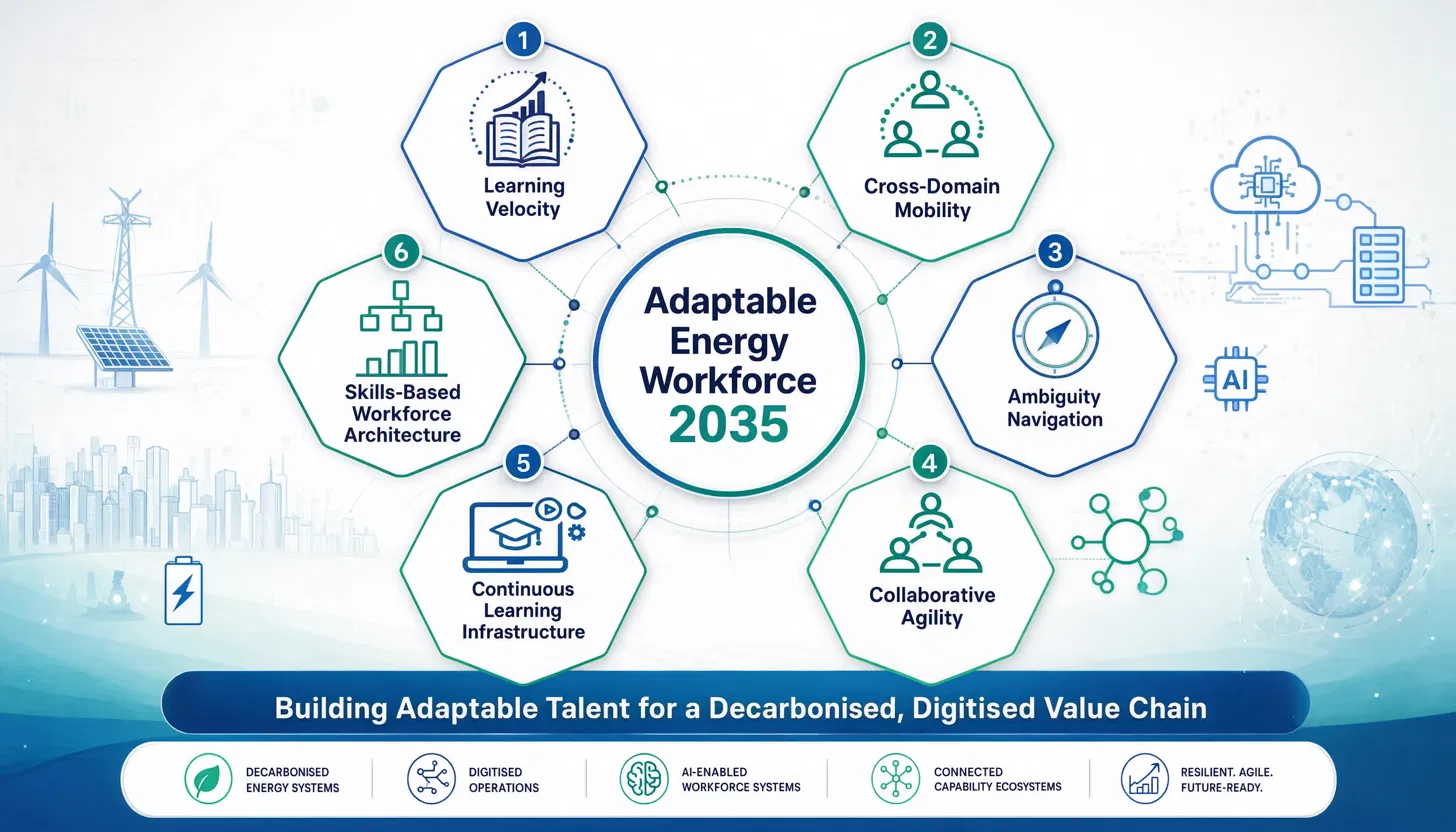
Learning Velocity
The speed at which individuals and teams can acquire new knowledge and skills when roles and contexts change. Learning velocity is determined by both individual cognitive agility and organisational learning infrastructure. High-learning-velocity organisations invest in continuous learning mechanisms -- digital platforms, peer learning communities, structured reflection -- that make learning a daily operational habit rather than a periodic event.
Unlock the Full Research
Create a free account or sign in to access the complete methodology, deep-dive analysis, and key implementation frameworks.
Don't have an account? It's free to join.
Organization Learning Labs
Research & Insights Division


Comments