Energy Leadership in Transition: Mindsets for 2035

What does effective leadership look like in the energy transition? Explore the mindsets, behaviours, and capabilities energy leaders must build for a multi-energy, high-change world.
Why the Energy Transition Is First and Foremost a Leadership Challenge
No global industry is navigating a more complex simultaneous transformation than energy. Leaders in this sector are being asked to decarbonise portfolios worth hundreds of billions of dollars while maintaining reliability for billions of customers. They must digitise operations while managing a rapidly expanding cybersecurity risk surface. They must respond to geopolitical disruption while securing supply chains stretched across multiple continents. And they must transform the workforce -- recruiting green skills, reskilling incumbent talent, and managing redundancy -- while delivering uninterrupted day-to-day performance.
Any one of these challenges would test the capacity of most leadership teams. Confronted simultaneously, they are redefining what effective energy leadership means and exposing the inadequacy of leadership models built for a more stable, more predictable energy world.
According to the World Economic Forum's 2023 Global Risks Report, energy transition is among the top three systemic risks facing the global economy over the next decade -- and it is also among the largest opportunities. The organisations that convert risk into advantage will be distinguished not primarily by their technology choices or capital structures, but by the quality, adaptability, and cultural authority of their leadership.
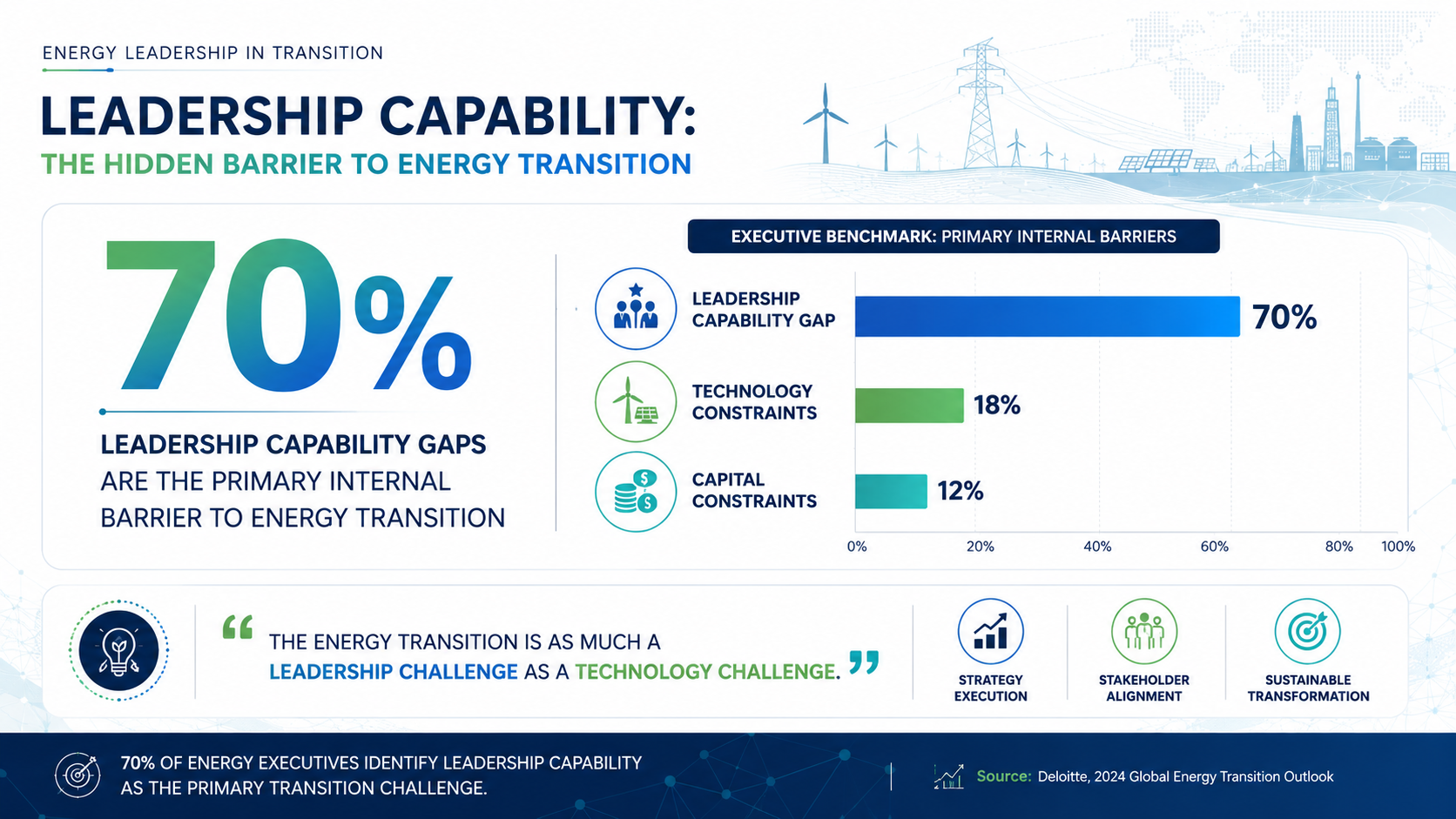
Why Command-and-Control Leadership is Failing the Energy Transition
For most of its modern history, the energy sector has been well served by command-and-control leadership. Centralised assets, predictable demand profiles, regulatory stability, and long investment cycles created conditions in which hierarchical authority, process adherence, and standardised decision-making delivered reliable performance. Leaders directed. People executed. Performance was measured against known benchmarks.
The transition to a multi-energy system disrupts every assumption that made this model viable. Energy systems are becoming more distributed, more digital, and more exposed to external forces that no central authority can predict or control. The transition requires simultaneous decisions across decarbonisation strategy, digital architecture, workforce transformation, regulatory engagement, supply chain security, and community social licence -- decisions that cut across functions, geographies, and time horizons in ways that no single leader or function can hold.
"The transition demands leaders who can navigate without full information, align without full authority, and build confidence in a destination that cannot yet be fully described." -- International Energy Agency, Energy Transitions: Leadership and Governance Challenges, 2022 |
The shift required is from directing action to shaping context. Instead of issuing instructions, effective transition leaders clarify intent, define operational boundaries, and empower diverse teams to act within them. Coaching replaces supervision. Cross-boundary collaboration becomes an operational necessity, not a cultural aspiration. This is not a loss of control. It is a more sophisticated and more demanding form of control -- one that relies on shared understanding and psychological safety rather than hierarchical instruction.
The Six Leadership Capabilities the Transition Demands
Analysis of leadership performance across energy organisations navigating transition -- drawing on WEF, IEA, McKinsey, and Deloitte research -- identifies six capabilities that consistently differentiate effective transition leaders from those who default to pre-transition management patterns.
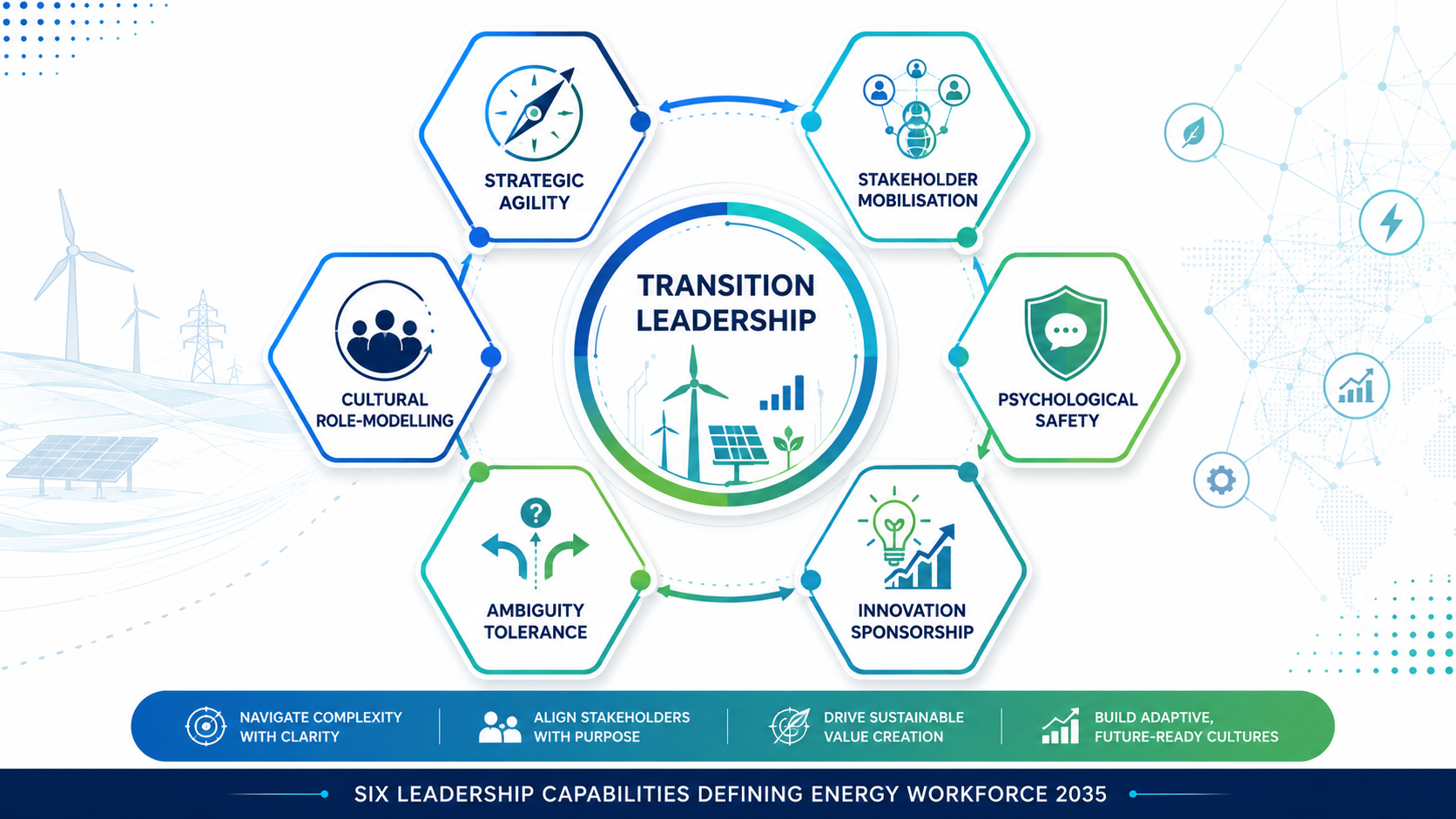
Leadership Capability | What It Means in Practice | Consequence of Deficit |
Strategic Agility | Ability to adjust priorities fluidly as policies, technology costs, and market signals evolve. Willingness to abandon sunk-cost positions when evidence changes. | Rigid strategy execution in a context requiring continuous recalibration. Capital misallocation as assumptions fail. |
Stakeholder Mobilisation | Capability to engage regulators, communities, investors, partners, and employees with genuine listening, not just managed messaging. Building trust across groups with competing interests. | Social licence erosion, project delays, and regulatory conflict that could be avoided through skilled engagement. |
Psychological Safety Culture | Creating conditions in which people surface concerns, challenge assumptions, and report weak signals early. Responding to bad news with curiosity, not punishment. | Suppression of critical operational information. Near-misses becoming incidents. Innovation suppressed by fear of failure. |
Innovation Sponsorship | Actively protecting experimentation space, resourcing uncertain initiatives, and connecting innovation to core operations rather than isolating it in peripheral labs. | Transition remains a strategy document, not an operational reality. Promising pilots die without scaling pathways. |
Ambiguity Tolerance | Comfort operating under fundamental uncertainty about regulatory trajectories, technology outcomes, and competitive dynamics. Making confident decisions without false certainty. | Paralysis or overcorrection in response to uncertainty. Inability to communicate direction credibly to boards and workforces. |
Cultural Role-Modelling | Demonstrating through visible behaviour -- collaboration, learning, responsiveness under pressure -- the culture the organisation needs to build. | Credibility gap between stated cultural ambition and observable leadership behaviour. Change fatigue in the workforce. |
Why Traditional Leadership Development Fails in Transition Contexts
Classroom-based leadership programs built around generic competency frameworks are structurally misaligned with the leadership demands of energy transition. They develop skills in isolation from the real complexity leaders must navigate. They focus on individual capability without building the cross-functional and cross-organisational collaborative capacity that transition demands. And they treat leadership development as an episodic event -- a programme attended -- rather than a continuous organisational capability-building process.
Unlock the Full Research
Create a free account or sign in to access the complete methodology, deep-dive analysis, and key implementation frameworks.
Don't have an account? It's free to join.
Organization Learning Labs
Research & Insights Division


Comments