Distributed Workforce Culture Strategy 2030

How CXOs and CHROs build globally coherent, locally adaptive culture for distributed, multigenerational workforces -- minimum viable culture, culture ambassadors, and co-creation models.
Why One-Size-Fits-All Organizational Culture Has Become Strategically Untenable
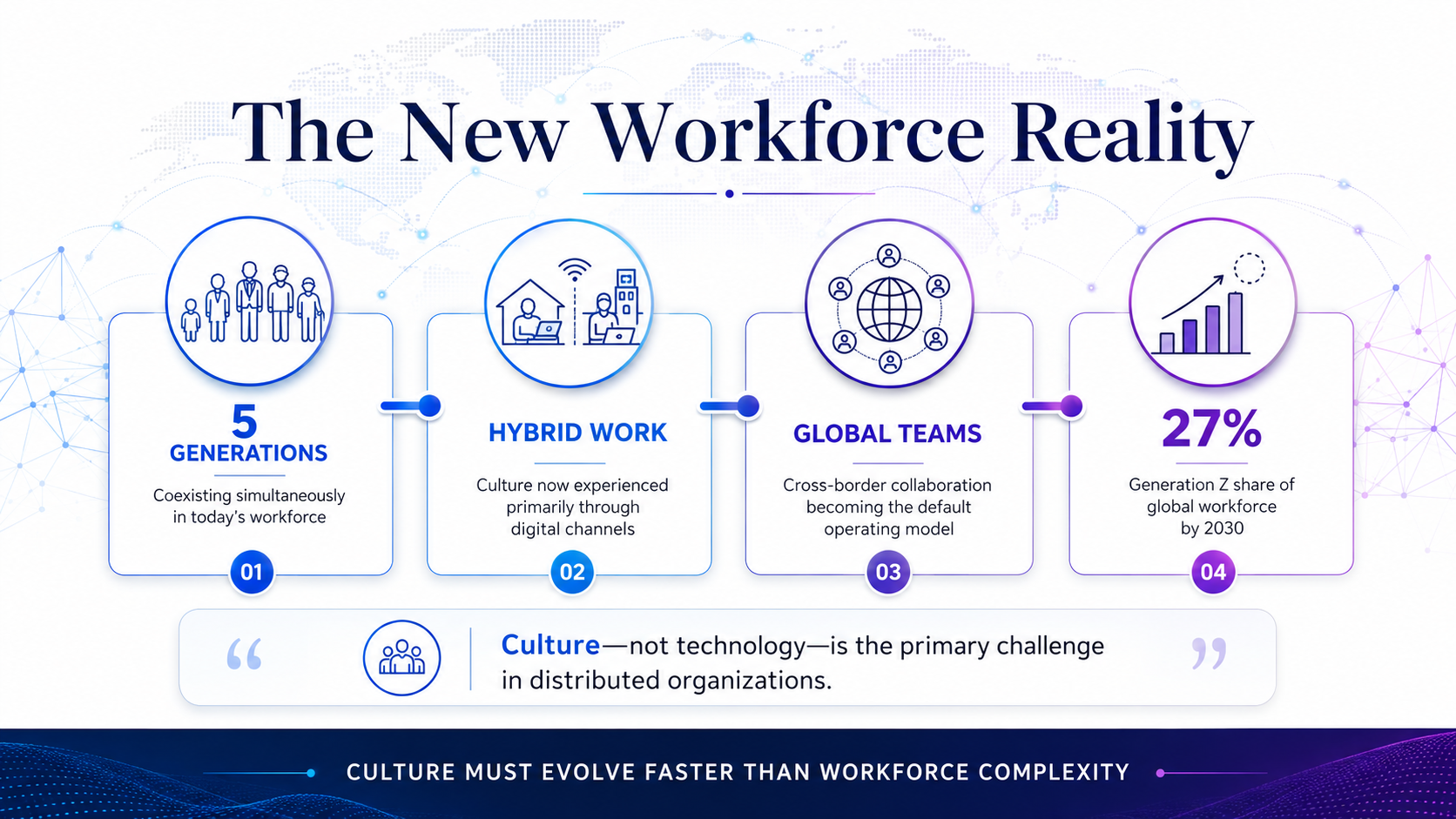
The organizational culture playbook that served companies through the industrial era -- built on the assumption that a unified workforce, sharing physical space, operating within common time zones and generational cohorts, could be shaped by centrally designed and uniformly enforced cultural norms -- is structurally obsolete. Not strategically suboptimal. Structurally obsolete.
The workforce conditions that justified that playbook no longer exist. By 2025, five distinct generational cohorts -- Baby Boomers, Generation X, Millennials, Generation Z, and an emerging Generation Alpha in early-career roles -- coexist in most large organizational workforces, each bringing materially distinct values, communication preferences, definitions of professional accountability, and expectations of organizational relationship. Hybrid work arrangements mean that a growing proportion of employees experience organizational culture primarily through screens, creating inherently asymmetric cultural access between co-located and distributed team members. Global operations and GCC (Global Capability Centre) expansion mean that critical teams separated by time zones, geographies, and institutional cultures are increasingly integrated into single operating models.
Research on distributed team effectiveness consistently identifies culture as the primary challenge -- not technology, not process, not communication tools. A 2025 Deloitte Middle East analysis of cultural change management for multigenerational workforces found that generational diversity, managed without deliberate cultural architecture, generates friction, disengagement, and knowledge transfer failures that materially impair organizational performance. The evidence from hybrid work research is equally consistent: organizations that transplant office-based cultural management into distributed environments without structural adaptation experience measurable declines in team cohesion, cooperation, and knowledge sharing.
5 GenerationsNow coexisting in most large organizational workforces simultaneously -- creating cultural complexity that centralized, uniform culture management models were never designed to address (Deloitte, 2025) |
"The future belongs to organizations that can hold a global cultural core while enabling local, generational, and contextual expression -- not because it is ideologically appealing, but because it is strategically necessary." -- Civility Partners, Culture Maturity Model Research, 2024 |
What Does a 'Minimum Viable Culture' Framework Mean -- and Why Does It Matter for Distributed Organizations?
The concept of minimum viable culture -- borrowed from lean product development methodology -- represents a fundamental reconception of how organizational culture gets designed and maintained in distributed, multi-generational environments. Rather than prescribing how every interaction should unfold, how every team ritual should be structured, and how every value should manifest in every context, minimum viable culture defines the irreducible shared elements that must remain consistent everywhere while enabling contextual adaptation of everything else.
The minimum viable culture framework asks a precise question: what is the non-negotiable core that must be present across all locations, generations, and work arrangements for the organization to maintain coherent identity and directional alignment? Research on emergent organizational models (Adler and Heckscher, USC Sustainability Solutions) suggests this core comprises three elements: transparent decision-making that is observably aligned with stated organizational values; explicit, accessible agreements about how work gets done and who makes which decisions; and genuine confidence among employees at all levels that they are receiving an accurate picture of organizational reality from leadership.
For globally distributed organizations, minimum viable culture shifts the cultural design mandate from 'here is how we do everything' to 'here is what we stand for, here are the strategic trade-offs we consistently prioritize, and here is the decision-making framework -- now adapt its expression to your context.' This is not a reduction in cultural ambition. It is a more sophisticated form of cultural architecture that recognizes contextual adaptation as a strength rather than a governance failure.
What Are the Leadership Capabilities That Distributed, Multi-Generational Culture Requires?
Designing Minimum Viable Culture: Distinguishing Sacred from Adaptable
The first and most demanding leadership capability is the disciplined clarity to distinguish what is sacred -- the non-negotiable cultural core -- from what is adaptable -- the contextually variable expressions of that core. This distinction is harder than it appears. Organizations consistently err in one of two directions: over-centralizing (prescribing detailed cultural practices that generate friction and resistance in diverse local contexts) or under-specifying (declaring values at such high abstraction that they provide no meaningful guidance for actual decisions and behaviours).
Effective minimum viable culture design requires leaders to move through a specific diagnostic sequence: What are the organizational values that, if abandoned or inconsistently applied, would fundamentally compromise strategic identity? What decision-making principles must be universally applied for the organization to function with integrity? And what are the outcomes -- rather than specific practices -- that cultural alignment must reliably produce across all contexts? Everything that does not appear in the answers to these questions is adaptable by definition.
Enabling Local Cultural Expression: Coherence Without Uniformity
The second capability is enabling local teams to translate global cultural principles into locally resonant practices without requiring central approval for every adaptation. Research on managing cultural differences in distributed teams (InfoQ) identifies transparency about the purpose of cultural practices as the mechanism that enables intelligent local adaptation. When team members understand not just what a cultural practice is but why it exists and what outcome it is designed to produce, they can adapt the practice to their context while preserving its functional intent.
A cross-generational team in Singapore might demonstrate a commitment to 'customer obsession' through structured monthly customer immersion programmes. A predominantly Gen Z team in Berlin might express the same value through continuous product feedback loops embedded in sprint cycles. A multigenerational team in Mumbai might operationalize it through intensive weekly customer call reviews. The value is consistent; the practice is locally authored.
Unlock the Full Research
Create a free account or sign in to access the complete methodology, deep-dive analysis, and key implementation frameworks.
Don't have an account? It's free to join.
Organization Learning Labs
Research & Insights Division


Comments