Digital & Agile Capability for Automotive SDV Transformation

How automotive OEMs build the digital and agile organizational capabilities required for SDV success -- from agile academies and DevOps to product management and culture change.
Why Organizational Capability - Not Technology - Is the Real Bottleneck in the SDV Transition
In any major automotive OEM today, two worlds coexist in uncomfortable proximity. Software engineers are designing centralized computing architectures and microservices-based platforms. Program managers are running hardware-driven product cycles that have not fundamentally changed in thirty years. Procurement is still thinking in terms of physical components. Finance is struggling to model software development costs that double every few years. And throughout the organization, everyone is talking about software-defined vehicles -- but very few are certain what that means for how work actually gets done.
This is not a problem that can be resolved with better architecture diagrams or new development tools. It is an organizational capability problem. And the evidence is accumulating that it is the primary constraint on SDV programme success.
In a 2024 survey of more than 1,200 automotive executives conducted by S&P Global Mobility, 74% reported that a strong mechanical-driven culture is making it difficult to transition to software-driven product development. That single data point reframes the entire SDV challenge. Organizations are not struggling primarily because the technology is too difficult. They are struggling because the organizational model -- the culture, the processes, the career architectures, the decision-making structures -- was built for a fundamentally different era of vehicle development.
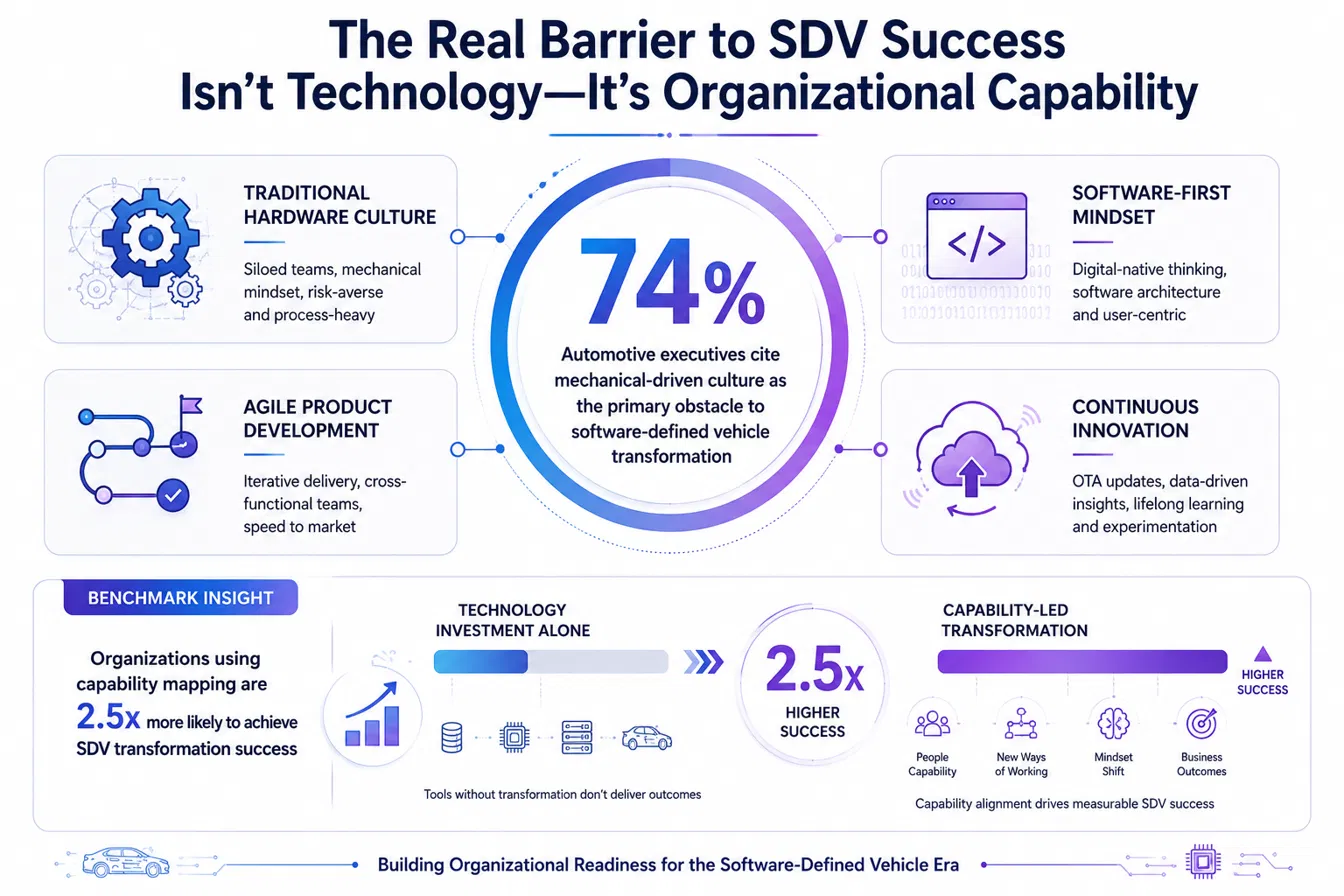
"OEMs that base digital transformation on comprehensive capability mapping are 2.5 times more likely to succeed than those that rely on technology investments alone." -- McKinsey & Company, Automotive Digital Transformation Research |
What Has Actually Changed? The Architectural Shift from Hardware Product to Software Platform
For more than a century, automotive product development followed a hardware-first operating logic. Features were tied to physical components. Innovation meant new parts, new assemblies, new manufacturing processes. Product cycles ran five to seven years -- a timeline dictated by the capital intensity of retooling plants and re-qualifying suppliers. Software existed in ECUs (electronic control units) that were physically distributed throughout the vehicle, tightly coupled to specific hardware, and updated only through physical dealer visits.
Software-defined vehicles invert this logic. The vehicle becomes a platform: a centralized computing architecture capable of running modular software, receiving OTA updates, and evolving continuously after the point of sale. Features are no longer locked to hardware specifications at manufacturing. They are deployed through software releases. Business models -- subscriptions, feature unlocks, data services, predictive maintenance packages -- are embedded in the product architecture. Tesla's demonstration that a vehicle in customer hands can receive a software update overnight that materially improves its performance has established a new expectation that every automotive OEM now faces.
This architectural shift looks straightforward on a technology roadmap. Operationally, it is a complete upheaval of how automotive organizations design, develop, validate, launch, and support products -- and how they structure themselves to do all of these things simultaneously and continuously.
What Are the Critical Organizational Capability Gaps Slowing SDV Transitions?
Multiple research programmes and industry analyses now map the capability gaps most commonly constraining SDV programme progress. The picture is consistent across OEMs and geographies:
Architecture and Systems Thinking
The majority of automotive OEMs currently operate at SDV maturity Level 2 -- domain-based architectures with limited OTA capability. Advancing to Level 3-4 (centralized computing, zonal architectures, full OTA with continuous deployment) requires architectural expertise in modularity, microservices design, hardware-software decoupling, and platform governance that simply did not exist in traditional automotive engineering organizations. Roland Berger's 2025 SDV Architecture and Organizational Alignment analysis identifies architectural capability as the single largest technical constraint in OEM SDV programmes.
Agile and Product Thinking
Traditional automotive development follows Waterfall methodology: long planning phases with defined requirements, followed by sequential execution phases, followed by integration and validation. SDVs demand agile methodology: rapid iteration, continuous customer feedback incorporation, experimentation, and the discipline to ship quickly and improve continuously. Product management in an SDV context is qualitatively different from traditional automotive programme management: you are not managing a feature set that ships once every seven years. You are managing a living roadmap of continuous updates, user engagement analytics, subscription economics, and software monetization. Most automotive organizations have very limited product management capability for this model.
DevOps and Continuous Integration Infrastructure
In technology-native organizations, CI/CD (continuous integration and continuous deployment) pipelines are foundational infrastructure. In automotive, they are rare -- and the challenge of building them is substantially more complex than in consumer software, because automotive safety, compliance, and validation requirements add multiple layers of verification that standard DevOps practices do not accommodate. Continental Engineering Services and Mobex's 2024 analysis of agile transformation in automotive identifies the absence of automotive-grade CI/CD infrastructure as a primary cause of software delivery delays in OEM SDV programmes.
Data Engineering and Analytics
Software-defined vehicles generate massive streams of data: sensor logs, user behaviour signals, performance metrics, diagnostic events, fault signatures, and over-the-air interaction records. Transforming this data into actionable product intelligence -- for continuous improvement, predictive maintenance service models, cybersecurity monitoring, and OTA update optimization -- requires data engineering and analytics capability that most automotive OEMs are still in the early stages of building.
Cybersecurity Governance
OTA updates, cloud connectivity, and software-defined functions create an attack surface that traditional vehicles never presented. Cybersecurity governance -- threat modelling, secure coding practices, secure OTA pipeline management, vulnerability disclosure processes, and incident response -- is now mission-critical for any OEM deploying connected software platforms. UNECE WP.29 cybersecurity regulations now impose legal obligations for cybersecurity management across the vehicle lifecycle in major markets.
Unlock the Full Research
Create a free account or sign in to access the complete methodology, deep-dive analysis, and key implementation frameworks.
Don't have an account? It's free to join.
Organization Learning Labs
Research & Insights Division


Comments