Digital Acumen in Oil & Gas: Build Future-Ready Teams

Unlock $320B in oil and gas digital value. Learn how to build digital acumen, AI literacy, and human-machine collaboration skills across your energy enterprise.
How to Build the Digital Acumen Your Energy Enterprise Needs to Capture $320 Billion
Control rooms across the oil and gas industry tell a story in two halves. On one side: paper logs, radio calls, clipboard rounds, and decisions made from experience and intuition. On the other: real-time dashboards, AI-driven recommendations, sensor networks generating petabytes of data per day, and predictive models flagging failures weeks before they occur.
The technology architecture for the second half now exists at scale. The human architecture does not. And that gap is precisely where $320 billion in projected digitalization value is either captured or lost.
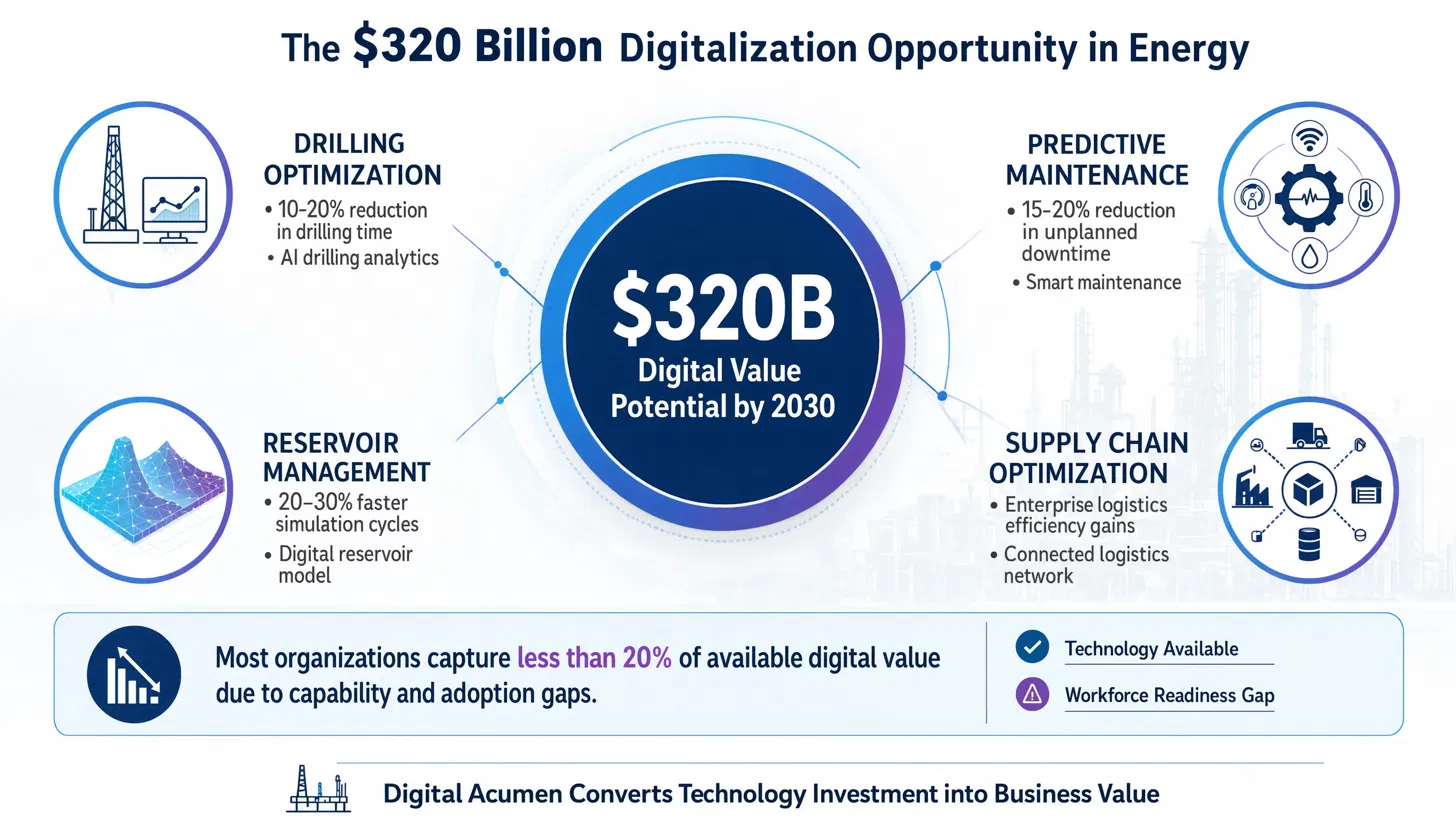
According to Rystad Energy's 2025 analysis, comprehensive digitalization across upstream operations, midstream logistics, and refining could unlock savings of $320 billion within this decade. But as McKinsey's sustained research into digital and analytics adoption in oil and gas makes clear, the primary barrier is not the tools -- it is the organizational capability to use them.
Where the Real Digital Value Lives
Understanding where digital value concentrates is the prerequisite for building the capabilities that unlock it. Four domains account for the majority of the financial opportunity:
Drilling Optimization
AI systems that ingest seismic data, drilling logs, and real-time operating parameters can recommend optimal weight-on-bit configurations, predict kicks before they escalate into well control events, and suggest trajectory adjustments that improve recoverable reserves. Industry operators report 10-20% reductions in drilling time and material reductions in non-productive time when AI-augmented drilling workflows are adopted effectively. In deepwater and complex formation environments, this translates to hundreds of millions in project-level value per well campaign.
Predictive Maintenance
Combining SCADA data streams with IoT sensor arrays, predictive maintenance platforms identify equipment at imminent risk of failure and optimize planned shutdown windows. Real-world implementations across upstream and refining consistently report 15-20% reductions in unplanned downtime and maintenance cost. The safety cobenefits -- reduced human exposure to unplanned equipment failures -- add a dimension of value that does not appear in EBITDA calculations but matters enormously to organizational risk profiles.
Reservoir Management
Machine learning is accelerating reservoir simulation cycles, improving production decline forecasts, and identifying underperforming patterns in well portfolios. Operators integrating AI into subsurface workflows report 20-30% faster simulation turnaround and more accurate production forecasts -- capabilities that directly improve capital allocation decisions and recovery factor outcomes.
Logistics and Supply Chain Optimization
AI applications optimizing marine scheduling, road transport, pipeline utilization, and spare-parts inventory management demonstrate that even single-digit efficiency improvements cascade into significant EBITDA gains at enterprise scale. Fuel consumption reduction, supply disruption anticipation, and inventory right-sizing collectively represent a substantial share of the digitalization prize.
The Uncomfortable Reality: Why Most Digital Value Remains Uncaptured
McKinsey's research into digital and analytics adoption in oil and gas reaches a consistent and uncomfortable conclusion: while the tools create substantial value in pilot environments, organizations struggle to scale because of adoption, capability, and change-management constraints -- not technology limitations.
The failure pattern is recognizable. Digital programs are launched with executive sponsorship. Dashboards are built. Pilot projects demonstrate value. Then the program stalls. The dashboard is not used in daily operations. The AI recommendation is overridden without documentation. The data scientist's analysis sits in a presentation that never reaches the field supervisor. Organizational value evaporates not because the algorithms fail, but because the people who need to act on them cannot or do not.
"Most oil and gas companies that have invested significantly in digital tools are capturing less than 20 percent of the potential value, because they have underinvested in the human capabilities required to use those tools." -- McKinsey & Company, Digital and Advanced Analytics in Oil and Gas, 2024 |
This reality demands a reframing of the digital transformation investment thesis. Technology spend is necessary but insufficient. The missing investment is in digital acumen -- the human capability to use digital tools effectively, critically, and in service of operational and commercial outcomes.
Defining Digital Acumen: The Four-Dimension Framework
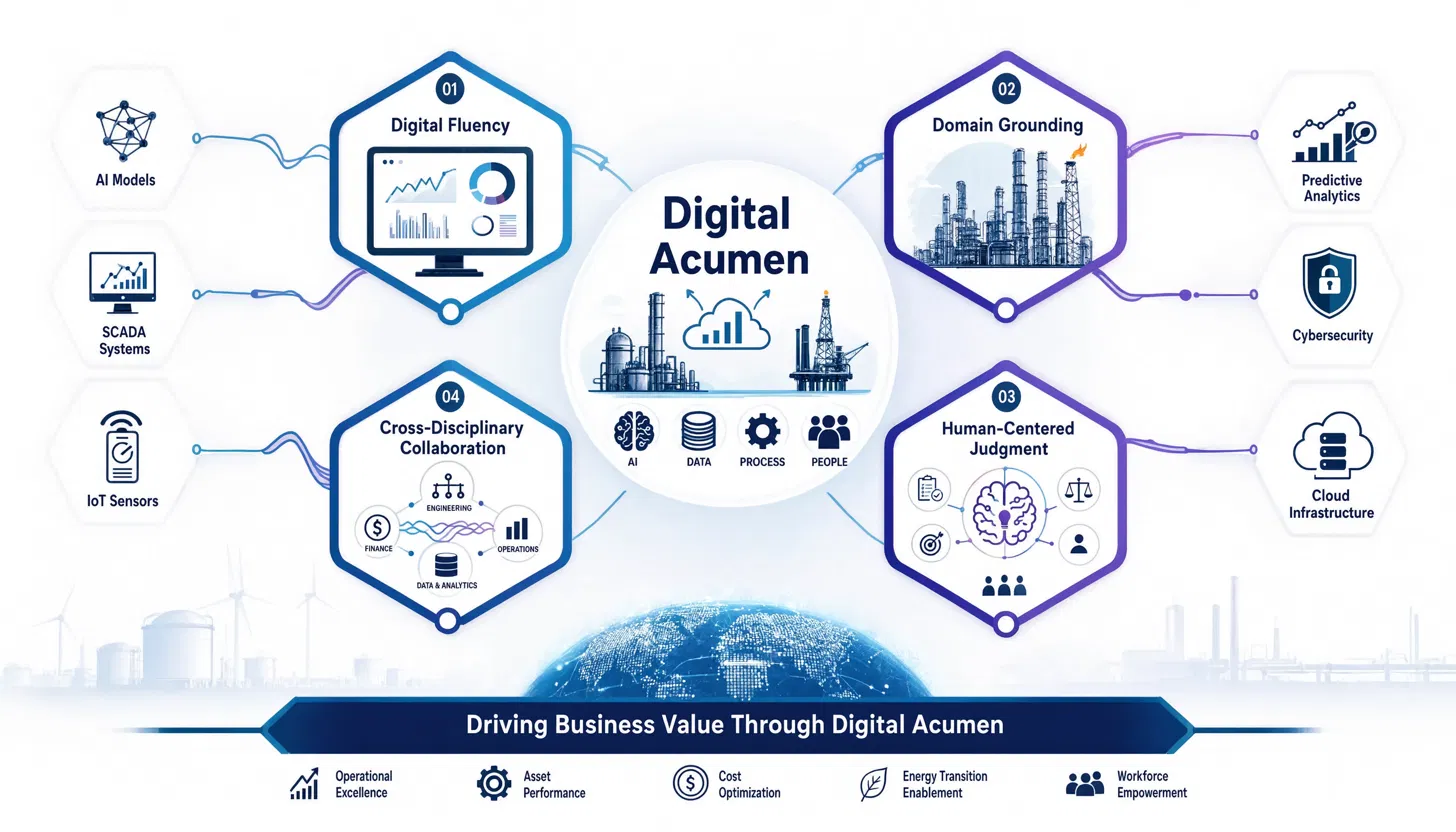
Digital acumen in energy is not a synonym for data science skills, coding competency, or technology literacy alone. It is a multidimensional human capability that combines:
Dimension | What It Means in Energy Operations |
Digital Fluency | Comfort with data, statistical reasoning, visualization, and foundational concepts including models, APIs, cloud infrastructure, and cybersecurity. This is the foundation layer -- not expertise, but confident literacy. |
Domain Grounding | Deep understanding of the operational context: reservoir behavior, well integrity, process unit dynamics, logistics constraints, and HSE frameworks. Data without domain knowledge produces incorrect or dangerous conclusions. |
Human-Centred Judgment | The capacity to ask: Does this recommendation make operational sense? What does my experience say that the model cannot know? What are the failure modes if I act on a flawed model output? |
Cross-Disciplinary Collaboration | The ability to work effectively in mixed-discipline squads where data scientists, drilling engineers, HSE professionals, and commercial analysts must share a common language and co-own outcomes. |
Digital acumen is the operating system that allows people to use digital tools as designed -- as decision-support infrastructure -- rather than treating them as either infallible oracles or irrelevant overhead.
A Layered Upskilling Strategy: From Field to Boardroom
Layer 1: Digital Fluency for the Entire Workforce
Unlock the Full Research
Create a free account or sign in to access the complete methodology, deep-dive analysis, and key implementation frameworks.
Don't have an account? It's free to join.
Organization Learning Labs
Research & Insights Division


Comments