Designing Hospitality Capability Academies

How leading hotel groups are replacing ad-hoc training with structured capability academies -- and building service excellence, retention, and leadership pipelines at scale.
Designing Hospitality Capability Academies: A Blueprint for Guest-Ready Teams
The shift from ad-hoc hospitality training to structured capability academies is one of the most consequential organizational design decisions available to hotel leaders today. It is not a training upgrade. It is an architectural change in how organizations develop people, build service standards, and grow leaders from within.
Large hotel groups -- including IHCL, the Oberoi Group, Dalata Hotel Group, and Dorchester Collection -- have already made this shift. What they discovered is that the academy model does not just improve training outcomes. It changes what an organization is capable of becoming.
This article examines the strategic case for capability academies, the design principles that separate effective academies from expensive training programs, and the capability imperatives that will determine which hospitality organizations lead and which lag through 2035 and beyond.
The Strategic Case: Why Ad-Hoc Training Is a Structural Liability
Ad-hoc hospitality training has a predictable architecture. A new hire joins. They shadow a colleague for several days, absorb departmental habits as they happen to exist in that moment, and learn a checklist. Some of what they learn is excellent. Some reflects the particular strengths and blind spots of whoever trained them. The organizational result is inconsistency at scale: service quality that varies by property, by shift, and by who happened to be on duty when a particular staff member was onboarded.
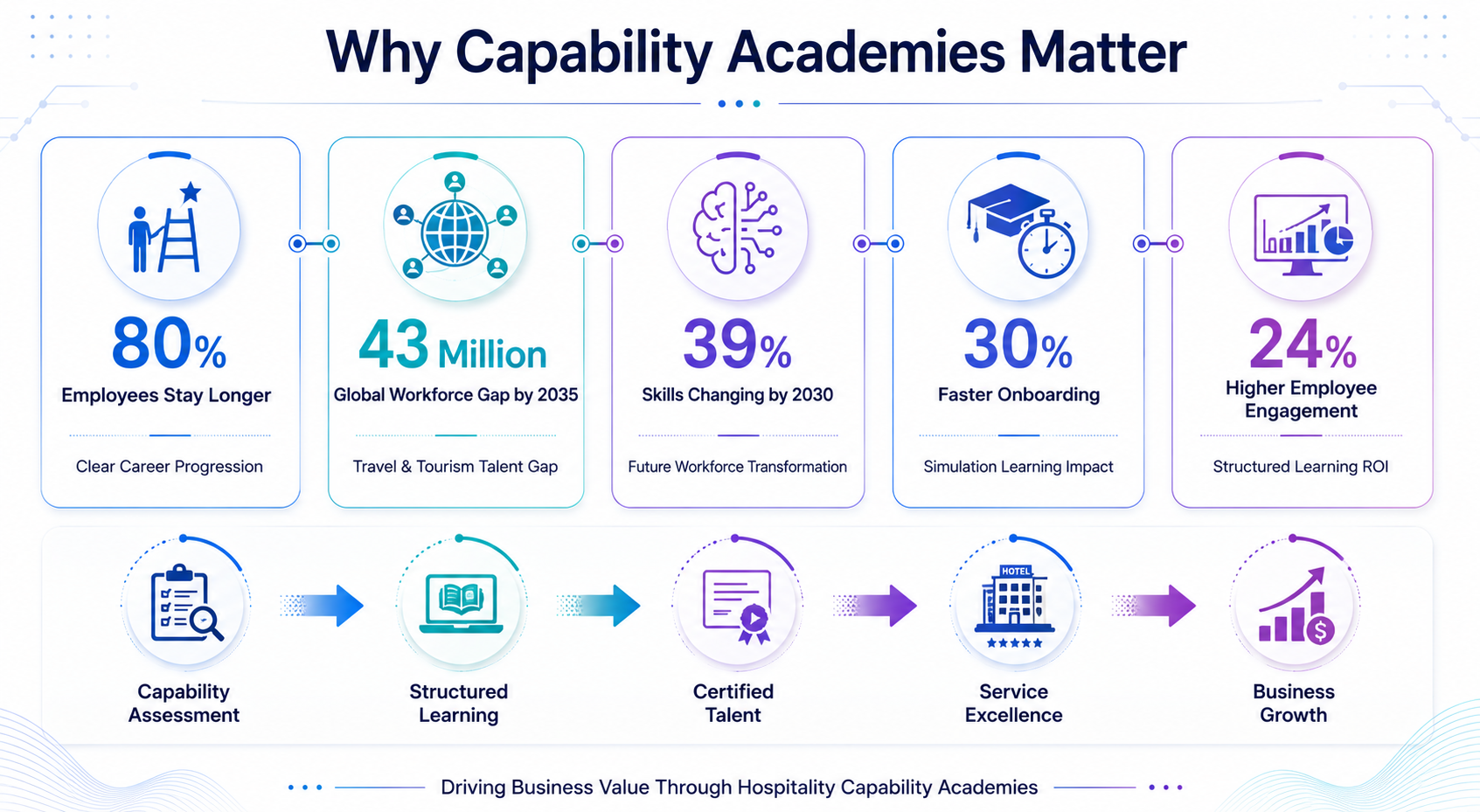
This inconsistency is not just a service quality problem. It is a brand problem, a retention problem, and a leadership pipeline problem simultaneously. The World Travel and Tourism Council projects a 43-million-worker global shortfall in travel and tourism by 2035. In an environment of structural talent scarcity, organizations that invest in systematic capability development will build self-reinforcing advantages. Those relying on ad-hoc approaches will compound their capability deficits year on year.
The WEF Future of Jobs Report 2025 identifies 39% of core workforce skills will be transformed or obsolete by 2030 across all sectors, with hospitality explicitly identified as a growth sector where interpersonal, operational, and digital capability will command increasing premium. Capability academies are how leading organizations are building for that future rather than managing within the present.
"Academies institutionalize standards so that core skills, service behaviors, and decision frameworks are consistent everywhere -- not as policy, but as genuine capability." -- OLL Hospitality Research, 2025
What a Capability Academy Actually Is
A capability academy is not a training department with a new name. The distinction matters and is frequently misunderstood. A training department delivers programs in response to immediate skill gaps. A capability academy is a systematic, assessed, and progression-linked infrastructure for developing people from entry level through leadership -- aligned to business outcomes and measurable against performance results.
The core architectural difference is that capability academies begin with assessment rather than training. Before any learning intervention is designed or deployed, effective academies establish a clear picture of where capability actually sits relative to where the organization needs it to be. This assessment-first architecture produces targeted learning journeys rather than generic programs, and it creates the baseline against which development can be measured.
Core Design Elements of an Effective Hospitality Academy
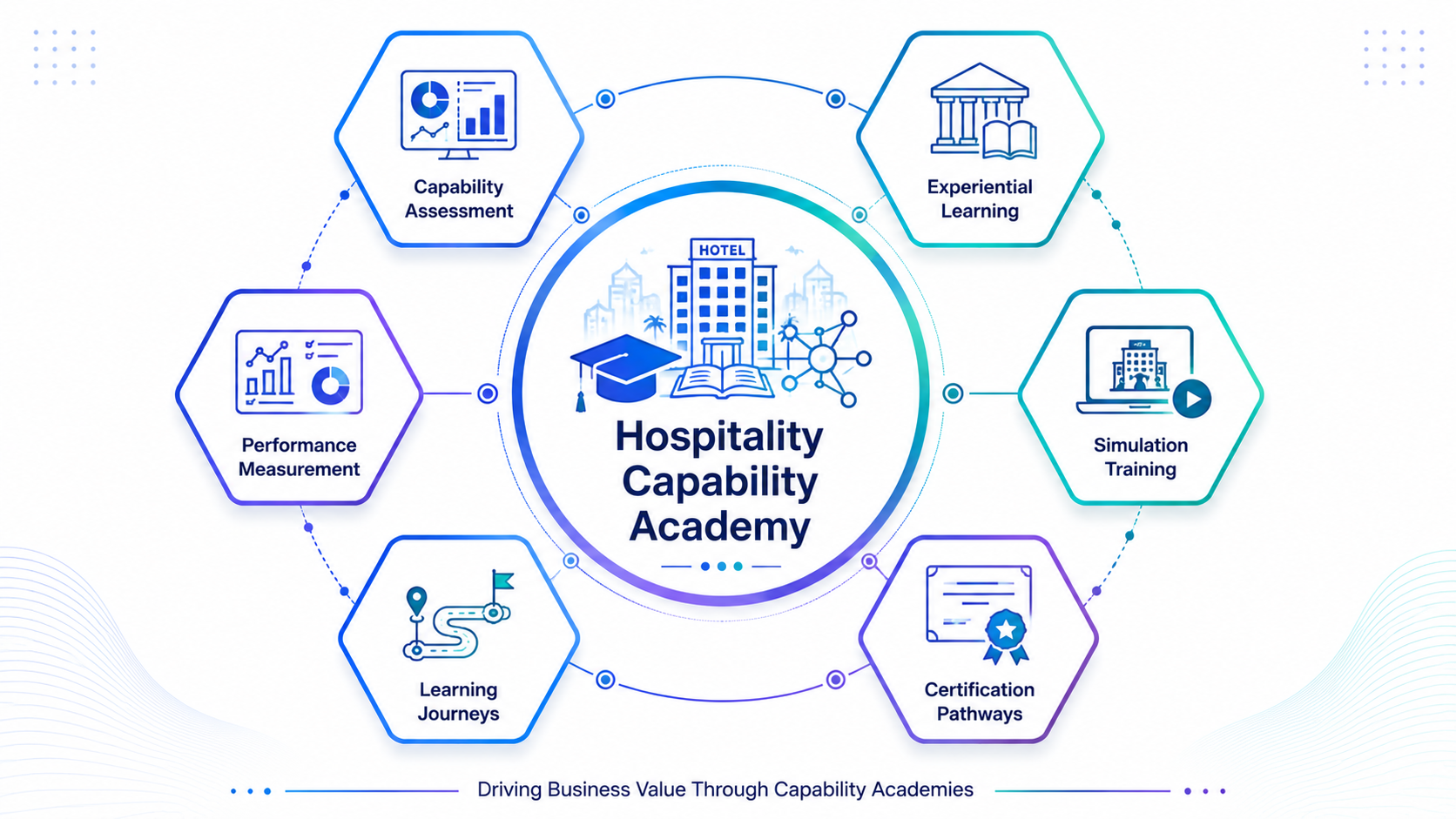
Element 1: Assessment Centres That Establish Real Baselines
The assessment architecture of an effective hospitality academy evaluates capability across three dimensions simultaneously:
• Cognitive capabilities: problem-solving agility, systems thinking, learning speed, and the capacity to interpret operational data and guest signals rather than simply respond to them.
• Technical and role-specific capability: proficiency with property management systems, knowledge of service standards, operational workflow competency, and regulatory compliance.
• Behavioral and interpersonal capability: emotional intelligence, cultural fluency, guest orientation, team collaboration, and the coaching behaviors that distinguish supervisors from operators.
The output of this assessment architecture is not a training recommendation. It is a capability profile for each individual that reveals where development investment will produce the highest return -- and where capability is already strong enough that investment would be misallocated. This profile-driven targeting is what separates academy investment from training spend.
Element 2: Experiential Learning Programs That Build Genuine Capability
Hospitality skills are embodied skills. They are developed through doing, not hearing. Effective academies rely heavily on experiential methods:
• Digital immersion labs using actual PMS and guest management systems, not demonstrations or screenshots.
• Service excellence simulations covering complaint management, accessibility needs, service recovery, and culturally complex guest interactions.
• Cross-department immersions that build operational systems understanding -- so a front desk agent understands what happens when they promise something to a guest that housekeeping cannot deliver, and why.
• Sustainability operations deep dives connecting environmental practice to cost management and guest experience quality in ways that make the connection visceral rather than theoretical.
Element 3: Simulations for High-Stakes Scenarios
Some situations are too consequential to learn through trial and error on live guests. Capability academies use simulation for crisis management, system failures, overbooking scenarios, and complex multi-party guest situations. Staff build cognitive frameworks and muscle memory before encountering these situations in actual operations.
Unlock the Full Research
Create a free account or sign in to access the complete methodology, deep-dive analysis, and key implementation frameworks.
Don't have an account? It's free to join.
Organization Learning Labs
Research & Insights Division


Comments