Cross-Training F&B Teams for Resilience

Discover how cross-training multi-skill F&B teams reduces turnover, cuts costs, and builds operational resilience for 2035 and beyond.
Building Multi-Skill, Multi-Role Teams in Food & Beverage: Cross-Training as a Strategic Resilience Imperative
Executive Summary
The Food & Beverage industry is confronting a structural staffing crisis that goes far beyond seasonal shortages. With annual turnover rates averaging 75 percent and replacement costs exceeding USD 5,800 per employee, single-skill staffing models are no longer financially or operationally tenable. This article argues that cross-training -- equipping frontline and supervisory staff to perform competently across multiple roles -- is not an incremental HR initiative. It is a fundamental redesign of how F&B organizations build, deploy, and protect their human capital. Drawing on evidence from McKinsey, Deloitte, the National Restaurant Association, and Cornell's School of Hotel Administration, we present a strategic framework for building multi-role teams capable of absorbing disruption, accelerating service, and creating genuine career pathways in a sector defined by volatility.
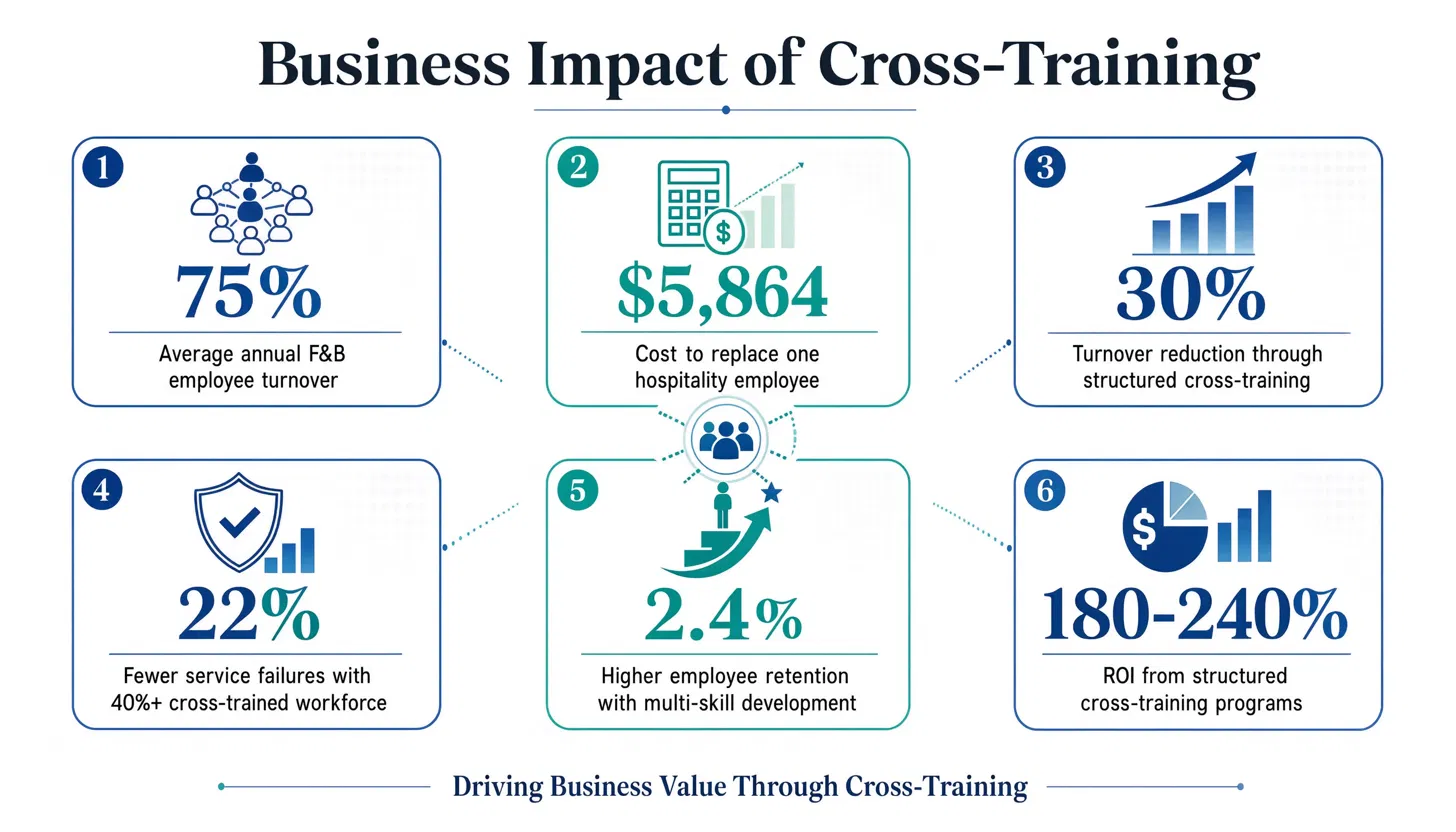
75% Average annual F&B employee turnover (NRA 2025) | $5,864 Cost to replace a single hourly hospitality worker | 70% Operators reporting hard-to-fill vacancies (NRA 2025) | 30% Turnover reduction with structured cross-training programs |
Why This Matters Now: The Structural Fragility of Single-Skill Staffing
The traditional staffing architecture of the F&B sector -- servers serve, bartenders pour, cooks cook -- was built for stability. It works elegantly when demand is predictable and labor is abundant. Neither condition reliably holds today.
The National Restaurant Association's 2025 State of the Industry Report documents that 70 percent of U.S. restaurant operators have job openings they cannot fill, while 45 percent acknowledge they lack sufficient staff to meet existing customer demand. McKinsey's global hospitality workforce study projects that structural labor shortages in food service will persist through at least 2030, driven by demographic shifts, competition from adjacent sectors (gig economy, logistics, retail), and the declining appeal of hospitality careers among Gen Z workers.
What single-skill staffing creates is not merely an inconvenience during a sick-day absence. It creates a systemic brittleness -- a vulnerability embedded in the operating model itself. When one cook does not show up, the kitchen does not slow down marginally. It may fail to open a station. When a bartender is absent on a Friday night, revenue at the bar collapses, not partially. The operational dependency is total, and the cost is immediate.
Cornell University's Center for Hospitality Research calculates that the hidden costs of understaffing -- overtime premiums, service degradation, customer churn from poor experience, and accelerated burnout among remaining staff -- can equal two to three times the visible cost of a replacement hire. The staffing crisis is a capability architecture crisis. Cross-training is how organizations redesign that architecture.
"The restaurants and hospitality businesses that will thrive through the next decade are those that treat their workforce not as a cost to be minimized but as a capability platform to be developed. Cross-skilling is not a nice-to-have -- it is structural defense."
-- Dr. Bill Carroll, Cornell SC Johnson College of Business, Hospitality Research
The Strategic Business Case: Four Evidence-Based Returns on Cross-Training Investment
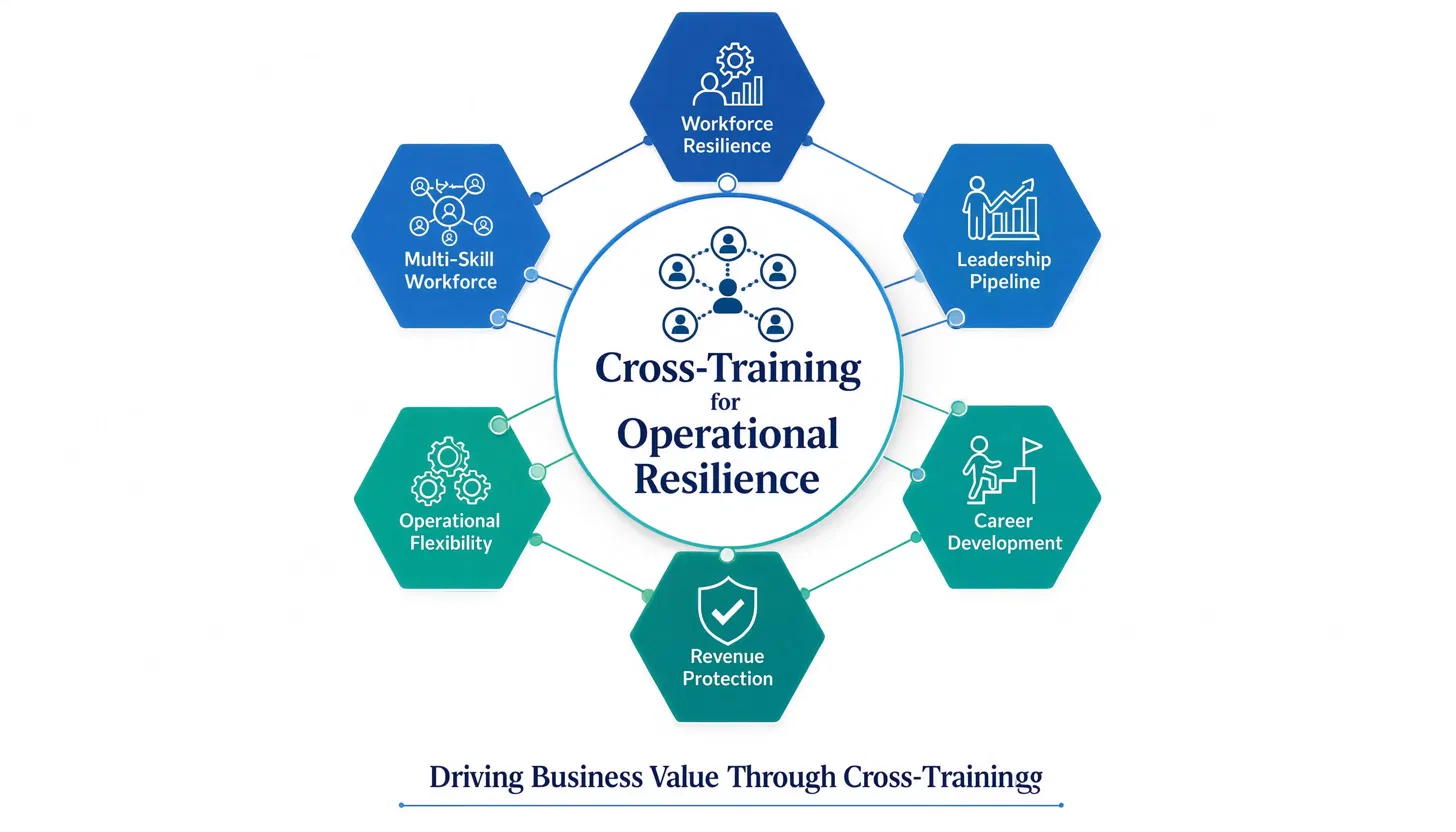
1. Operational Flexibility and Revenue Protection
Deloitte's 2024 Hospitality Industry Outlook identifies operational agility as the primary differentiator between high-performing and average-performing F&B operators. Specifically, operators who cross-train at least 40 percent of their frontline workforce report 22 percent fewer service failures during peak periods and 18 percent higher revenue capture during demand spikes compared to single-skill counterparts.
The mechanism is straightforward but powerful. When a bartender position opens mid-service, a cross-trained server steps in without a customer-facing disruption. When the expo station is unmanned during a rush, a line cook who has been trained in expediting steps across without breaking service flow. The kitchen and dining room are no longer separate, brittle silos. They are a responsive system.
Moe's Original BBQ documented a 30 percent reduction in staff turnover after implementing structured cross-training, but the revenue impact was equally significant: the ability to maintain full service capacity during unexpected absences translated directly into protected revenue nights that would previously have been written off as operational losses.
2. Labor Cost Efficiency and Schedule Optimization
PwC's 2024 Workforce Analytics in Hospitality report demonstrates that multi-skilled workforce models allow F&B operators to reduce total headcount by 12 to 18 percent while maintaining equivalent service output. The mechanism is demand-responsive redeployment: rather than maintaining fixed staffing levels for each specialized function, cross-trained teams can shift labor to where it is needed in real time.
The scheduling implications are significant. When staff can work across roles, operators gain flexibility to offer consistent hours to a smaller workforce, address one of the most commonly cited drivers of hospitality attrition. Erratic scheduling and unpredictable income are identified in a 2024 Hospitality Technology survey as the second and third most frequent reasons for voluntary departures, behind only inadequate career development opportunity.
Unlock the Full Research
Create a free account or sign in to access the complete methodology, deep-dive analysis, and key implementation frameworks.
Don't have an account? It's free to join.
Organization Learning Labs
Research & Insights Division


Comments