Cross-Border Trade Compliance Capability Guide

A leadership guide to building cross-border logistics and trade compliance capability that turns tariff volatility into a manageable, governed process.
From Paperwork to Predictability: Building Cross-Border Logistics and Trade Compliance Capability
Why Trade Compliance Has Moved From Back Office to Boardroom
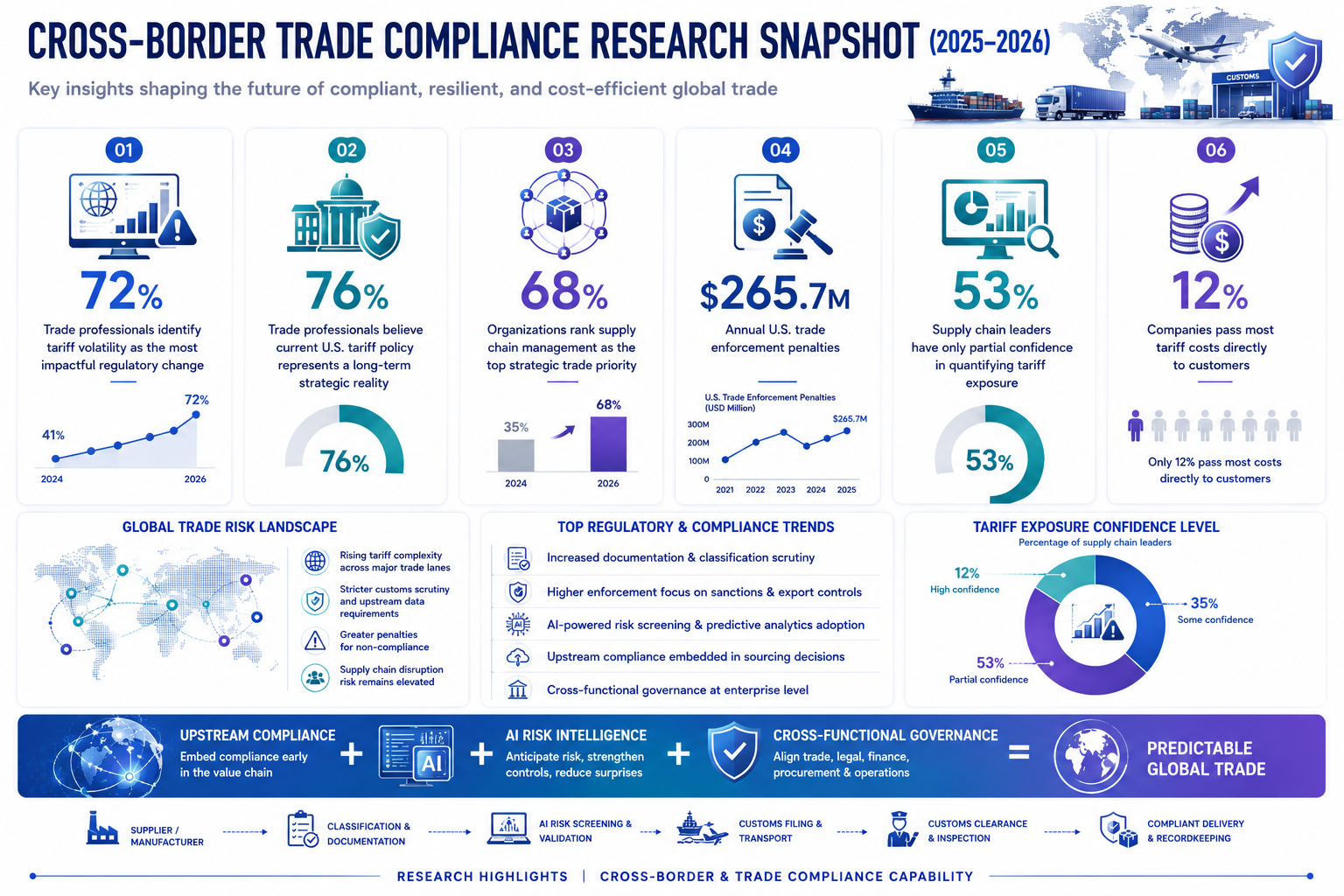
Trade compliance spent decades as a documentation function measured on error avoidance. That era is over. Seventy-two percent of trade professionals now identify US tariff volatility as the most impactful regulatory change affecting their organization, a dramatic increase from just 41 percent the year before, and supply chain management has emerged as the dominant strategic priority for trade teams, cited by 68 percent of professionals, nearly double the 35 percent who named it a top concern only a year earlier. Perhaps most tellingly, 76 percent of trade professionals now believe recent US tariff policy represents a permanent approach to trade that will persist for at least the next four years, rather than a short-term negotiating tool. Organizations still treating compliance as a downstream, transactional task are managing yesterday’s risk profile against today’s environment.
72% of trade professionals identify tariff volatility as the most impactful regulatory change, up from 41% the prior year. Thomson Reuters, "The 2026 Supply Chain Challenge: Global Trade Disruption," 2026 |
Capability Building Blocks for Predictable Cross-Border Movement
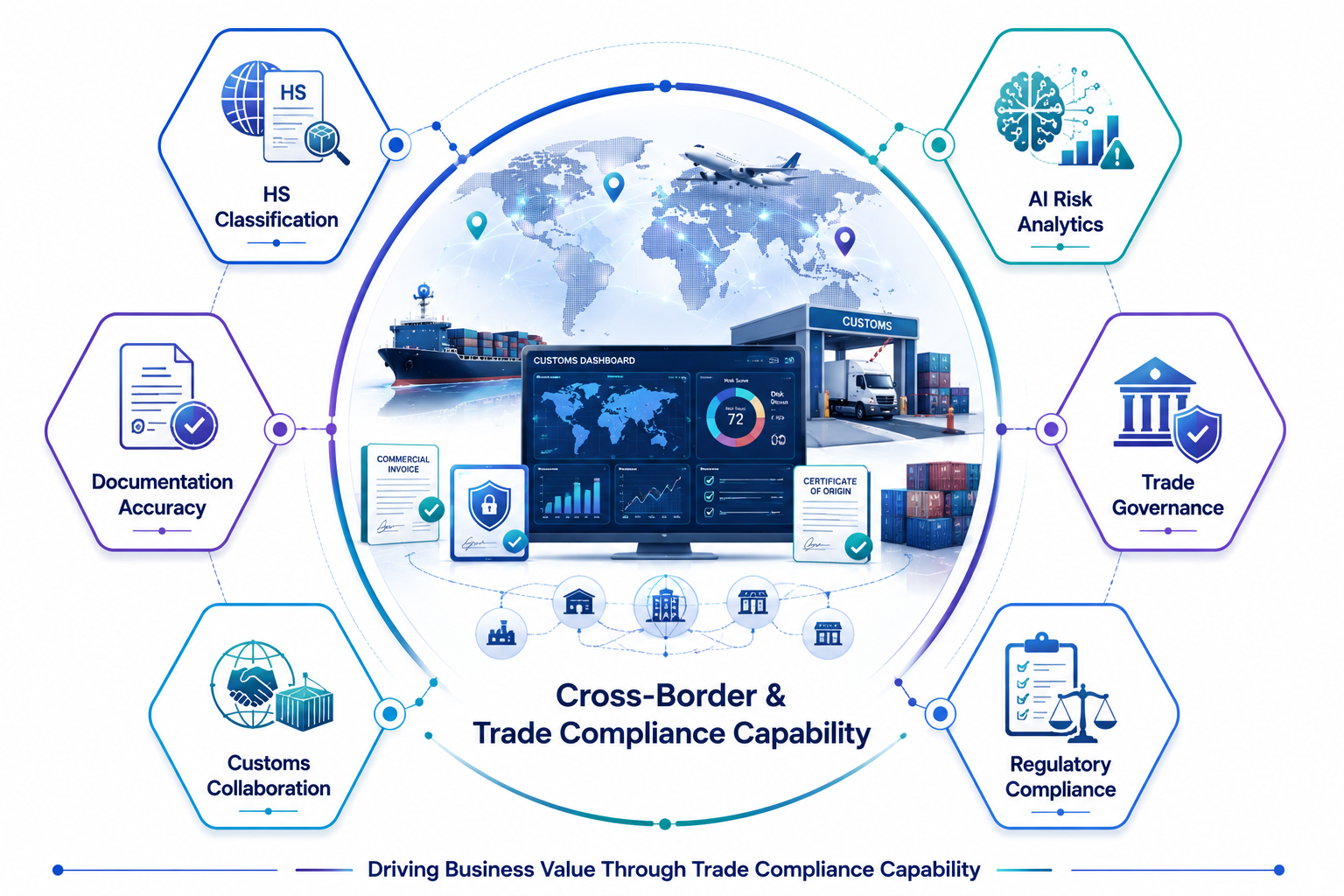
HS Classification, Duty and Tax Basics, Documentation Accuracy
Accurate classification is the foundation every other trade capability sits on, and it is becoming harder to get right at the exact moment it matters most. Companies report increased documentation requirements, deeper scrutiny of tariff classification and country-of-origin claims, and more frequent inspections, while customs authorities increasingly analyze pre-validated shipment data weeks before goods arrive, meaning compliance now has to start at the point of product design and supplier onboarding rather than at the point of shipment. The upcoming HS 2027 Harmonized System update adds a further layer of urgency: classification, origin, valuation, and even emissions data are becoming interconnected, so a gap in one area increasingly creates scrutiny risk in the others.
Sanctions, Export Controls, and Special Trade Regimes
Sanctions and export control enforcement remained historically elevated through the most recent reporting cycle, with US penalties totaling approximately 265.7 million dollars in a single year, including one enforcement action exceeding 215 million dollars on its own. Export control enforcement has continued to concentrate on advanced computing, semiconductor ecosystems, and military end-use concerns, meaning organizations trading in technology-adjacent categories face materially higher scrutiny than the broader import population. Special trade regimes, including foreign trade zones and bonded warehousing, remain underused levers for managing landed cost, but only where the organization has the classification and documentation discipline to use them defensibly under audit.
Working With Brokers and Customs
The relationship between an organization and its customs brokers has shifted from transactional filing to strategic partnership. As customs authorities move toward earlier, more upstream risk assessment, brokers who are looped into sourcing and product design decisions can flag classification and origin risk before a purchase order is even issued, rather than discovering it at the border. Organizations still treating brokers as a pass-through filing service, engaged only once goods are ready to ship, are structurally unable to capture this upstream advantage regardless of how skilled the broker itself may be.
Implementable Practices That Build Predictability
Predictability in cross-border movement is built through standardized, repeatable practices rather than case-by-case expert judgment applied inconsistently across shipments:
- Standard classification and documentation checklists tailored to each distinct shipment profile, rather than a single generic checklist applied regardless of product category or destination.
- "Right-first-time" documentation routines enforced at origin, since correcting an entry after filing is materially more expensive and more likely to trigger scrutiny than getting it right before submission.
- Exception logs tracking every border delay, with regular root-cause reviews that feed corrections back into sourcing and product-design decisions, not just into the compliance function.
- Auditable decision logs that document how a classification or valuation choice was made and on what data, since regulators are increasingly asking not just what decision was made but how it was made.
Talent and Learning: Building a Trade Compliance Career Path
Unlock the Full Research
Create a free account or sign in to access the complete methodology, deep-dive analysis, and key implementation frameworks.
Don't have an account? It's free to join.
Organization Learning Labs
Research & Insights Division


Comments