Control Tower and Data-Driven Decision Capability

A leadership guide to moving beyond dashboards toward real-time, data-driven decision capability across transportation and logistics networks.
From Spreadsheets to Control Towers: Building Practical Data-Driven Decision Capability in Transportation and Logistics
Why Visibility Without Decision Capability Is a Wasted Investment
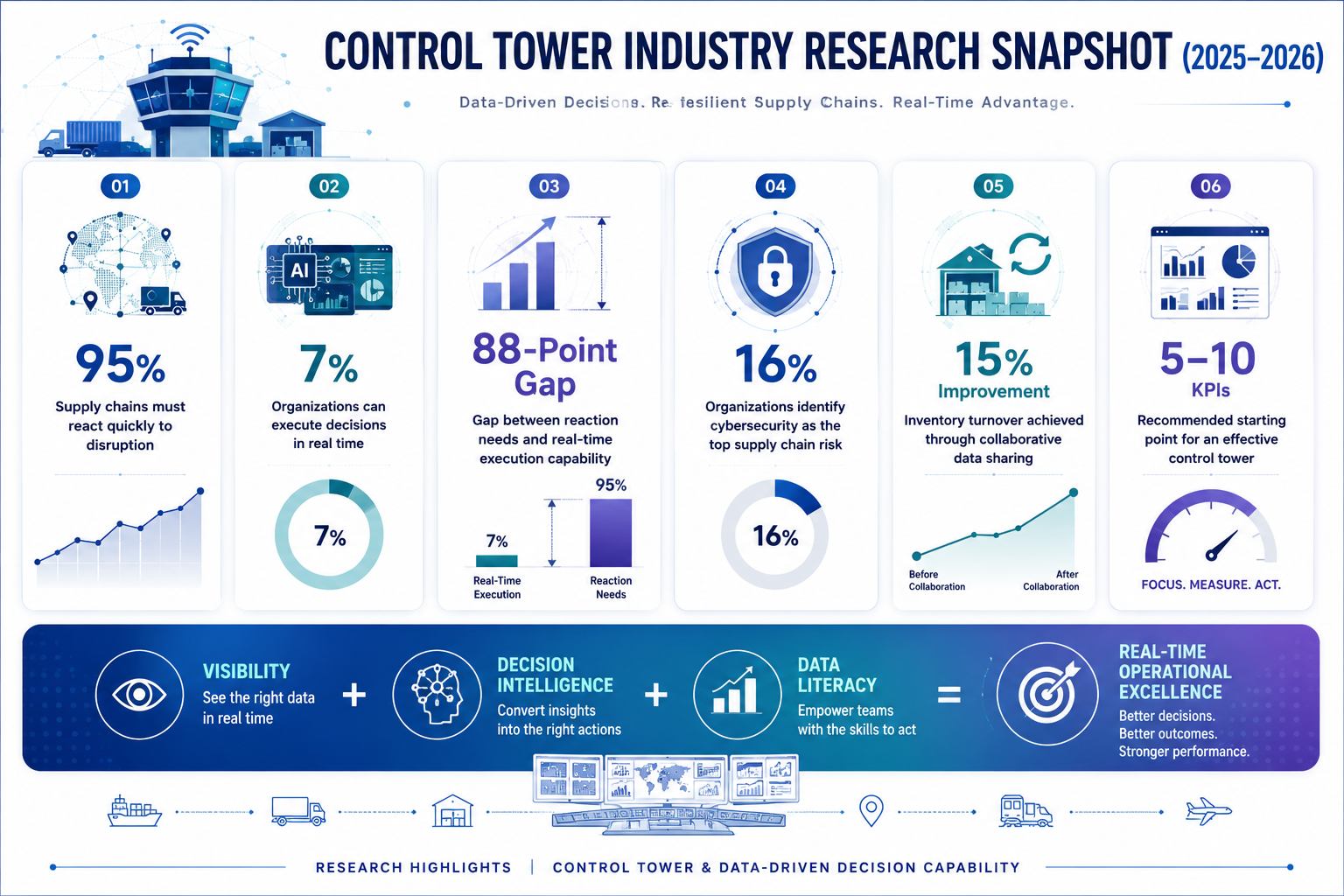
Ninety-five percent of supply chains must react quickly to change, yet only 7 percent can currently execute decisions in real time. That 88-point gap is not a technology gap; most organizations already have more data than they can act on. It is a decision-capability gap: the organizational ability to convert a dashboard alert into a reallocation, a reroute, or a reprioritization within the same operational window the exception occurred, rather than the next planning cycle. Closing it is the single highest-leverage capability investment available to transportation and logistics leaders through the next decade.
Only 7% of supply chains can execute decisions in real time, even though 95% must react quickly to change. Gartner, Future of Supply Chains research, cited 2026 |
The Minimum Viable Control Tower: What It Actually Requires
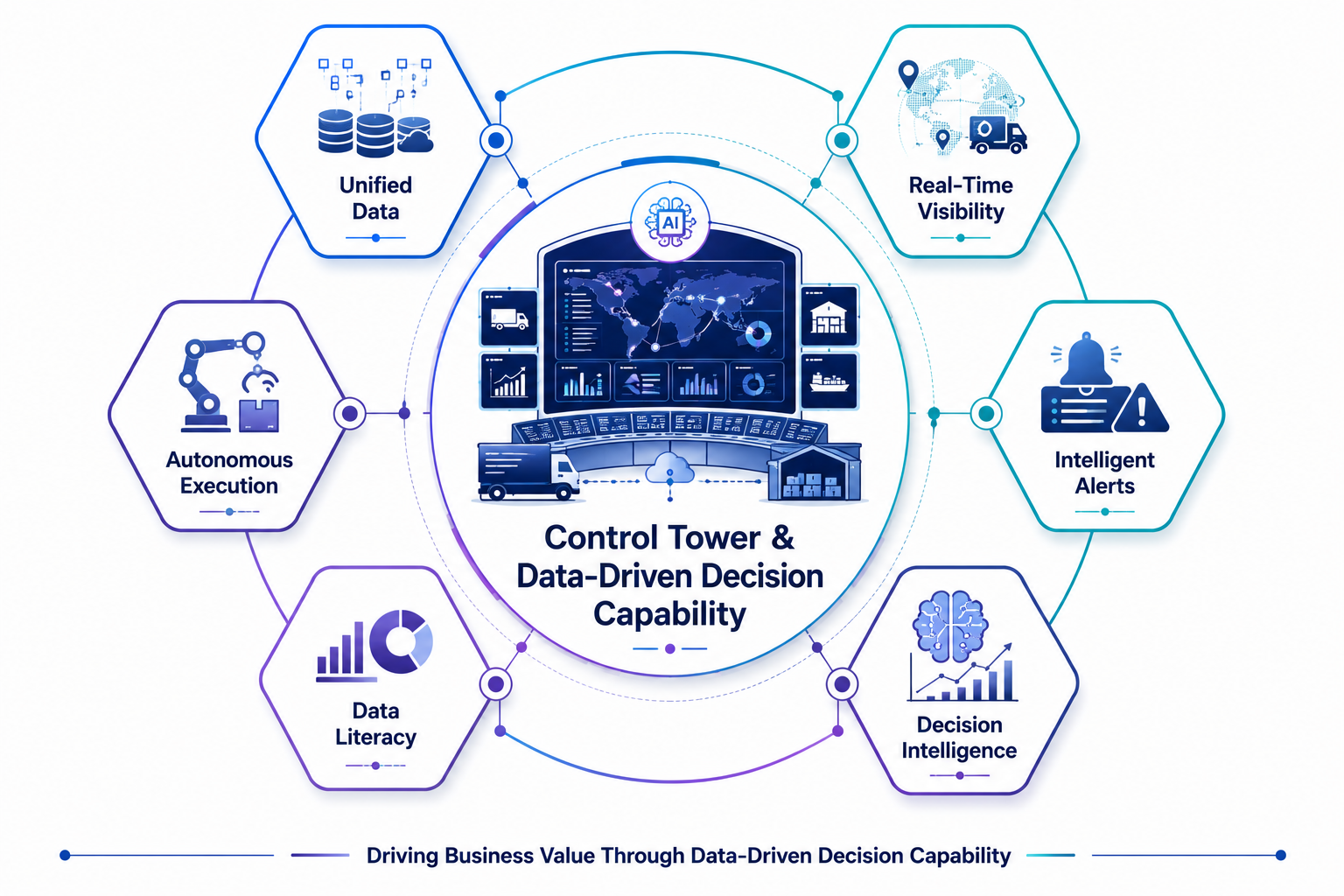
A control tower is not a piece of software; Gartner defines it as the combination of people, process, data, organization, and technology that captures near-real-time information across a business and turns it into improved decisions. That definition matters because it explains why so many technology-led control tower rollouts underdeliver: they build the data layer and skip the other four. A genuinely minimum viable control tower requires three things working together, not sequentially delivered.
Aggregating Orders, Capacity, Status, and Exceptions Into One View
The first requirement is unglamorous but foundational: a single, trusted view connecting orders, capacity, shipment status, and exceptions across ERP, TMS, and WMS systems. Gartner’s December 2025 research on the visibility journey toward orchestration platforms describes this explicitly as a phased evolution, from retrospective business intelligence in the early 2000s, through domain-specific control towers built on IoT and near-real-time data in the 2010s, to today’s push toward connected, granular operational data. Most organizations attempting to skip directly to advanced analytics or AI-driven orchestration without first solidifying this data foundation find their investment underdelivers, precisely because the foundation was never built.
Standard Alerts and Simple Prioritization Rules
The second requirement is a defined, standard set of alerts, delay thresholds, failure triggers, and risk-shipment flags, paired with simple, agreed prioritization rules for which exceptions get human attention first. Without this, control towers generate alert fatigue rather than decision support: they show that a shipment is late and flag a carrier’s declining performance, but stop there, without triggering a reroute or a load reallocation. That gap between alerting and acting is precisely where operational control towers diverge from legacy monitoring tools.
Roles and Skills: The People Layer Gartner Says Matters Most
Even with full automation, skilled people remain essential to a control tower’s success. A functioning control tower requires clearly defined roles, typically a control-tower lead, an analyst, and a duty manager, each bringing domain expertise and decision authority for complex situations that alerts alone cannot resolve. Equally important is data literacy across the broader planning and supervisory population: the ability to read a dashboard, ask a good question of the data, and spot a pattern before it becomes an incident. This is a training and capability-building requirement, not a hiring problem that can be solved through a handful of specialist roles.
Implementable Steps: Starting Small and Building the Review Rhythm
Organizations that build durable control-tower capability, rather than an expensive dashboard nobody trusts, tend to follow the same sequence:
- Start with five to ten key metrics, typically OTIF, dwell time, capacity utilization, and aging shipments, rather than attempting to instrument the entire network at once.
- Establish a weekly review rhythm explicitly focused on learning, what went wrong, what changed, what will be tried next, rather than status reporting to leadership.
- Layer in more advanced optimization and predictive capability only after basic visibility and review discipline are already functioning reliably.
- Assign clear ownership for converting each alert category into a defined action, so the control tower has an accountable decision-maker behind every metric it surfaces.
Advanced control towers now provide real-time visibility, collaboration, and AI capabilities to move beyond decision support to decision making. - Gartner research on supply chain control towers |
From Linear Chains to Networks: What the Best-Performing Organizations Are Building
Unlock the Full Research
Create a free account or sign in to access the complete methodology, deep-dive analysis, and key implementation frameworks.
Don't have an account? It's free to join.
Organization Learning Labs
Research & Insights Division


Comments