Consultant 2030: New Skills Stack for IT Advisory Talent

The multi-layered skills stack IT services consultants must build for 2030 -- from AI fluency to translational leadership.
Consultant 2030: The New Skills Stack for IT Services and Advisory Talent
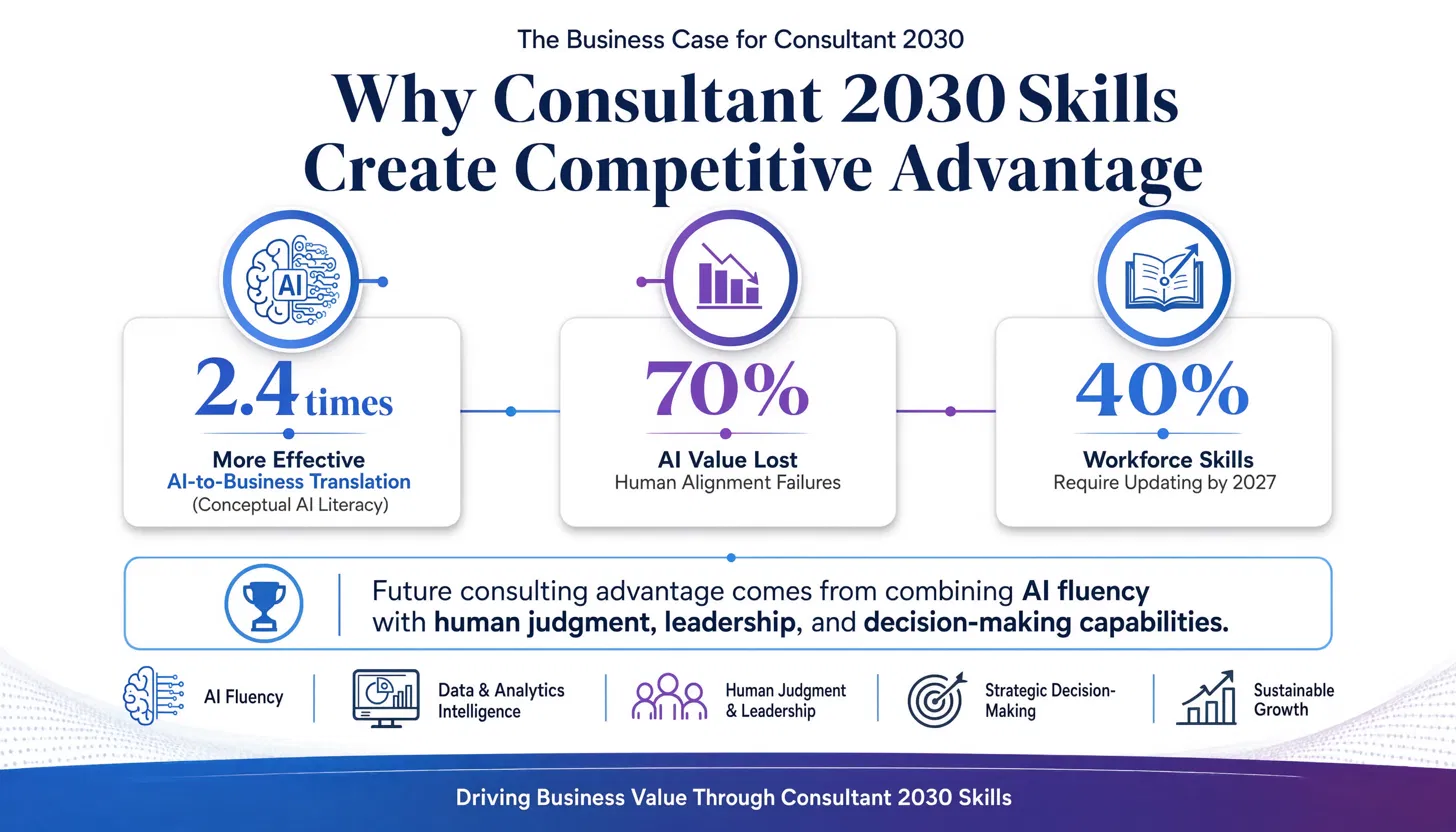
The consulting value proposition is undergoing its most fundamental restructuring yet. Technical depth alone is becoming insufficient - not because it is less valuable, but because it is no longer differentiating. The consultants who will be most commercially valuable in 2030 and beyond are those who combine credible technical foundations with multi-layered human-centered, analytical, and ethical capabilities that AI tools cannot replicate.
Why Is Technical Depth No Longer Sufficient for IT Advisory Excellence?
Cloud infrastructure is increasingly standardized. AI tools generate analyses, dashboards, and strategic drafts in seconds. Low-code platforms allow business teams to build functional solutions without deep engineering expertise. The body of specialized knowledge that once required years to accumulate is now increasingly accessible through the right tools and prompts.
This creates a paradox: there is more analytical output available to organizations than at any point in history, but the capacity to use it effectively has not kept pace. According to OECD research (2023), the primary bottlenecks in successful AI adoption are not technical. They are organizational alignment, governance readiness, trust in AI outputs, and the human capacity to translate analytical insight into operational change.
"The most valuable consultant of 2030 will not be the one who knows the most. It will be the one who can frame the right questions, facilitate the right conversations, and translate complex signals into decisions that organizations can actually act on." — Harvard Business Review, The Future of Knowledge Work, 2023 |
The Consultant 2030 Skills Stack: A Layered Architecture
Rather than viewing consulting competencies as isolated skills, it is more useful to think of them as a layered stack. Each layer builds on and amplifies the capabilities beneath it, progressing from technical credibility at the foundation through analytical, ethical, communicative, and facilitative layers to translational leadership at the apex.
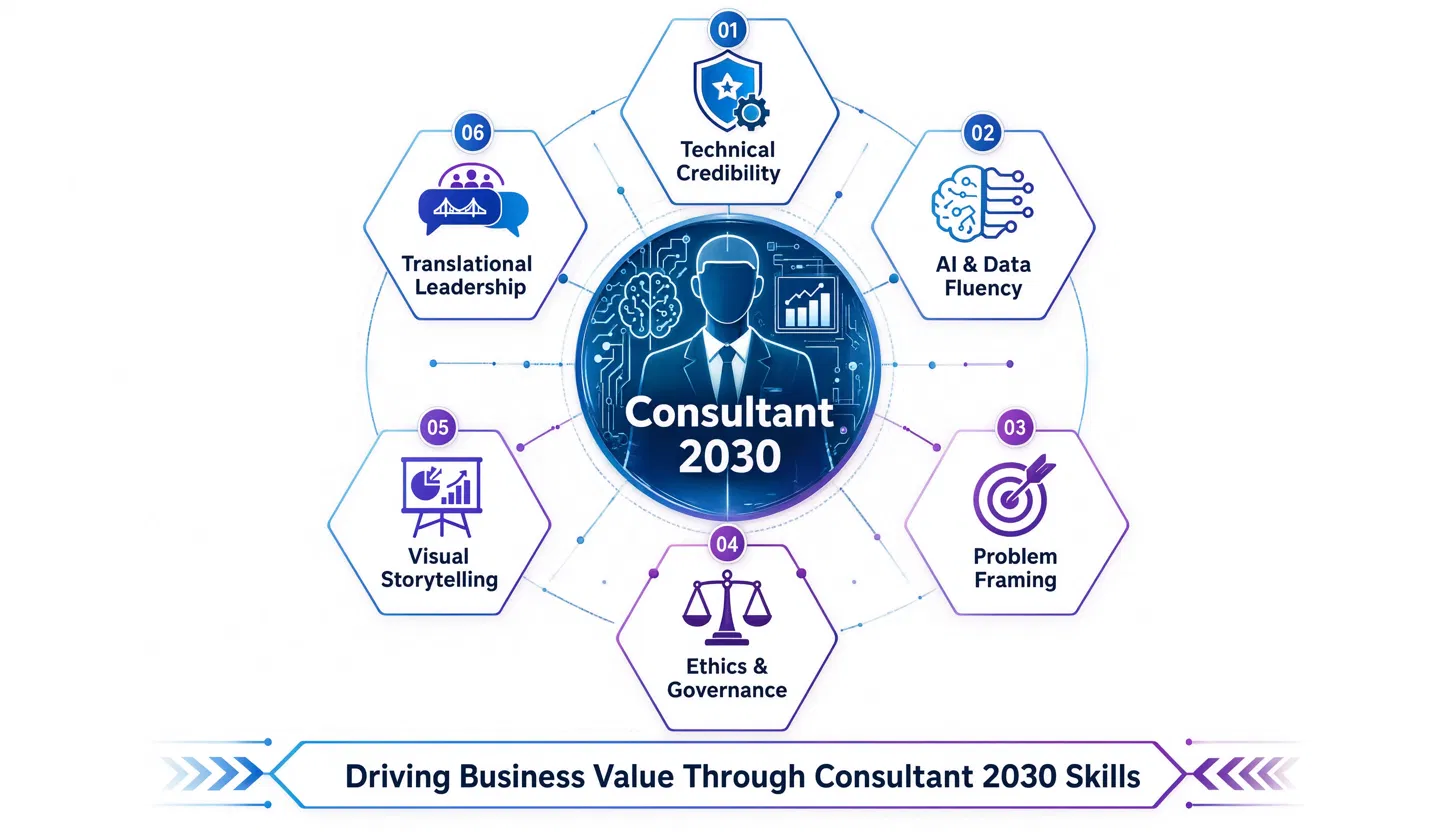
Layer 1: Core Technical Credibility (The Foundation)
Even in 2030, consultants will require solid technical foundations: cloud architectures and integration patterns, data pipelines and interoperability, cybersecurity principles, APIs, platforms, and automation workflows. The critical distinction is that technical expertise becomes the baseline expectation rather than the primary differentiator. Without this foundation, consultants lose client credibility. With it alone, they no longer stand out.
Layer 2: Data Literacy and AI Fluency
Just as spreadsheet competence became a professional minimum in the 1990s, AI fluency will be mandatory by 2030. This means understanding different data types and their governance implications, recognizing model limitations, uncertainty, and bias risks, evaluating the credibility of AI-generated outputs, formulating effective analytical queries, and translating AI outputs into business-relevant language for executive audiences.
Harvard Business Review (2023) shows that employees with conceptual AI understanding are 2.4 times more effective at using AI responsibly and productively, and significantly more capable of communicating AI implications to decision-makers.
Layer 3: Analytical Thinking and Problem Framing
One of the most commercially distinctive capabilities in the AI era is the ability to frame the right problem before seeking the answer. AI systems excel at answering well-specified questions. They are structurally incapable of determining which questions matter, which business trade-offs are most consequential, or which analytical framings will generate the most decision-relevant insights.
McKinsey's future-of-work research (2023) documents accelerating demand for higher-order cognitive capabilities including critical thinking, structured reasoning, and judgment in the face of uncertainty -- precisely as automation reduces demand for routine analytical processing.
McKinsey (2023) documents accelerating demand for critical thinking, structured reasoning, and judgment as automation reduces routine analytical processing -- the exact capabilities that distinguish Consultant 2030 professionals. Source: McKinsey & Company, Future of Work Research, 2023 |
Layer 4: Ethics, Governance, and Risk Fluency
Unlock the Full Research
Create a free account or sign in to access the complete methodology, deep-dive analysis, and key implementation frameworks.
Don't have an account? It's free to join.
Organization Learning Labs
Research & Insights Division


Comments