Commerce OS: Building End-to-End E-Commerce Capability Today

Why treating e-commerce as an operating system, not a website, is the capability imperative CXOs must fund now. Research, roles, and a 2035 roadmap inside.
From Webstore to Commerce OS
Building End-to-End E-Commerce Capability Across Channels, Technology, Talent, and Governance
Introduction: E-Commerce Was Never Supposed to Be a Project
Most enterprises still run e-commerce the way they ran their first website in the 2000s: as a project with a launch date, a budget line, and a team that hands off to "business as usual" once the site goes live. That model is now the single biggest constraint on digital commerce performance. The global e-commerce market is estimated to have reached roughly USD 7.4 to 8.5 trillion in 2026 depending on methodology, with the National Retail Federation and eMarketer converging on the higher end of that range as online penetration approaches a quarter of total retail sales worldwide. Growth of this magnitude does not reward organizations that treat commerce as a channel to be maintained. It rewards organizations that treat commerce as an operating system to be engineered.
The distinction matters because the failure pattern is remarkably consistent across sectors. A retailer builds a strong website, wins a marketplace listing, launches a loyalty app, and each initiative is owned by a different team using different data, different KPIs, and different vendors. Inventory does not reconcile between channels. Marketing cannot see fulfillment cost. Customer service cannot see what marketing promised. The result is a fragmented commerce estate that looks impressive on a slide and underperforms in the market. Deloitte's Global Retail Outlook and multiple 2025 to 2026 industry surveys point to the same root cause: capability fragmentation, not lack of technology investment, is what separates commerce leaders from laggards.
The Case for a Commerce Operating System
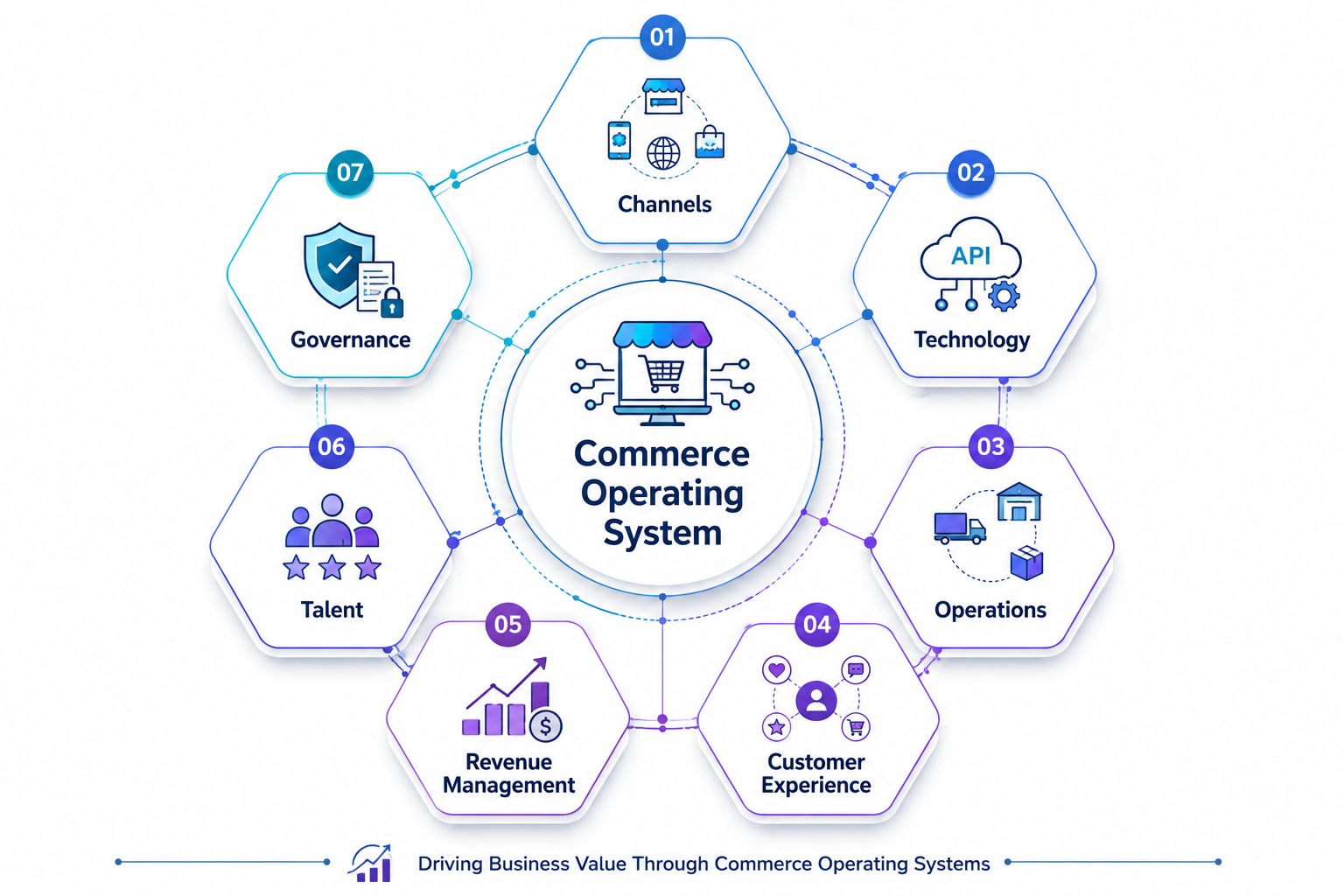
A commerce operating system is the set of interlocking capabilities, channels, technology, operations, customer experience, revenue management, talent, and governance, that together determine whether an organization can sell profitably and consistently across every place a customer might transact. It is a deliberate reframing away from "e-commerce team" toward "commerce capability," and it changes how leaders should staff, fund, and measure the function.
Channels: Presence Without Fragmentation
Direct-to-consumer storefronts, marketplaces, social commerce, and franchise or retail integration each carry different economics and different customer expectations, yet they must present one coherent brand and one accurate inventory position. Social commerce alone is now estimated at roughly USD 1.2 to 2.9 trillion globally depending on scope, growing 25 to 30 percent annually, which means a channel strategy finalized eighteen months ago is already incomplete.
Technology: The Backbone, Not the Bottleneck
Platform, integration, data, and automation choices determine how fast every other pillar can move. The global e-commerce platform and software markets are both compounding at roughly 16 to 20 percent annually into the early 2030s, reflecting a wholesale shift toward modular, API-first, and increasingly headless architectures. Leaders should treat platform decisions made in 2026 as determining competitive positioning three to four years out, since replatforming cycles rarely move faster than that.
Operations, Customer, Revenue, Talent, Governance
Inventory, fulfillment, and returns form the operational core explored in depth in the companion article on operations excellence within this series. Customer experience and service determine whether acquisition spend converts into loyalty. Revenue management, pricing, promotions, and catalog discipline, determines whether growth converts into margin. Talent and ways of working determine whether any of the above can be executed at speed. Governance, spanning risk, compliance, data, and brand integrity, determines whether the system is defensible as it scales into new markets and new regulatory regimes such as the EU's Digital Product Passport requirements taking effect from 2027.
"Retailers who embed omnichannel capability deeply in supply chain, marketing, and store operations are the ones reaping the dividends. Those who treat it as a bolt-on function see diminishing returns."
Source: Senior Vice President of Digital Strategy, international retail consultancy, cited in industry commentary on 2025 to 2026 omnichannel performance
Capability Maps and Role Archetypes
Organizations that operationalize a commerce OS tend to converge on a small set of durable role archetypes, even when their org charts look different on paper. The e-commerce product owner holds the P&L logic for a channel or category and translates commercial intent into a backlog. The commerce architect owns the technical coherence of the stack, ensuring that a promotion engine, an inventory ledger, and a personalization layer all agree on the same facts. The performance marketing lead owns acquisition efficiency across paid, owned, and earned channels. The customer experience lead owns the end-to-end journey, including the moments the marketing function does not usually see, such as a delayed refund or a mis-picked order. The operations excellence manager owns the physical and digital fulfillment chain.
• Capability, not job title, is the unit of design: Each archetype must be assessed against all seven pillars, not just their home function, because the roles that fail fastest are the ones with narrow, single-pillar mandates in a business that has already gone cross-channel.
Unlock the Full Research
Create a free account or sign in to access the complete methodology, deep-dive analysis, and key implementation frameworks.
Don't have an account? It's free to join.
Organization Learning Labs
Research & Insights Division


Comments