Collaborative Robotics: Redesigning Shop Floor Roles for Cobots

Cobots are reshaping the shop floor. Learn how to redesign roles, build trust and train operators for effective human-robot collaboration in 2026.
Collaborative Robotics and Human-Centered Automation: Redesigning Roles, Learning and Behavior on the Shop Floor
Advanced robotics is not a headcount question. It is a role-design, trust-building and learning-architecture question that most manufacturers have not yet answered deliberately
1. Introduction: Beyond Simple Automation
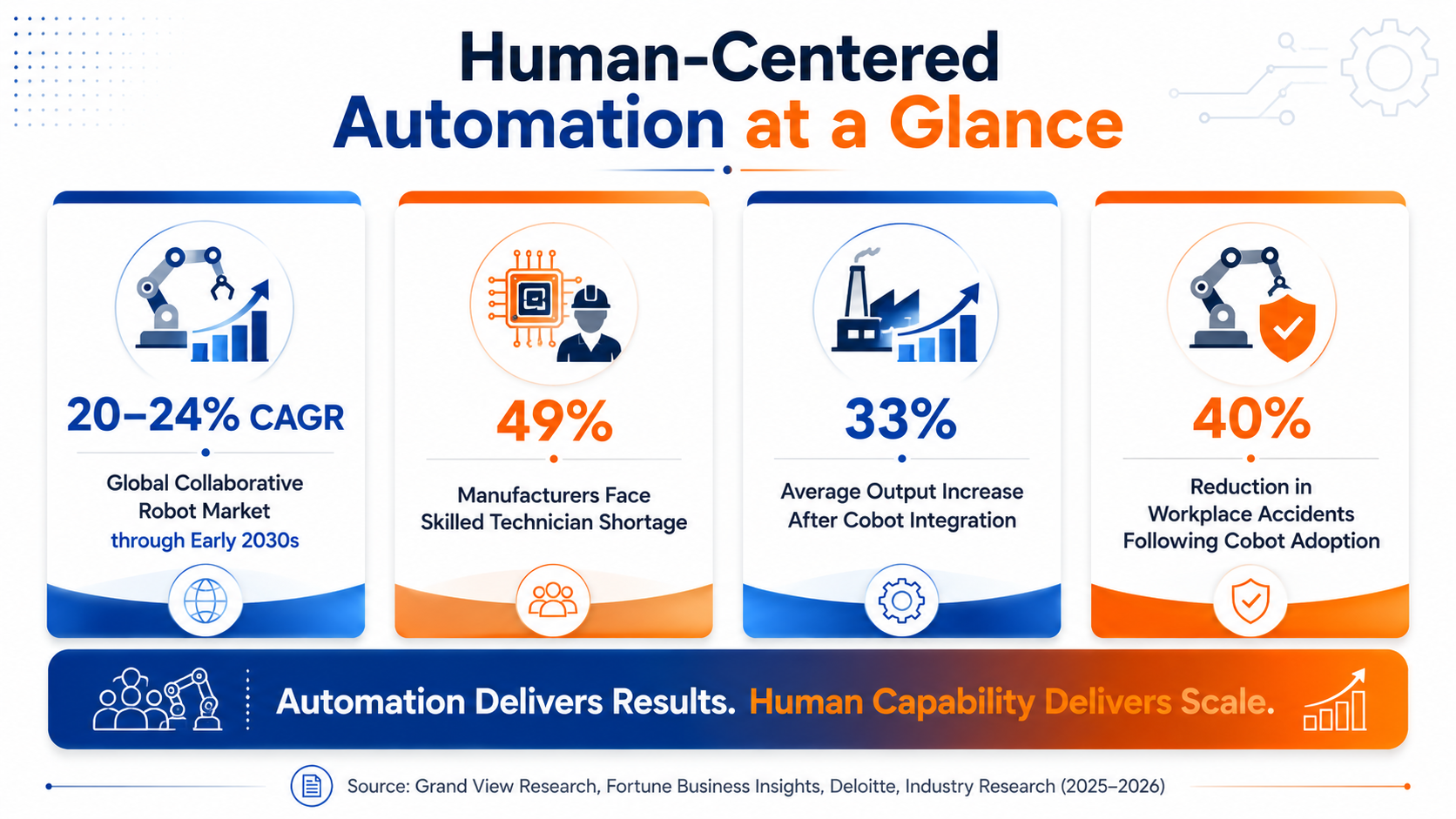
Human-centered automation has become the defining design question for manufacturers deploying advanced robotics in 2026, not because the robots themselves have changed dramatically, but because the scale and pace of deployment has made poor role design impossible to ignore. Collaborative robots, cobots designed to work safely alongside people rather than behind safety cages, are being adopted across manufacturing at a pace that outstrips traditional industrial robotics growth. The global collaborative robot market, valued in the range of two to three billion dollars in 2025 depending on the analyst, is projected to grow at a compound annual rate of roughly 20 to 24 percent through the early 2030s, driven overwhelmingly by labor shortages and the need for flexible, redeployable automation rather than by an ambition to eliminate human roles.
The risk manufacturers face is not that cobots will fail technically. Adoption data suggests the opposite: 58 percent of companies deploying cobots report a roughly 33 percent increase in output alongside a 40 percent reduction in workplace accidents. The risk is that poorly designed human-robot interactions create safety incidents, morale erosion and operator distrust that undermine the very productivity gains automation is meant to deliver. Nearly half of surveyed manufacturers cite a shortage of skilled technicians, and over a third cite integration difficulty with existing systems, as the reasons cobot deployment stalls after an initial pilot cell, findings that point toward a capability gap rather than a technology limitation.
This article treats human-centered automation as a deliberate design discipline, spanning capability building, role redesign, behavioral trust-building and governance, rather than as an inevitable byproduct of purchasing robotics equipment. The manufacturers succeeding with cobots at scale are the ones treating these dimensions as seriously as they treat the underlying engineering.
Around 49 percent of firms cite a lack of skilled technicians and 37 percent face difficulty integrating cobots into existing systems. The barrier to scale is workforce readiness, not robot capability. — Synthesis of collaborative robotics adoption research, 2026 |
2. The Capability Stack for Human-Robot Collaboration
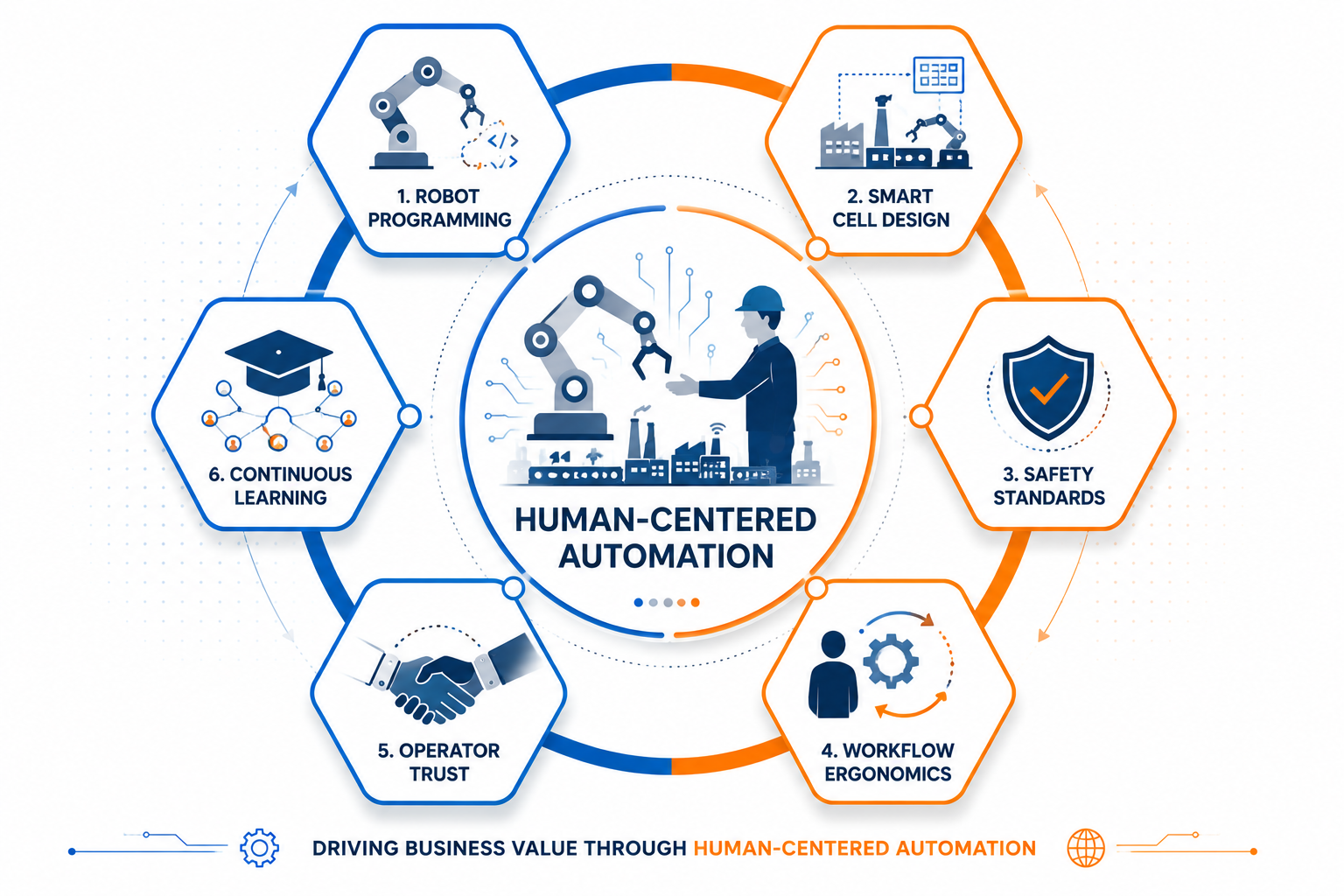
Successful human-robot collaboration rests on four capability layers that extend well beyond the robotics engineering typically associated with automation projects. Robotics programming and application engineering, the most visible layer, covers path planning, gripper selection and the increasingly AI-assisted vision systems now found in over half of newly launched cobots. Cell design, the second layer, determines how a cobot's workspace interacts with human movement, material flow and existing line layout, and it is where many integration failures originate when a cobot is dropped into a line designed around a purely human or purely automated workflow rather than a genuinely mixed one.
Safety standards compliance, increasingly governed by updated ISO and technical specification frameworks that clarify force and speed thresholds for safe human proximity, has matured significantly and now enables faster certification timelines than in previous years, but still requires genuine engineering and operational discipline to implement correctly rather than treating certification as a paperwork exercise. Ergonomics and workflow integration, the fourth and most frequently underinvested layer, determines whether the redesigned human role around a cobot is actually more sustainable and satisfying than the task it replaced, or whether it simply relocates strain and monotony to a different point in the process.
Capability Layer | Core Discipline | Common Integration Failure |
Robotics programming | Path planning, gripper selection, AI-assisted vision systems | Programming complexity that only the integrator, not plant staff, can maintain |
Cell design | Workspace layout, material flow, mixed human-robot workflow | Cobots dropped into layouts designed for purely human or purely automated work |
Safety standards | Force and speed thresholds, certification, safety zone definition | Treating certification as a compliance checkbox rather than an operational discipline |
Ergonomics and workflow | Sustainable, engaging redesigned human roles around the cobot | Strain and monotony relocated rather than eliminated from the human role |
3. Talent Archetypes for the Human-Robot Shop Floor
Three roles anchor a manufacturing organization's human-robot collaboration capability. Robotics engineers own the technical design and programming of cobot cells, increasingly requiring fluency in AI-assisted vision and adaptive real-time programming as over half of new cobot launches now include these features. Line integrators, a role that bridges robotics engineering and traditional production engineering, translate a cobot's technical capability into an actual line design that accounts for takt time, material flow and existing equipment, a translation that generic robotics training rarely covers.
Operator-partners, the least discussed but arguably most consequential role, are the frontline workers who share a workspace with a cobot day to day, and whose competency extends beyond simply avoiding the robot's safety zone to actively collaborating with it, recognizing when its behavior deviates from expected patterns, and knowing when and how to intervene or escalate. Manufacturers that invest primarily in the first two archetypes while treating operator-partner competency as an afterthought consistently see the trust and adoption problems that undermine otherwise sound technical deployments; the operator who does not trust a cobot's predictability will work around it in ways that erode both safety and the productivity case for the investment.
Unlock the Full Research
Create a free account or sign in to access the complete methodology, deep-dive analysis, and key implementation frameworks.
Don't have an account? It's free to join.
Organization Learning Labs
Research & Insights Division


Comments