Cloud-Native Manufacturing: The Platform Capability Playbook

Manufacturers are shifting to cloud-native, platform operations. Learn the capability stack, talent archetypes and behaviors leaders need to compete by 2035.
From Machines to Mesh: Building Capability for Cloud-Native, Platform-Orchestrated Manufacturing
Why the next competitive edge in manufacturing belongs to organizations that can operate as part of a globally orchestrated, software-defined mesh
1. Introduction: Manufacturing Moves Into the Cloud
Cloud-native manufacturing capability has moved from a technology upgrade to a governance question for the boardroom. The plant that once ran as a self-contained island, with its own historian, its own scheduling logic and its own definition of a good day, is being asked to become one node in a mesh of suppliers, logistics partners, demand signals and design systems that all expect to talk to each other in near real time. Deloitte's most recent manufacturing outlook describes this shift plainly: manufacturers are moving from agentic AI pilots to full-scale implementation, a transition expected to accelerate through 2026, and the technologies underpinning it, cloud infrastructure, digital twins and platform-based orchestration, are no longer optional experiments sitting in an innovation lab.
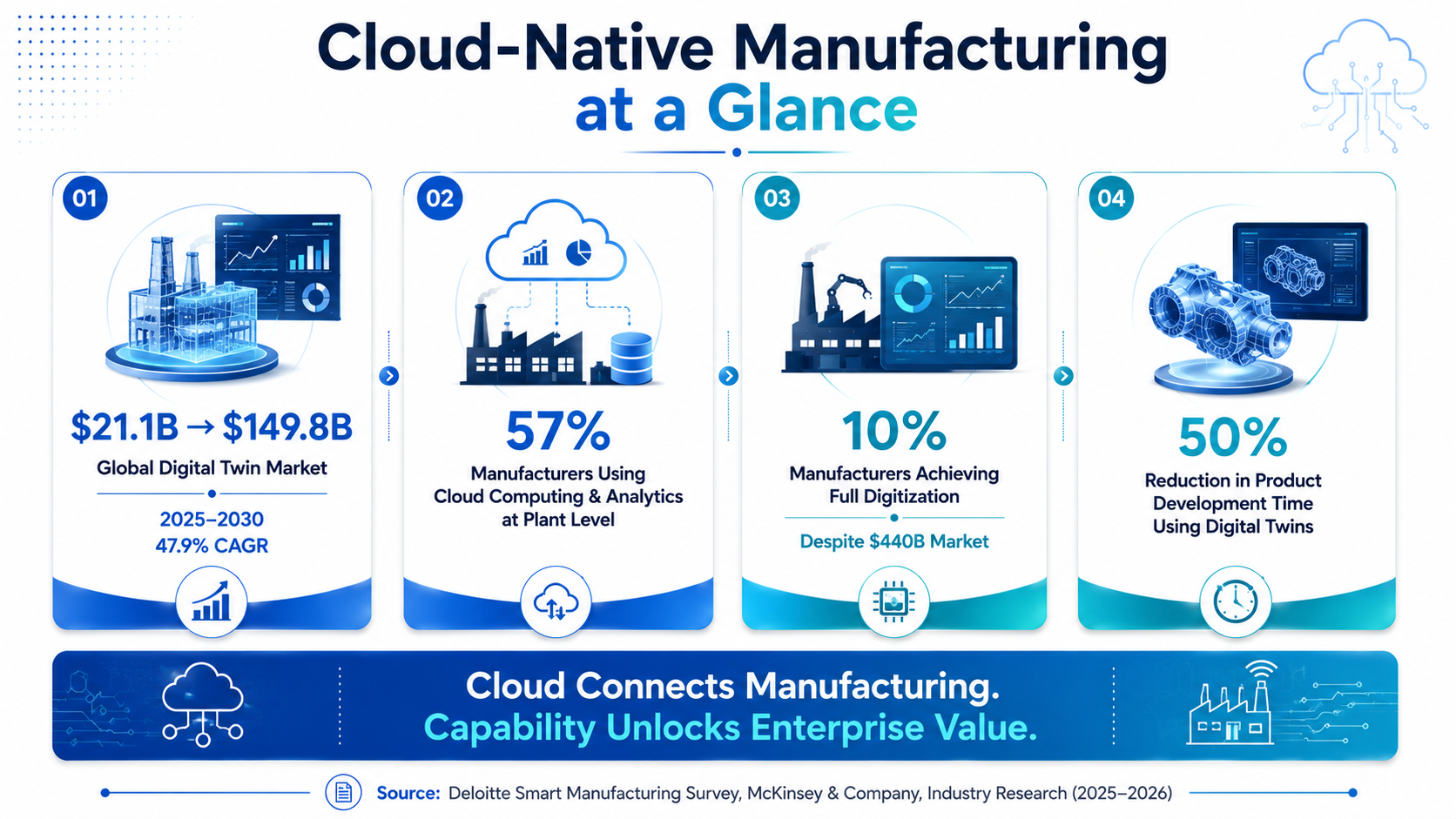
The scale of the shift is already visible in the numbers. The global digital twin market grew from roughly 14.5 billion dollars in 2024 to an estimated 21.1 billion dollars in 2025, and multiple analyst houses now project it will approach 150 billion dollars by 2030, a compound annual growth rate above 47 percent. Cloud, generative AI and 5G ranked among the top three technology investment priorities for manufacturers in 2024, and by 2025 a WalkMe and McKinsey survey found that 95 percent of European manufacturers reported that cloud adoption had already reduced IT costs and improved productivity. The direction of travel is not in question.
What is in question, and what rarely appears in a technology roadmap, is whether the organization built for a plant-only world can operate effectively once it becomes part of a platform. A cloud migration changes where data lives. A platform-orchestrated operating model changes who makes decisions, on what timescale, and with what degree of visibility into partners the organization does not own or control. That is a capability and behavior problem as much as an infrastructure problem, and it is the subject of this article.
Manufacturing technology budgets have grown faster than any other category of capital expenditure, yet only a fraction of manufacturers have achieved full digitization. The gap between spending and maturity is the real story. — Synthesis of Deloitte, McKinsey and Gartner manufacturing technology research, 2025-2026 |
2. The Capability Stack for Cloud-Native, Platform-Orchestrated Manufacturing
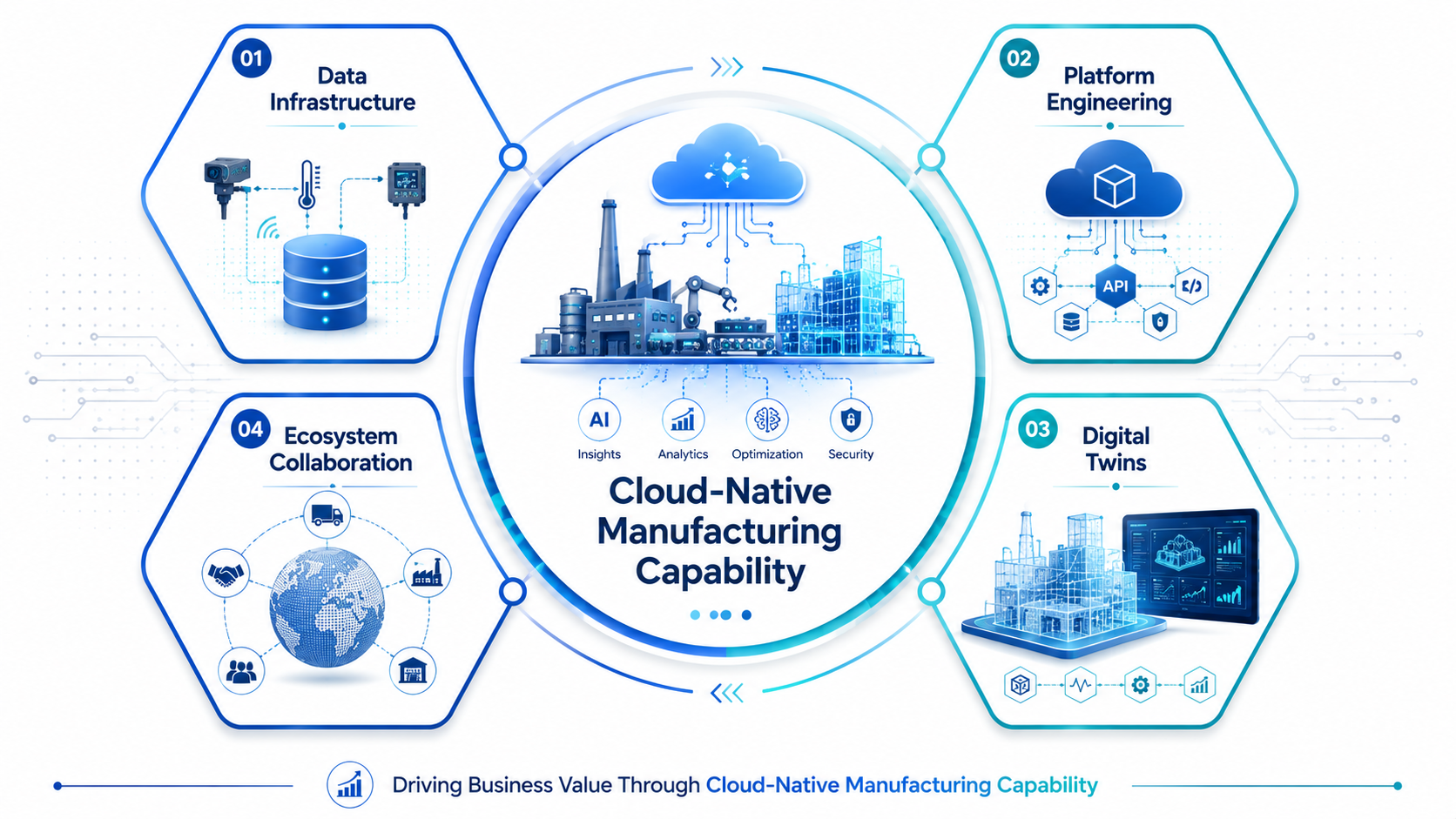
A useful way to think about cloud-native manufacturing capability is as four interdependent layers, each of which depends on the one below it functioning well. The first layer is data infrastructure: sensors, historians, SCADA and MES systems that generate clean, timestamped, contextualized data. Industry research is consistent on this point, a 2025 IoT Analytics survey found that 58 percent of digital twin project delays trace back to OT and IT integration challenges rather than software limitations. No amount of platform sophistication compensates for dirty data at the source.
The second layer is platform engineering, the discipline of exposing plant data and capacity through APIs that partners, planning systems and digital twins can consume without a bespoke integration project for every new connection. The third layer is digital twin and simulation capability, the ability to build, validate and maintain virtual representations of assets, processes or entire factories that are accurate enough to inform real decisions. McKinsey's research on digital twin applications shows the payoff is not marginal: organizations report up to a 20 percent improvement in fulfilling consumer promises, a 10 percent reduction in labor costs, a 5 percent revenue increase, and in some cases a 7 percent reduction in carbon emissions, largely through better demand forecasting and production planning.
The fourth and most frequently underinvested layer is ecosystem collaboration, the organizational and contractual capability to share data, capacity and even proprietary process logic with suppliers and logistics partners in a way that creates mutual value without exposing the organization to unacceptable risk. This is where most manufacturers stall. Building a digital twin is a project. Learning to operate inside a platform where other companies can see your capacity constraints is a cultural shift.
WHAT THE DATA SHOWS Nine in ten manufacturing executives surveyed by McKinsey in 2024 reported facing visibility challenges and shortages with their supplier partners, precisely the problem platform orchestration is designed to solve, and precisely the problem most manufacturers have not yet built the organizational capability to address. |
Six Value Streams, One Common Constraint
Documented ROI from digital twin and platform investment tends to concentrate in six areas: product design validation that eliminates physical prototyping cycles, predictive maintenance that detects degradation before failure, real-time process simulation that catches quality drift at the source, optimized production scheduling that reduces idle time, energy optimization that reduces both cost and emissions, and supply chain visibility that shortens the distance between a demand signal and a production decision. Each is independently justifiable on ROI grounds, with manufacturers reporting 15 to 30 percent returns within the first few years and payback periods often under 24 months for targeted pilots. But every one of these value streams depends on the same underlying constraint: people who can build, trust and act on the data the platform produces.
Capability Layer | Core Discipline | Primary Failure Mode When Absent |
Data infrastructure | Sensor calibration, OT/IT integration, historian hygiene | Digital twins built on unreliable data, eroding trust before scale-up |
Platform engineering | API design, cloud architecture, cybersecurity by design | Point-to-point integrations that do not scale beyond a handful of partners |
Digital twin and simulation | Model validation, scenario testing, continuous refinement | Twins that drift from reality and are quietly abandoned by operators |
Ecosystem collaboration | Data-sharing governance, joint planning, trust-building with partners | Platforms adopted in name but never used for real cross-company decisions |
3. Talent Archetypes in Platform Ecosystems
Unlock the Full Research
Create a free account or sign in to access the complete methodology, deep-dive analysis, and key implementation frameworks.
Don't have an account? It's free to join.
Organization Learning Labs
Research & Insights Division


Comments