Closing the IT Skills Gap Through Experiential Learning

Cybersecurity, cloud, and AI skills gaps are stalling IT delivery. See why experiential, simulation-based learning closes the gap faster than classroom training.
Closing the IT Skills Gap: How Experiential Learning Builds Future-Ready Tech Talent
Why simulation-based, experiential learning outperforms traditional IT training and closes the capability bottleneck
The Organization Learning Labs | 2026 Edition
Nearly every technology leader has lived some version of the same scene: a critical project stalls, not because the architecture is wrong or the budget is thin, but because there is no one available who can execute it. The 2026 SANS/GIAC workforce report marked a genuine inflection point for the industry: for the first time, skills gaps overtook headcount shortages as the top workforce challenge facing security and technology teams. The problem has shifted from "we can't find enough people" to "the people we have can't yet do what the mission now requires."
Cybersecurity, cloud computing, and AI/ML sit at the center of this gap. ISC2's 2025 Cybersecurity Workforce Study found that 95% of security teams report at least one critical skills gap, and 88% experienced a significant security event in the past year tied directly to a skills shortfall. IDC projects that more than 90% of global enterprises will continue to face critical IT skills shortages through 2026, with unresolved gaps costing the global economy trillions in lost productivity. Meanwhile, McKinsey's 2026 Global Tech Agenda survey finds AI and data literacy now sit alongside cybersecurity as the fastest-growing skill categories employers say they cannot fill quickly enough.
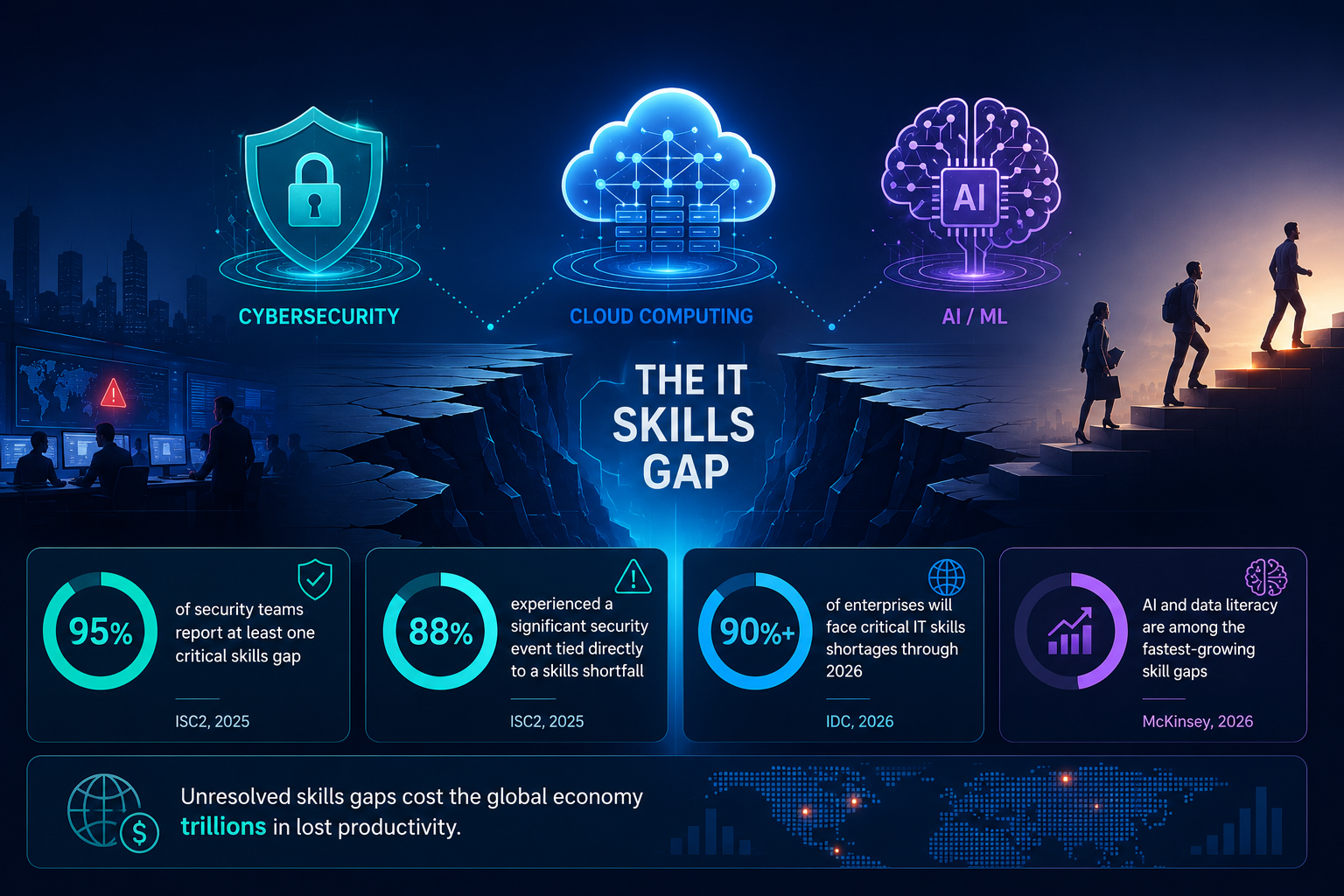
The Real Cost of the IT Skills Gap
The consequences of the gap ripple well beyond a single unfilled requisition. Skills shortages delay cloud initiatives, widen security exposure, and quietly throttle innovation as teams patch capability holes with generalists who are stretched across too many disciplines. Deloitte's 2026 State of AI in the Enterprise report identifies the skills gap as the single biggest barrier to AI integration, ahead of budget, technology limitations, or leadership skepticism. That finding alone should reorder how most technology budgets are allocated for the next planning cycle.
PRODUCTIVITY TAX New technical hires typically take five to six months to reach full productivity. Even when hiring succeeds, organizations are effectively waiting half a year before a new hire contributes meaningfully, a hidden tax on top of already-elevated recruiting costs in a tight talent market. |
The instinctive response, hire more aggressively, runs into its own economics. AI and cybersecurity specialists now command steep salary premiums, with some research placing AI-specific skill premiums at well over 60% above comparable traditional software roles. Hiring is frequently more expensive than upskilling for the same capability outcome, yet organizations continue defaulting to external hiring because it feels like the only lever they know how to pull quickly. The more durable answer is not hiring your way out of the gap. It is rethinking how capability gets built in the first place.
Why Traditional IT Training Falls Short
Picture a training session where an instructor clicks through slides on cloud architecture, incident response, or DevOps pipelines. Attendees take notes, nod along, and two weeks later can recall little of substance. This is not a criticism of the instructor or the content; it is the predictable outcome of a delivery format that was never designed to produce durable capability under pressure. Generic e-learning modules and theoretical frameworks rarely prepare people for the real decisions they will face when a production system is degrading at 2 a.m., because they never require the learner to make that decision under realistic constraints.
Unlock the Full Research
Create a free account or sign in to access the complete methodology, deep-dive analysis, and key implementation frameworks.
Don't have an account? It's free to join.
Organization Learning Labs
Research & Insights Division


Comments