Change Fitness vs Change Fatigue: Building Adaptive Culture

How organizations build change fitness as a core capability -- shifting from episodic change management to continuous adaptive culture through behavioural science, peer champions, and transformation labs.
Why Change Fatigue Has Become an Organizational Emergency
In boardrooms and leadership offsites across the world, a paradox is playing out with increasing urgency. Organizations are investing more in transformation than at any point in corporate history -- and failing at it more consistently. The reason is not inadequate strategy, insufficient technology, or poor execution planning. The reason is that organizations are pursuing continuous transformation with a fundamentally episodic tool: change management.
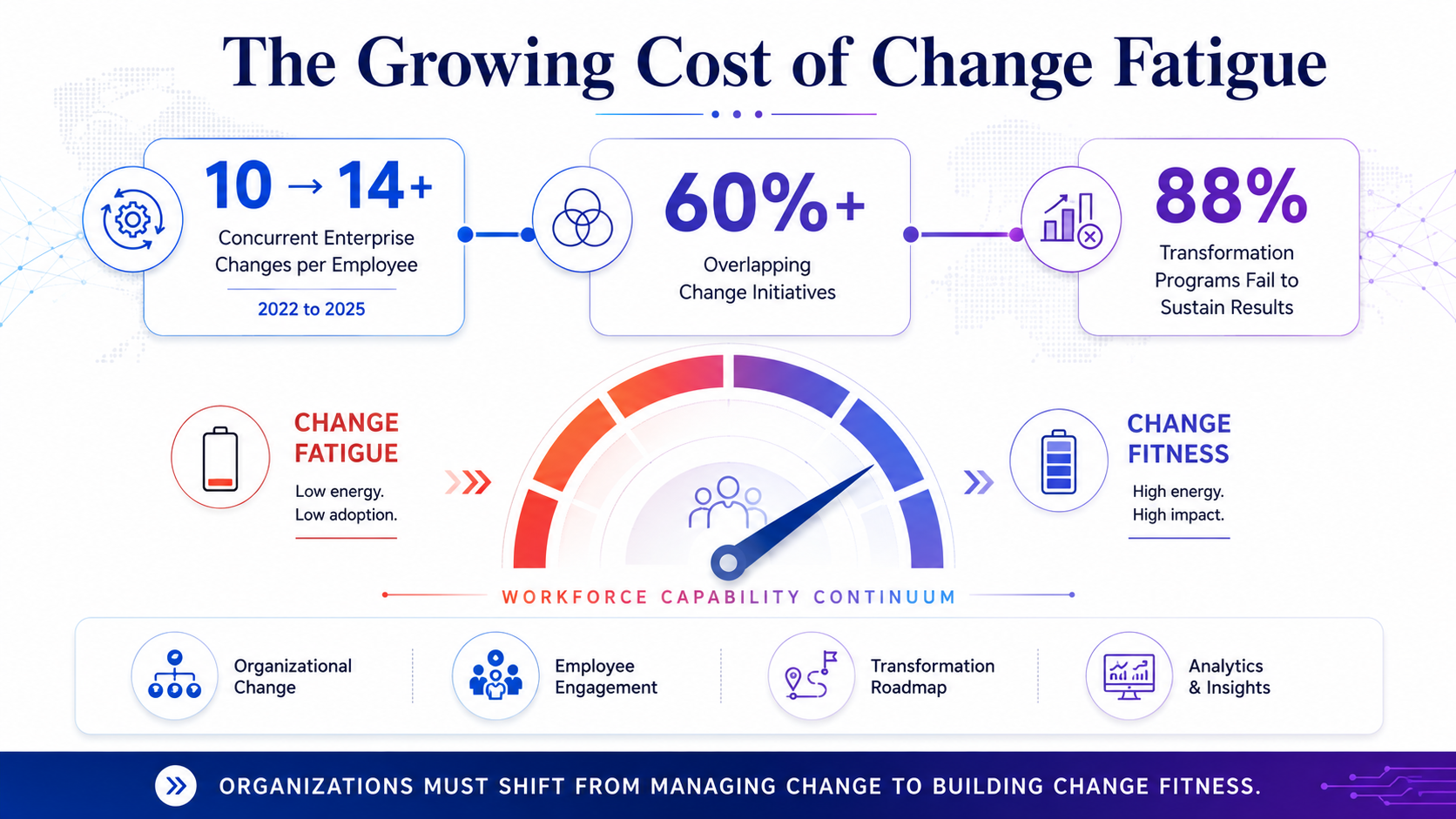
The evidence is stark and converging. Gartner research found that the average employee experienced 10 planned enterprise changes in 2022 -- nearly double the number from 2016. By 2025, estimates suggest employees navigating 14 or more concurrent change initiatives simultaneously, with overlap rates exceeding 60% in complex organizations. Gallagher's 2025 State of the Sector research identified change fatigue as one of the five most significant barriers to communications and HR effectiveness. And broader studies indicate that 88% of major transformation initiatives fail to deliver lasting results -- not because they are poorly conceived, but because they deplete the human resources required to sustain them.
Change fatigue is not simply feeling tired of change. It is a clinically recognized state of psychological and emotional exhaustion arising from repeated, overlapping organizational transformation demands. When employees operate in chronic change fatigue, they lose access to the exact cognitive and emotional resources required to sustain change: attention, creative thinking, risk tolerance, and collaborative energy. The initiatives multiply; the capacity to absorb them does not.
88%Of major transformation initiatives fail to deliver lasting results -- not due to poor strategy, but because episodic change management cannot sustain continuous transformation demands (Multiple research sources, 2024-25) |
"The organizations that will lead in the next decade are not those that manage change better. They are those that build the organizational fitness to absorb continuous change as a natural operating condition." -- Harvard Business Publishing, Building the Fitness to Sustain Transformation, 2026 |
What Is the Difference Between Change Management and Change Fitness?
Change management treats transformation as an exceptional event -- a discrete initiative with a defined beginning, structured implementation, and declared completion. This model was designed for a world in which organizational disruptions were episodic: a major restructuring every few years, a new system deployment, a strategy pivot. In that world, the episodic model was adequate.
That world no longer exists. Digital evolution, AI disruption, sustainability imperatives, geopolitical reconfiguration, and macroeconomic volatility are not arriving as discrete, manageable waves. They are arriving simultaneously and continuously. The episodic change management model responds to this reality by launching more initiatives, assigning more project managers, and scheduling more communication cascades -- amplifying the exact conditions that generate change fatigue.
Change fitness is a different response entirely. Rather than treating each wave of disruption as a project to be managed, change fitness treats continuous adaptability as an organizational capability to be built and sustained. The distinction is analogous to the difference between medical treatment and physical fitness: you manage an illness episode, but you build fitness as a permanent underlying capacity that determines how your body responds to stressors. Organizations with high change fitness do not manage each transformation more efficiently -- they have built the structural, cultural, and behavioural infrastructure that enables them to absorb continuous transformation with less depletion and faster adaptation.
Research by organizational psychologists Rafferty and Minbashian (2019) establishes that cognitive beliefs and positive emotions about change -- the psychological substrates of change fitness -- are significantly more predictive of sustained change-supportive behaviour than communication quality or change management process rigor. Change fitness is therefore a people and culture capability, not a project management capability.
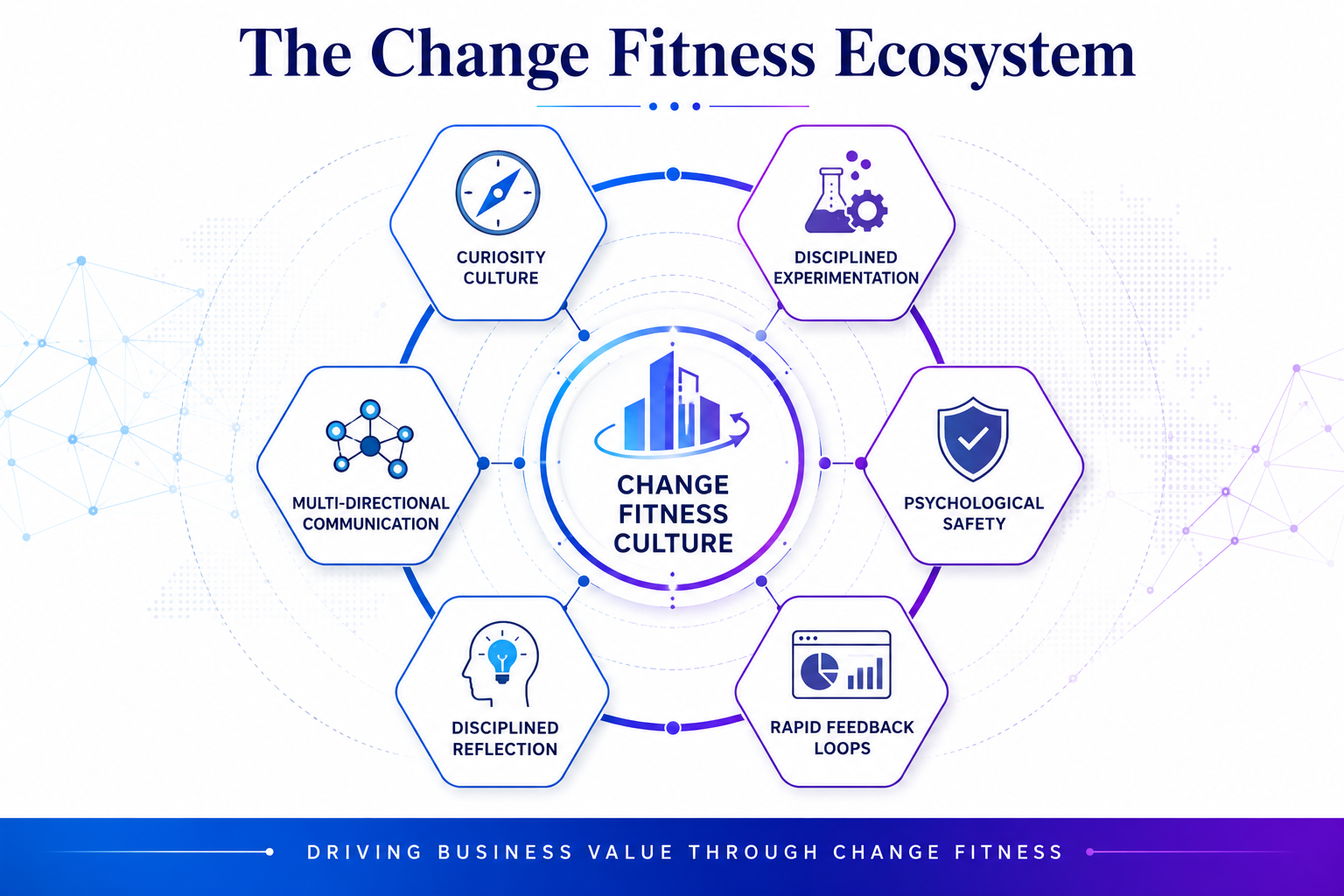
What Does a Change-Fit Organization Actually Look Like? Six Interconnected Capabilities
Capability 1: Curiosity as a Cultural Operating System
Change-fit organizations cultivate what researchers call 'complexity capacity' -- the ability to hold multiple, sometimes contradictory realities simultaneously without becoming paralysed. This capability manifests in teams that engage in continuous sensemaking as an embedded routine: asking 'What has changed this week relative to last?' in team standups rather than waiting for clarity that may never fully arrive. Curiosity is not treated as a personality trait of certain individuals -- it is designed into team rituals, meeting structures, and leadership behaviours as an organizational operating norm.
Capability 2: Disciplined Experimentation
Organizations experiencing high change fitness demonstrate a counterintuitive characteristic: they fail more frequently but succeed more consistently. The distinction lies in their relationship with failure. Change-fit cultures have structurally reframed failure as learning data rather than performance evidence, establishing platforms -- hackathons, sprint-based innovation labs, rapid prototyping environments -- where experimentation is both expected and protected from reputational consequence. The financial services research literature consistently demonstrates that organizations with formal experimentation infrastructure recover more quickly from external disruptions because they have already built the muscle for rapid hypothesis generation and testing.
Cisco's Black Belt Academy provides a documented example of this principle at enterprise scale. By embedding game mechanics into transformation learning modules and creating a competitive, recognizable achievement framework, the organization converted learning engagement from a compliance activity into an iterative performance driver. Highly engaged teams showed significantly faster capability development, demonstrating how gamified experimentation structures function simultaneously as performance accelerators and cultural change catalysts.
Capability 3: Psychological Safety as Structural Foundation
No factor in the organizational behaviour literature is more consistently predictive of change fitness than psychological safety: the shared team belief that the environment is safe for interpersonal risk-taking. Research by Amiri, Azadi, and Rahimnia (2023) in the Open Psychology Journal establishes that psychological safety has statistically significant impact on team learning efficacy, knowledge sharing, and adaptive performance -- the exact capabilities that change fitness requires. Harvard Business Publishing research identifies it as 'the hidden engine behind innovation and transformation'.
Unlock the Full Research
Create a free account or sign in to access the complete methodology, deep-dive analysis, and key implementation frameworks.
Don't have an account? It's free to join.
Organization Learning Labs
Research & Insights Division


Comments