Capability Chains: Skills for Distributed Energy

Discover why distributed energy success demands capability chains, not just supply chains. Build workforce skills across the full energy ecosystem.
Why Distributed Energy Projects Fail: The Skills Gap Nobody Talks About
Distributed energy projects rarely collapse dramatically. Instead, they underperform slowly. Energy output drifts below projections. Fault resolution stretches from hours to days. Safety practices erode quietly over months. Customer confidence in clean energy erodes, threatening the political and commercial viability of the entire transition.
When post-mortems are conducted, the diagnosis habitually defaults to familiar culprits: equipment quality, financing delays, policy uncertainty, or supply chain disruptions. These factors matter. But a more fundamental and systematically underexamined cause consistently emerges from field evidence: the skills across the distributed energy ecosystem are structurally uneven.
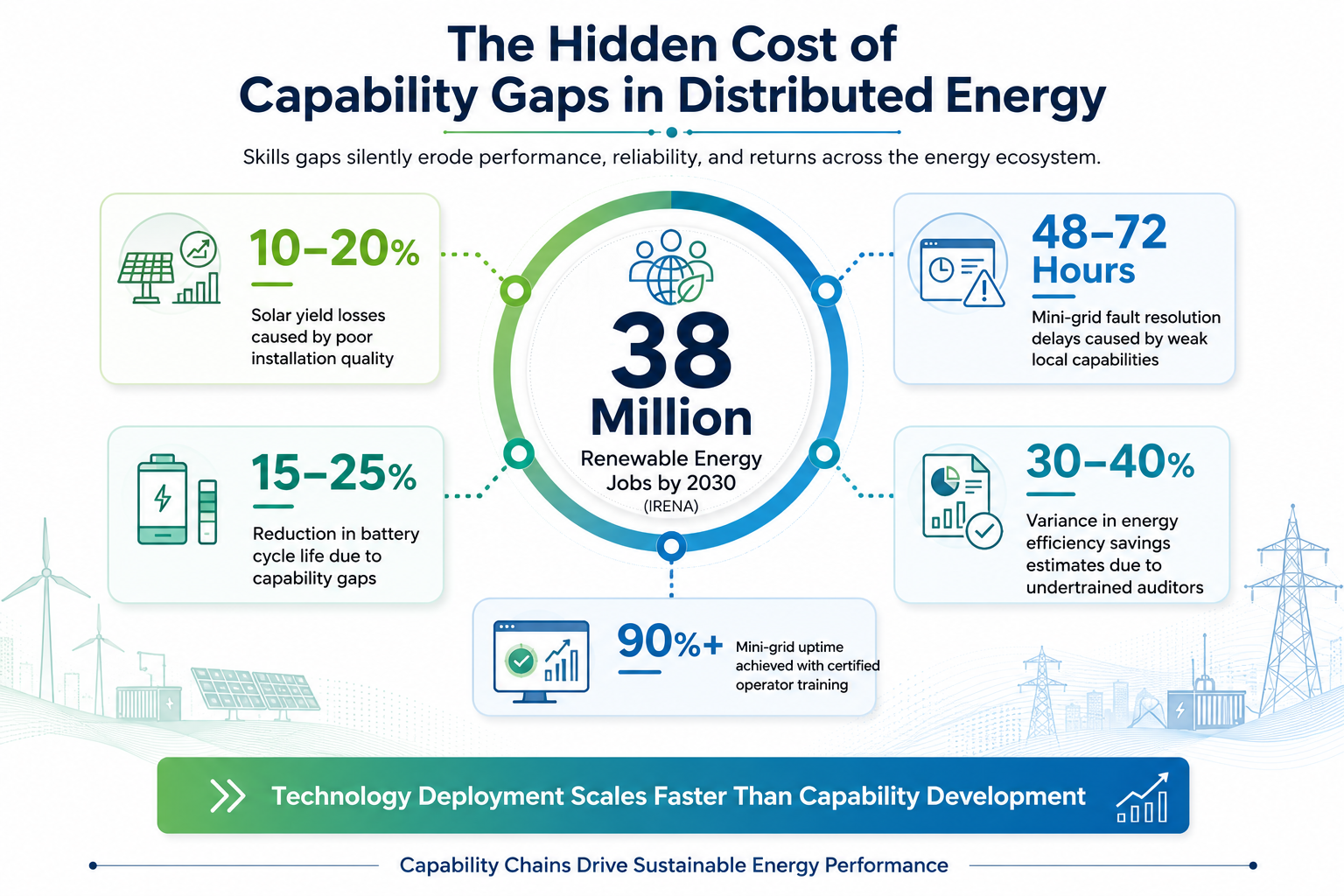
According to IRENA's Renewable Energy and Jobs Annual Review, the global renewable energy workforce reached 13.7 million jobs in 2022 and is projected to expand to over 38 million by 2030. Yet IRENA simultaneously flags that skill mismatches, inadequate training systems, and certification gaps represent critical barriers to achieving those deployment targets. The technology pipeline is robust. The human capability pipeline is not.
This asymmetry is the defining strategic risk for energy transition leaders in the decade ahead. And it demands a conceptual reframe: from supply chains to capability chains.
Why Supply Chains Are No Longer Sufficient: The Case for Capability Chains
The traditional supply chain lens in energy focuses on logistics and delivery. Equipment is manufactured, transported, installed, and handed over. Success is measured by on-time delivery and budget compliance. For centralized power generation -- large thermal plants, major hydroelectric facilities, grid interconnectors -- this framing is broadly adequate. The asset is operated by a concentrated pool of highly credentialed professionals in controlled, institutionally supported environments.
Distributed energy fundamentally disrupts this logic. Solar PV installations, mini-grids, distributed storage, and demand-side management programs create value not at commissioning, but over years and decades of operation. Their performance depends not only on what is installed, but on who installs it, who operates it day-to-day, and who maintains it after external contractors have moved on to the next project.
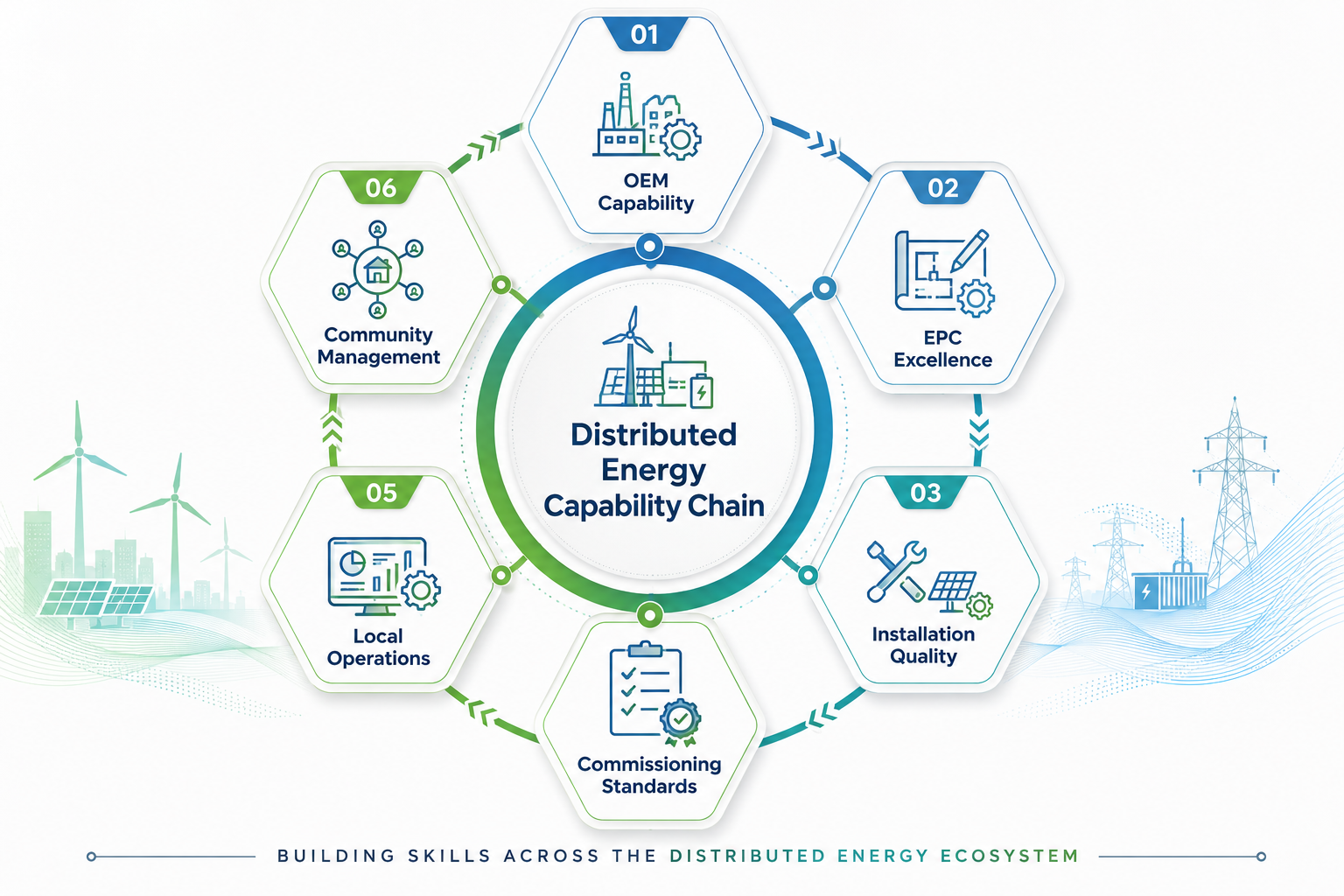
A capability chain reframes the energy value chain around people and skills. It recognizes that every link -- from the original equipment manufacturer (OEM) to the EPC contractor to the installer to the community-based operator -- must possess adequate technical, operational, and safety competence for projects to deliver lasting value. The chain is only as strong as its weakest link.
"Renewable energy deployment can only succeed at the pace and scale required if we treat human capability as infrastructure, not afterthought." -- IRENA Renewable Readiness Assessment Framework, 2022 |
In practice, this requires energy leaders to ask fundamentally different questions. Can EPCs design systems that reflect local operating realities, not just technical optima? Do installers understand quality standards well enough to apply them under field conditions? Are community operators trained to diagnose faults and communicate with customers, or only to react to visible failures? The answers to these questions, more than any technology choice, determine whether distributed energy assets deliver on their investment case.
The Distributed Energy Skill Frontier: Why Scale Creates New Risk
Centralized power systems rely on a compact pool of highly specialized professionals operating in institutionally supported environments with strong feedback loops. Distributed energy systems are architecturally different. They depend on thousands of semi-specialized actors -- technicians, installers, SME operators, community energy managers -- working across diverse geographies, regulatory contexts, and institutional settings.
This dispersion creates compounding risk. According to the World Bank's Mini Grids for Half a Billion People report, technical capability gaps among local operators are among the top three causes of mini-grid underperformance globally. GOGLA's Quality Assurance Framework for Off-Grid Solar similarly identifies inconsistent installer skills as a leading driver of premature product failure and customer dissatisfaction in off-grid markets.
Energy Segment | Primary Capability Failure Mode and Consequence |
Solar PV (rooftop and utility) | Inconsistent installation quality leads to early degradation, safety incidents, and yield losses averaging 10-20% below projections (IEA, 2023) |
Mini-grids | Weak local O&M capacity causes fault resolution delays of 48-72 hours versus 4-8 hours benchmark, eroding customer trust (World Bank, 2022) |
Energy Efficiency Programs | Undertrained auditors produce savings estimates with 30-40% variance from realized outcomes, undermining financial models (IEA Energy Efficiency 2023) |
Distributed Storage | Lack of battery management skills reduces usable cycle life by 15-25%, increasing total cost of ownership (BloombergNEF, 2023) |
The pattern is clear. Informal learning, on-the-job improvisation, and experience-based skill transfer can sustain early-stage markets. As scale increases, they become structural constraints. Variability in skills maps directly and measurably to variability in outcomes.
Anatomy of a Capability Chain: Who Builds Skills and Where
A capability chain is not a training program. It is a systemic architecture that aligns skill development with the operational realities of each role across the value chain. For energy organizations building distributed portfolios, it has three interdependent layers.
Upstream: OEM and EPC Capability
At the upstream end, manufacturers and EPC contractors must ensure that system designs are not only technically optimal but operationally executable by local teams. Overly complex designs introduce failure modes that only surface during operation, when external contractor support is no longer available. OEMs that co-design installation protocols with local partners, and EPCs that embed capability transfer into project delivery, systematically outperform those that treat handover as an administrative milestone.
Midstream: Installation and Commissioning Quality
At the installation level, technicians need competencies well beyond basic electrical skills. They must understand system integration principles, quality assurance protocols, and commissioning verification processes. The IEA's Renewable Integration and Sustainable Energy report identifies poor installation quality as one of the three leading causes of early solar PV system degradation globally. Standardized certification programs for installers have demonstrated 15-30% reductions in post-installation fault rates in markets where they have been rigorously implemented.
Unlock the Full Research
Create a free account or sign in to access the complete methodology, deep-dive analysis, and key implementation frameworks.
Don't have an account? It's free to join.
Organization Learning Labs
Research & Insights Division


Comments