Building Last-Mile Delivery Capability | OLL Research Insights

A leadership guide to building last-mile delivery capability that protects reliability and customer trust while controlling cost per stop and margins.
Owning the Doorstep: Building Last-Mile Delivery Capability That Keeps the Customer Promise Without Breaking the Cost Model
Why the Doorstep Has Become the Most Expensive, Most Strategic Part of the Network
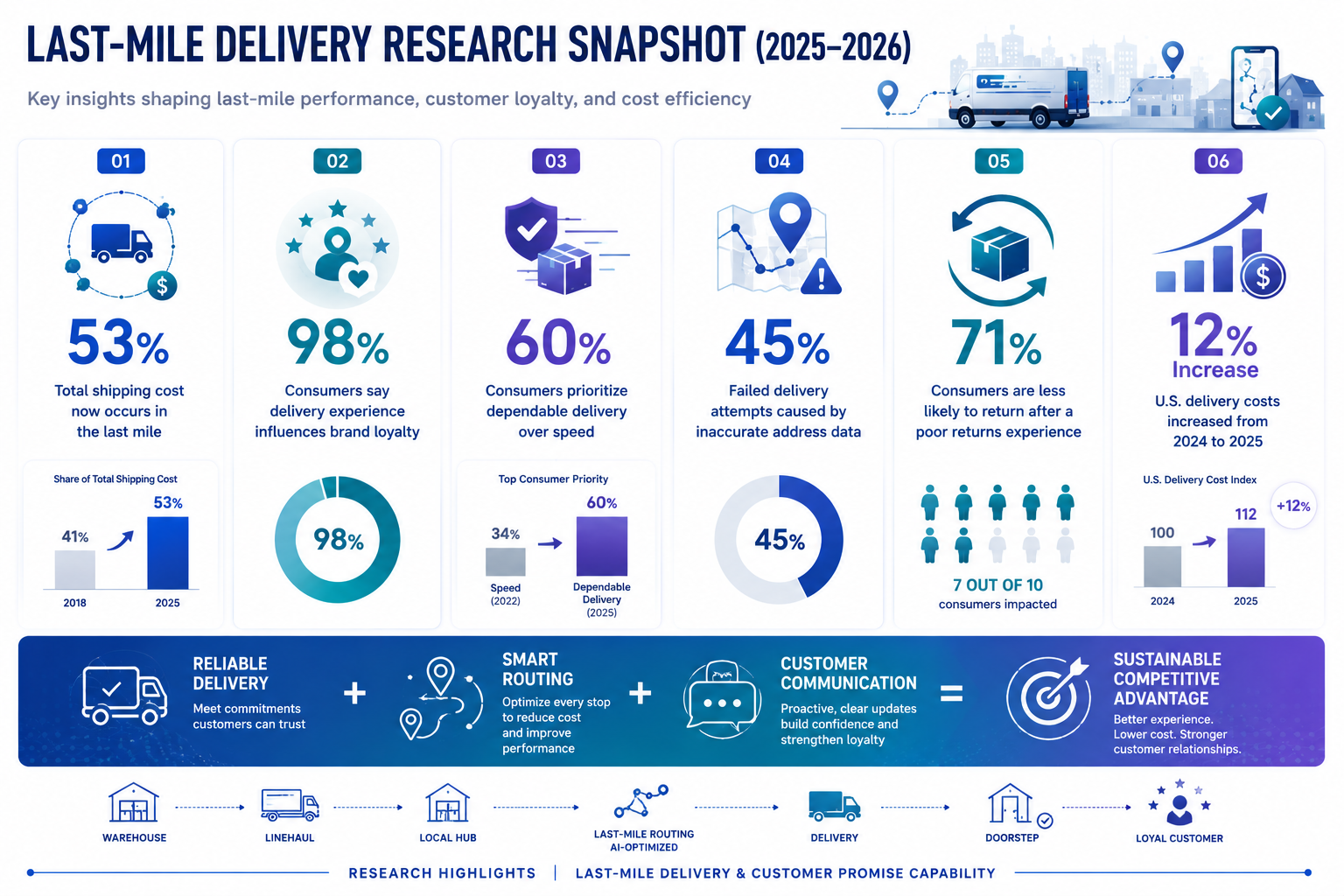
Last-mile delivery now accounts for roughly 53 percent of total shipping costs, up from around 41 percent of total shipping in 2018, making it the single most expensive and operationally complex segment of the entire supply chain. It is also now the segment customers actually experience directly; 98 percent of consumers say delivery experience shapes their brand loyalty, which means last-mile capability has quietly become a brand capability, not merely an operations line item. The strategic question for leaders is no longer how to make delivery faster. McKinsey research shows that reliable, predictable delivery commitments have overtaken pure speed as the top consumer priority, with 60 percent of consumers now valuing dependable delivery over expedited delivery, and speed itself falling from the top consumer priority in 2022 to fifth place by the most recent surveys.
Roughly 53% of total shipping costs now sit in the last mile, and 98% of consumers say delivery experience shapes their brand loyalty. ClickPost, Last-Mile Delivery Statistics, 2026; CDS Logistics, 2026 |
Practical Capability Building Blocks for Last-Mile Excellence
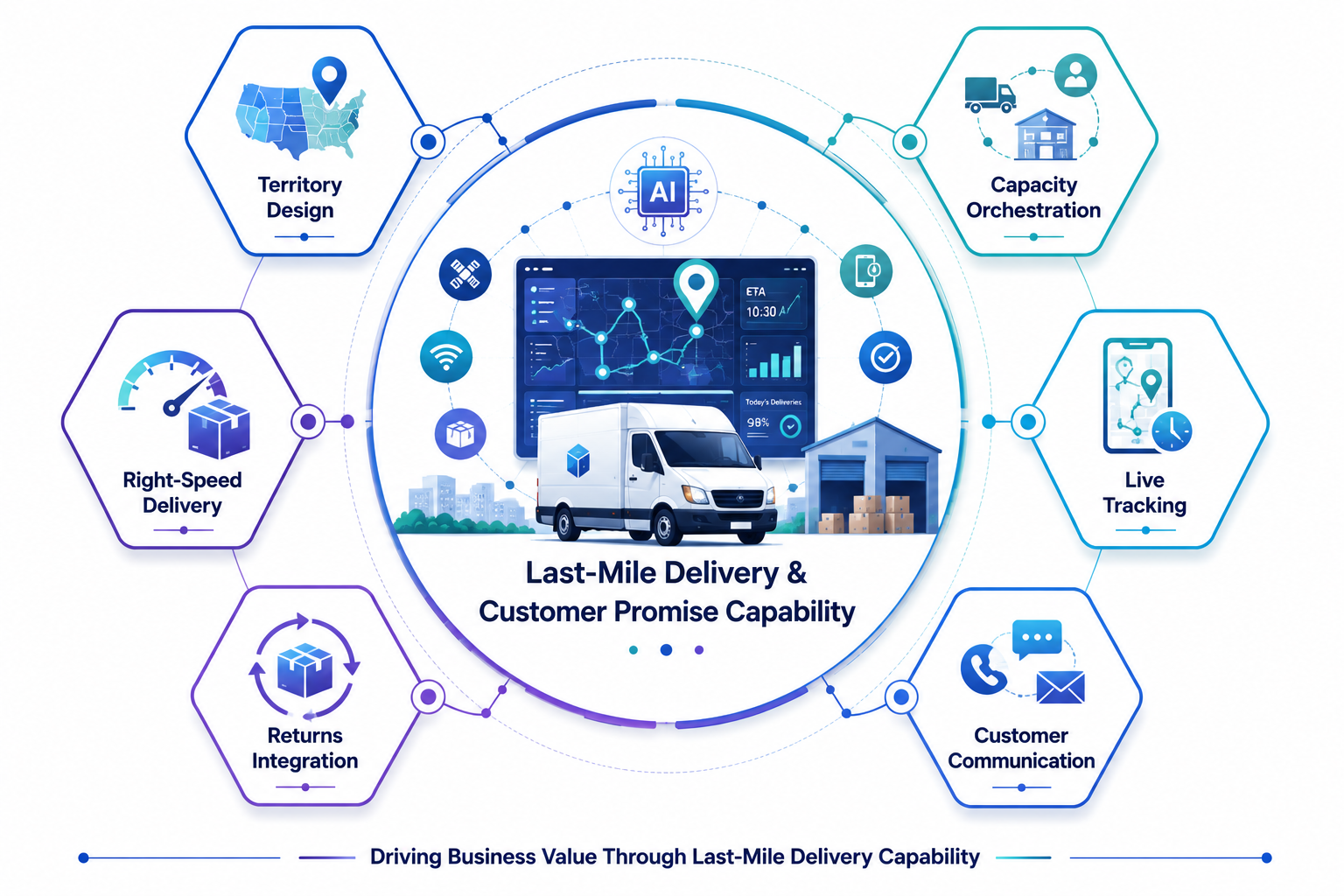
Territory Design and Micro-Routing
Urban deliveries average roughly 10 dollars per package while rural deliveries can reach 50 dollars, a cost variance driven almost entirely by territory design and route density before a single failed attempt or return is even considered. Precise micro-routing, factoring in live traffic, weather, and delivery windows rather than static distance calculations, is now treated as standard practice among leading operators, not an advanced capability reserved for the largest carriers.
Capacity and Partner Management
Single-carrier reliance has become a recognized business risk in its own right; major carrier rate hikes, capacity shifts, and policy changes, such as UPS reducing the volume it handles for Amazon by more than half, have exposed brands that had not diversified across their own fleet, third-party logistics partners, and gig delivery capacity. Building the organizational capability to orchestrate across these three capacity types dynamically, rather than defaulting to a single carrier relationship out of convenience, is now a resilience requirement, not a procurement optimization.
Real-Time Status Communication
Communication failure is a direct driver of delivery failure, not merely a symptom of it. Inaccurate or outdated address information alone accounts for 45 percent of failed delivery attempts, and 71 percent of retail businesses cite inaccurate addresses as a top cause of delivery issues, while roughly a third of companies either do not verify address data at all or leave that verification entirely to the courier. Proactive, real-time status communication, address verification at checkout, SMS alerts with live tracking, and clearly scheduled delivery windows, is one of the highest-return, lowest-cost capability investments available in last-mile operations.
Behavioral and Service Elements at the Doorstep
Every failed delivery carries a direct cost of approximately 17 to 18 dollars once labor, customer service handling, and logistical disruption are accounted for, and even a modest 5 percent failure rate can produce close to 200,000 dollars in annual losses for an operation handling 140,000 orders. But the larger cost is behavioral, not financial: roughly 23 percent of consumers refuse to reorder after a failed delivery, and 21 percent report losing trust in the retailer entirely as a result. Clear, well-rehearsed protocols for failed deliveries, returns, and complaint handling, including how a driver or delivery partner communicates and recovers in the moment, directly determine whether a single service failure becomes a lost customer or a preserved relationship.
Consumers now prioritize dependable deliveries over expedited deliveries. - McKinsey and Company, last-mile consumer research |
Implementable Practices and the Metrics That Matter
Operations that consistently protect both the customer promise and the cost model share a common practice set:
- Documented playbooks for peak-volume days, weather disruption, and service failures, tested before peak season rather than improvised during it.
- Micro-training delivered through mobile content for drivers and delivery partners, focused on doorstep behavior, problem handling, and communication protocols.
- A core metrics set, typically first-attempt success rate, customer satisfaction or NPS specific to delivery, and cost per stop, reviewed at the same weekly cadence as broader network KPIs, not treated as a separate reporting stream.
- Address verification embedded at the point of order capture, not left to the courier at the point of delivery, directly addressing the largest single cause of failed attempts.
The Returns Connection: Why Reverse Logistics Belongs in the Last-Mile Conversation
Unlock the Full Research
Create a free account or sign in to access the complete methodology, deep-dive analysis, and key implementation frameworks.
Don't have an account? It's free to join.
Organization Learning Labs
Research & Insights Division


Comments