Building Fleet & Network Operations Capability

A leadership guide to building fleet and network operations capability that lowers cost per mile, lifts OTIF, and future-proofs transportation networks.
From Routes to Runtime: Building Fleet and Network Operations Capability for the Next Decade of Transportation Leadership
Why Fleet and Network Operations Capability Is Now a Boardroom Issue
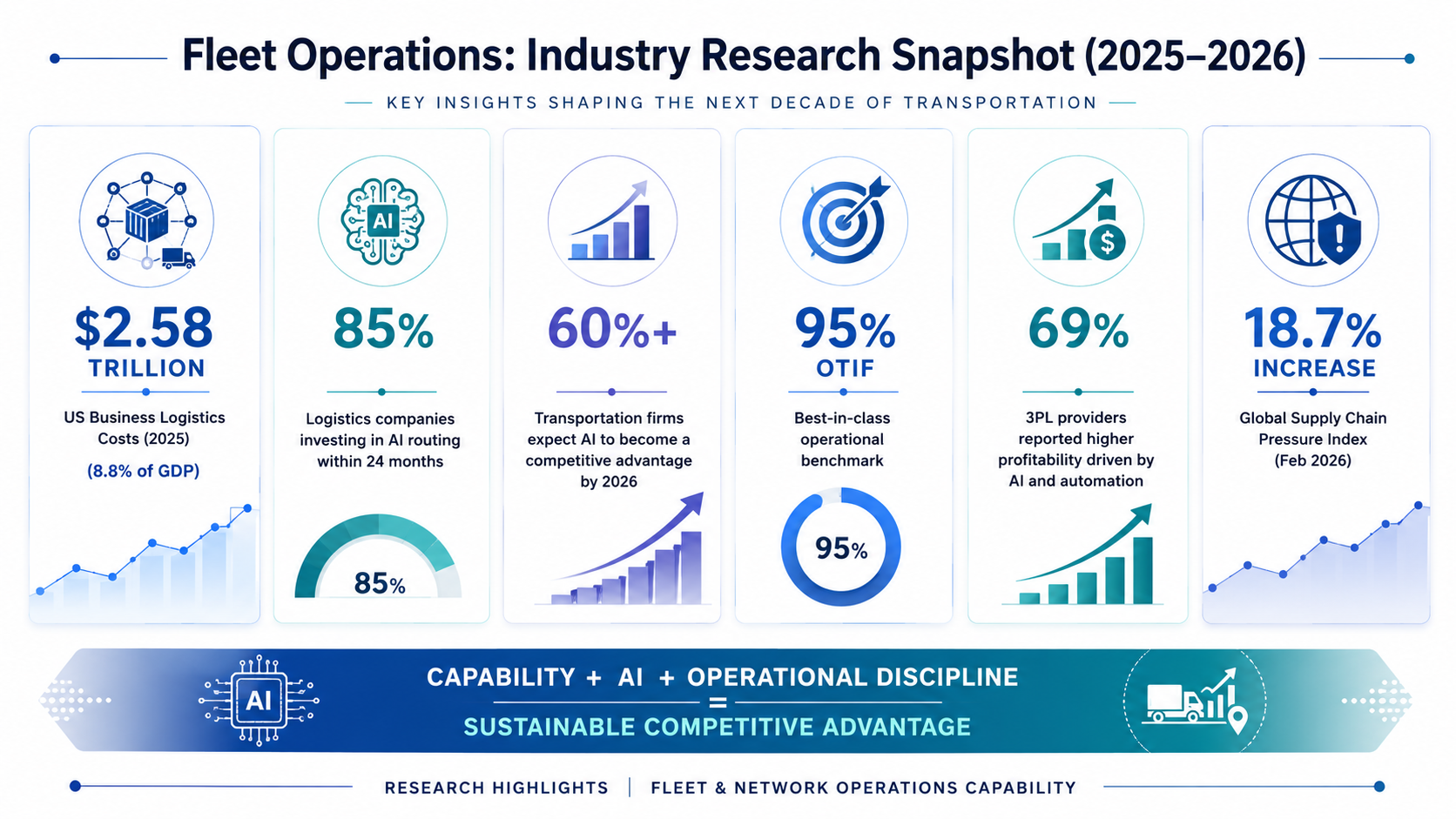
For two decades, fleet and network operations sat comfortably inside the operations function, measured on cost per mile and reviewed in monthly ops meetings. That era is over. Between 2020 and 2025, transportation and logistics networks absorbed demand whiplash, capacity normalization, and a structural shift in customer expectations around visibility and reliability. Boards now ask a different question: not "are trucks moving," but "can this network absorb the next shock without breaking its cost structure or its service promise." That question cannot be answered by technology procurement alone. It is answered by capability: the planning discipline, dispatch judgment, and exception-handling routines that determine whether a network performs on an ordinary Tuesday and on a disrupted one.
The economics make the case bluntly. US business logistics costs reached 2.58 trillion dollars in 2025, equal to 8.8 percent of national GDP, and cost inflation from fuel volatility, labor, and asset replacement continues to compress margins even as demand has stabilized. At the same time, digital and data expectations have shifted from optional to essential for competitiveness, with clients now expecting real-time visibility and predictive service levels that legacy planning processes were never built to deliver. Closing that gap is a capability-building exercise before it is a software-buying exercise.
US business logistics costs reached $2.58 trillion in 2025, equal to 8.8% of national GDP. Penske / Council of Supply Chain Management Professionals, 2025 |
The Four Capability Blocks That Define Operational Excellence
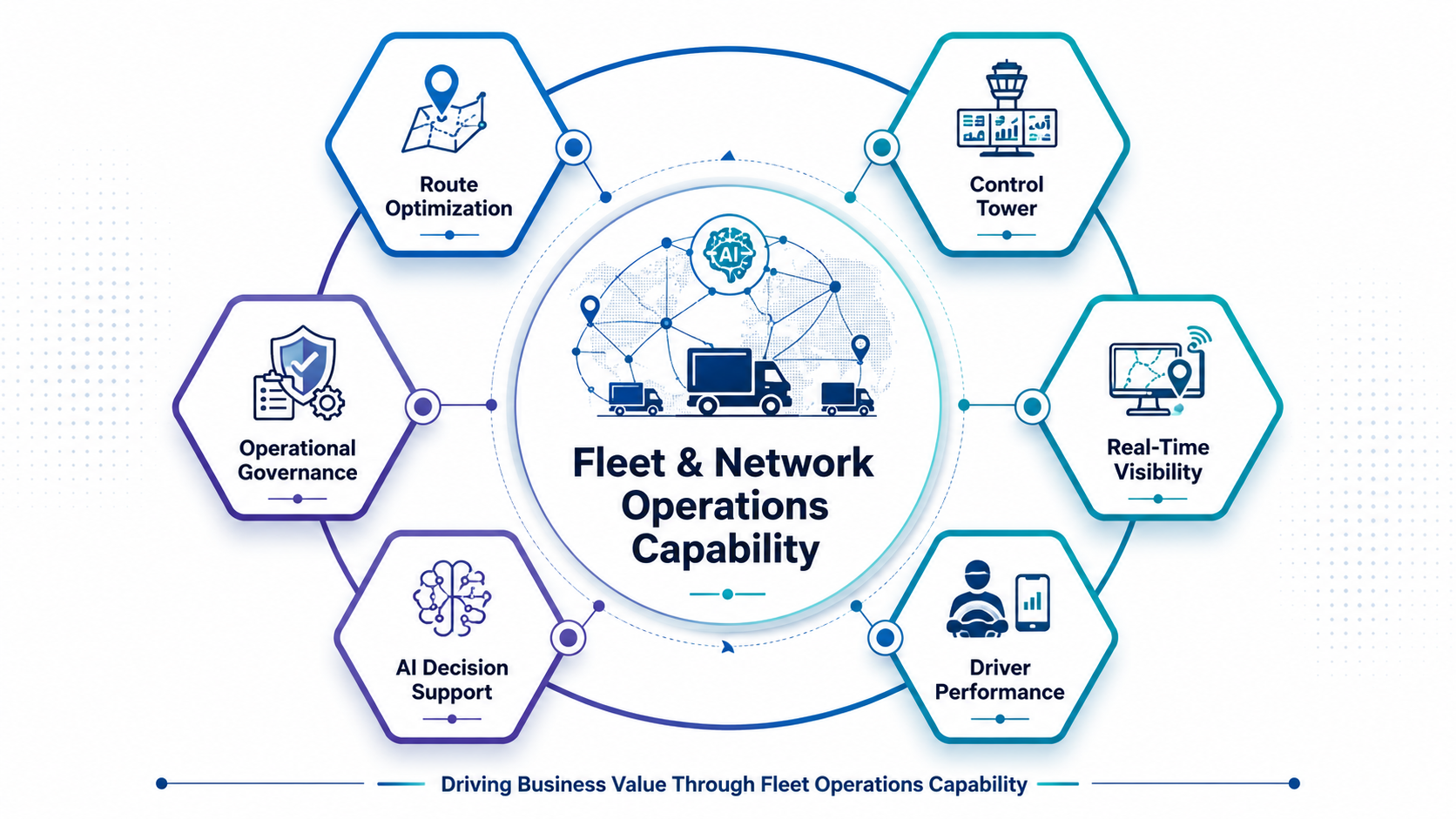
Operational excellence in transportation is rarely won through a single system implementation. It is built across four interlocking capability blocks, each of which requires its own routines, skills, and governance rather than a single dashboard rollout.
Route Planning and Load Optimization
Route planning has moved well beyond distance minimization. Leading operators now plan against vehicle constraints such as hours of service, hazardous materials rules, and tonnage limits, not distance alone, treating this as a technological standard rather than an advanced capability. Gartner’s 2025 Supply Chain Survey found that 85 percent of logistics companies plan to invest in AI tools for routing and cost prediction within the next 24 months, and Deloitte reports that more than 60 percent of transportation companies expect AI to be a source of competitive advantage by the end of 2026. The capability gap is not access to optimization software; it is the planning discipline to feed it clean constraint data and to trust its outputs over habit-driven manual overrides.
Dispatch and Control-Tower Operations
Dispatch is where planning intent meets operational reality, and it is where most networks lose their promised efficiency. A defined control-tower operating rhythm, aggregating orders, capacity, and exception status into a single view, is now the baseline expectation rather than a differentiator, though execution maturity varies widely. The capability that separates leaders is not the existence of a control tower but the authority and skill of the people staffing it: control-tower leads and duty managers who can convert an alert into a reallocation decision within minutes, not a ticket that waits for the next shift.
Real-Time Visibility and Exception Management
Visibility has become table stakes, but exception management remains the harder, less automated discipline. Truck turnaround time at the dock and yard exceeded 90 minutes in 2025 for most large US fleet operations, a figure increasingly tracked as a leading indicator of dock and warehouse efficiency rather than transportation efficiency alone. Reducing turnaround below 60 minutes typically requires coordinated change across yard management and warehouse receiving, not a transportation fix in isolation. This is the clearest evidence that fleet capability cannot be built as a function-level exercise; it has to be designed as a cross-functional operating system.
Driver Performance and Safety Management
Driver capability is both a safety and a service-quality lever. Multimodal UI tools, including voice-activated controls and gesture-based interfaces, are increasingly deployed specifically to improve driver safety and productivity, reflecting an industry recognition that driver-facing technology succeeds or fails on usability under real driving conditions, not on feature count. Structured driver performance management, covering safety incidents, on-time performance, and coaching cadence, remains one of the most underbuilt capability areas in mid-sized fleets even as it directly drives OTIF outcomes.
From Practice to Discipline: The Daily Operating Rhythm
Capability is built through routines that repeat daily, not through a change program that runs for a quarter and fades. Networks that consistently outperform on cost and service share a common operating rhythm:
- A daily planning huddle grounded in actual order, capacity, and constraint data, not yesterday’s assumptions carried forward by habit.
- A standard, written workflow for delays, re-routing, and escalation, so responses do not depend on which dispatcher is on shift.
- A simple, shared set of KPIs, typically OTIF, cost per kilometer or stop, empty-run percentage, and delay-reason codes, reviewed at the same cadence by planners, dispatchers, and drivers.
Unlock the Full Research
Create a free account or sign in to access the complete methodology, deep-dive analysis, and key implementation frameworks.
Don't have an account? It's free to join.
Organization Learning Labs
Research & Insights Division


Comments