Building a Transportation Talent Capability System

A leadership guide to building a skills-based talent and learning system for transportation and logistics teams, mapped to a 2035 capability horizon ahead.
From Roles to Skills: Designing a Practical Talent and Learning System for Transportation and Logistics Teams
Why the "Skills Gap" in Transportation Is Not Quite What It Appears
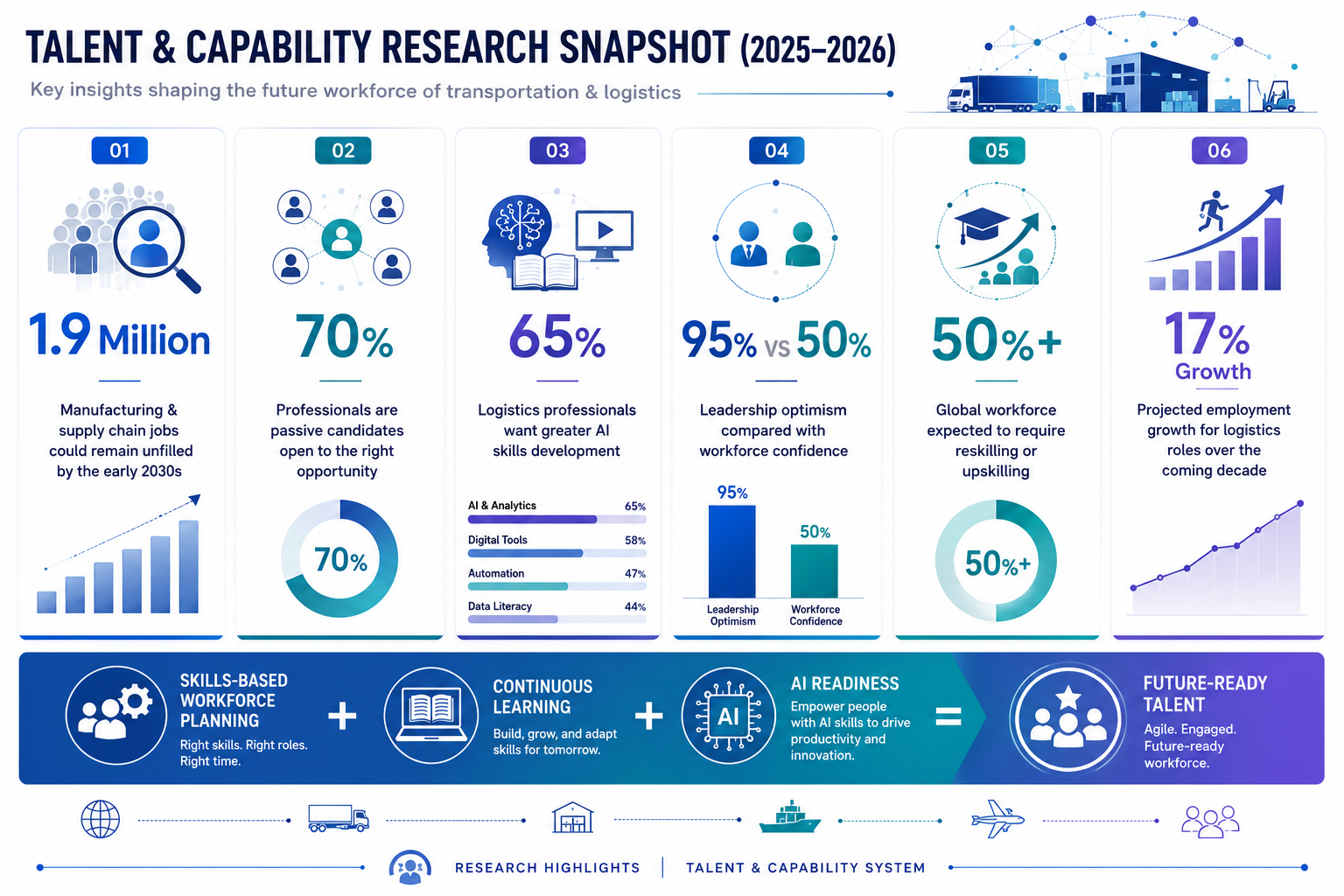
The dominant narrative in transportation and logistics talent is scarcity: the right candidates do not exist, or they are increasingly rare. That narrative is not entirely wrong, but it is incomplete. Job postings requiring AI-adjacent skills in operations, procurement, and logistics have more than doubled in recent years, which means the role an organization is hiring for today genuinely looks different from the same role two years ago. But a significant portion of the hiring friction being labeled a skills gap is, in practice, a sourcing and evaluation problem: most companies reach only the roughly 30 percent of professionals actively searching, while missing the 70 percent who would move for the right opportunity, and nearly a quarter of hiring decision-makers admit they struggle to evaluate candidates whose skills were self-taught or non-traditionally acquired. Building a genuine talent and capability system, not just a recruiting funnel, is how leading organizations are closing this gap.
Roughly 1.9 million manufacturing and supply chain jobs could go unfilled in the US by the early 2030s if talent challenges are not addressed. Deloitte and The Manufacturing Institute, 2025 |
A Capability Model in Plain Language
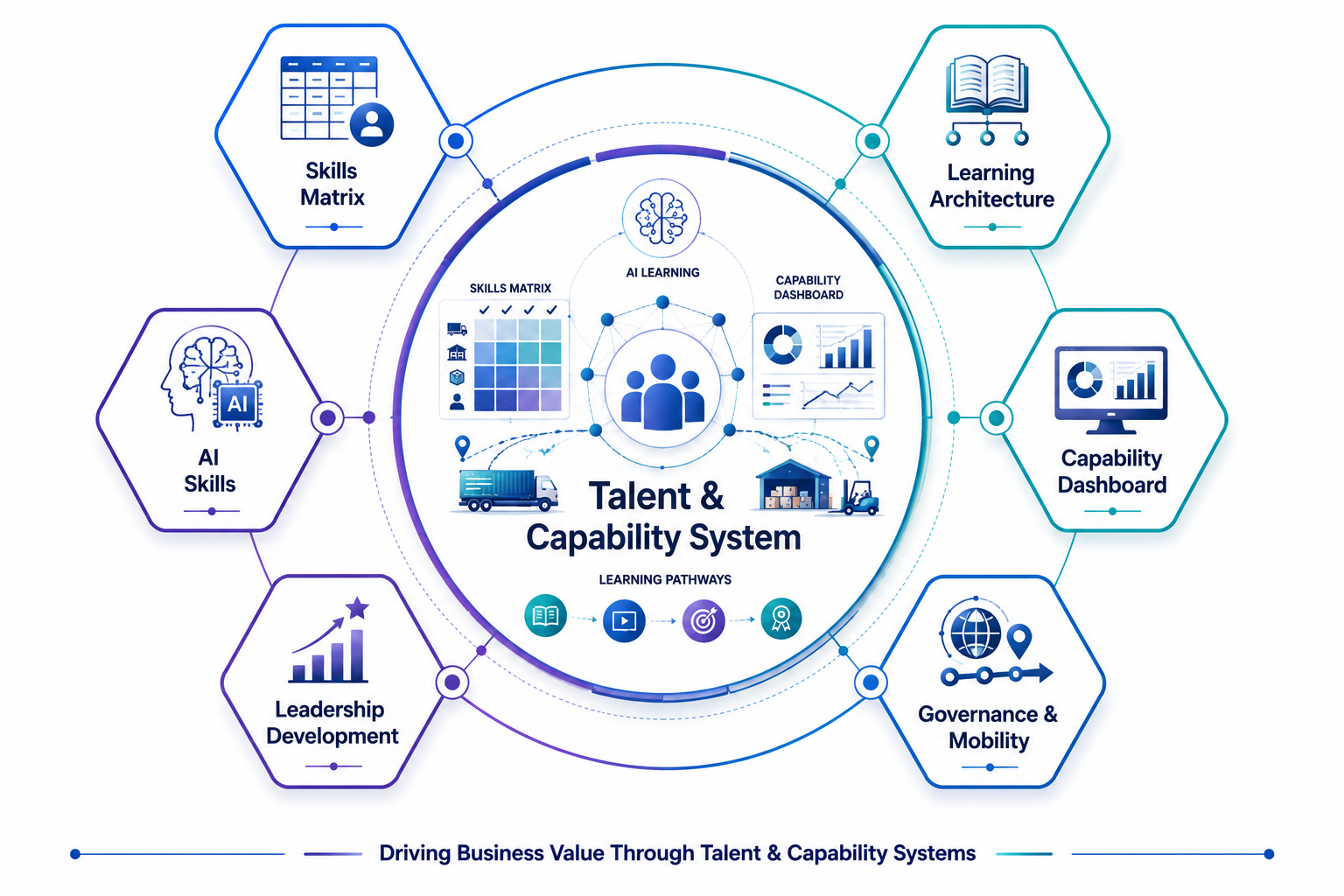
The starting point for any durable talent system is a shared, plain-language capability model, not a job-title list. Transportation and logistics organizations that build this well typically organize it around core domains, network and transport, warehousing, planning, customer service, and data and analytics, layered with cross-cutting skills that apply across every domain: problem solving, communication, digital fluency, and a genuine safety mindset. The World Economic Forum’s Jobs of Tomorrow research names transport and logistics as one of seven major global job families being actively recoded by four converging technology forces, which means the capability model itself needs to be treated as a living document, reviewed at least annually, rather than a static organizational chart translated into competencies once and left unchanged.
Practical Capability Mapping: The Skills Matrix
A simple skills matrix, mapped per role, planner, dispatcher, supervisor, driver, warehouse lead, is the single most practical tool for converting a capability model into day-to-day people decisions. Used well, it supports staffing decisions, promotion criteria, and, critically, the early identification of capability gaps before they become operational risk. By 2030, Deloitte’s manufacturing and supply chain research indicates AI-based management of employee skills and deployment will be a core capability, tracking employee skills and certifications alongside demand forecasts to identify staffing gaps before they affect production or service levels. Organizations that build the discipline of a well-maintained skills matrix now will be positioned to adopt that AI-augmented layer as it matures; organizations without the underlying matrix will have nothing for the AI layer to build on.
Learning Architecture: A 70-20-10 Model Built for Operations
The learning architecture that works best in transportation and logistics is rarely classroom-first. A 70-20-10 design, adapted for operational reality, consistently outperforms generic training calendars:
- 70 percent through on-the-job projects and rotations: a planner spending time in the control tower, a supervisor shadowing a driver route, a warehouse lead running a cross-functional Kaizen event.
- 20 percent through peer learning circles and structured after-action reviews following major disruptions, capturing operational lessons while they are still fresh rather than losing them to turnover.
- 10 percent through short courses or micro-modules focused specifically on tools, safety protocols, and analytics literacy, sized to fit around shift schedules rather than requiring extended time away from operations.
This design matters because it matches how the workforce actually wants to learn. Randstad’s Workmonitor 2026 research found that 65 percent of logistics talent want more investment in AI skills development specifically, yet many feel they must navigate that shift alone, without structured organizational support. A 70-20-10 architecture directly addresses that gap by embedding structured support inside daily operations rather than treating learning as something that happens separately from work.
The 2026 Global Human Capital Trends survey shows a shift from tensions to tipping points. - Deloitte Insights, 2026 Global Human Capital Trends |
Governance That Is Easy to Implement
A talent system without governance decays within a year, as skills matrices go stale and learning plans lose executive attention. The governance that sustains a capability system does not need to be elaborate: a monthly capability review with operations leadership, focused on skills coverage rather than training completion rates, and a simple capability dashboard tracking skills coverage, learning progress, and internal mobility. Randstad’s research identifies a "confidence gap" worth watching closely here: while 95 percent of business leaders are optimistic about growth, only about half of the talent population shares that optimism, a divergence that widens when communication about the capability system and its purpose is limited. Governance that includes visible, regular communication to the workforce, not just to leadership, is part of what makes the system durable.
Unlock the Full Research
Create a free account or sign in to access the complete methodology, deep-dive analysis, and key implementation frameworks.
Don't have an account? It's free to join.
Organization Learning Labs
Research & Insights Division


Comments