Bridging Clicks and Bricks: E-Commerce and Franchise Integration

How franchise and retail networks unify online and in-store operations. Roles, incentives, and the full capability blueprint for true omnichannel growth.
Bridging Clicks and Bricks
Building E-Commerce Capability That Integrates Retail Stores and Franchise Networks Seamlessly
Introduction: The Omnichannel Promise Meets Franchise Reality
Brick-and-mortar retail still generates more than 80 percent of global retail revenue, and in the United States physical stores produced an estimated 1.46 trillion dollars of sales in the first quarter of 2025 alone. The strategic question for retail and franchise leaders was never whether to abandon stores for digital, it was always how to make the two work as one system. Most organizations answer that question badly. Stock is not visible across channels, prices and promotions drift out of sync between the website and the till, and a customer who orders online and picks up in a franchise location can find staff who were never told the order was coming.
The National Retail Federation has found that roughly three-quarters of shoppers now use multiple channels before committing to a purchase, and research compiled from Capital One and Harvard Business Review shows omnichannel customers spend meaningfully more per order and carry substantially higher lifetime value than single-channel shoppers. The gap between that opportunity and what most franchise networks actually deliver is a capability gap, not a technology gap. Buy Online, Pick Up In Store has moved from pandemic-era convenience to a baseline expectation, with U.S. click-and-collect sales projected near 178 billion dollars in 2026, up more than 15 percent year over year, yet a large share of retailers still cannot guarantee the inventory accuracy that makes the promise reliable.
The Structural Capability Franchise Networks Actually Need
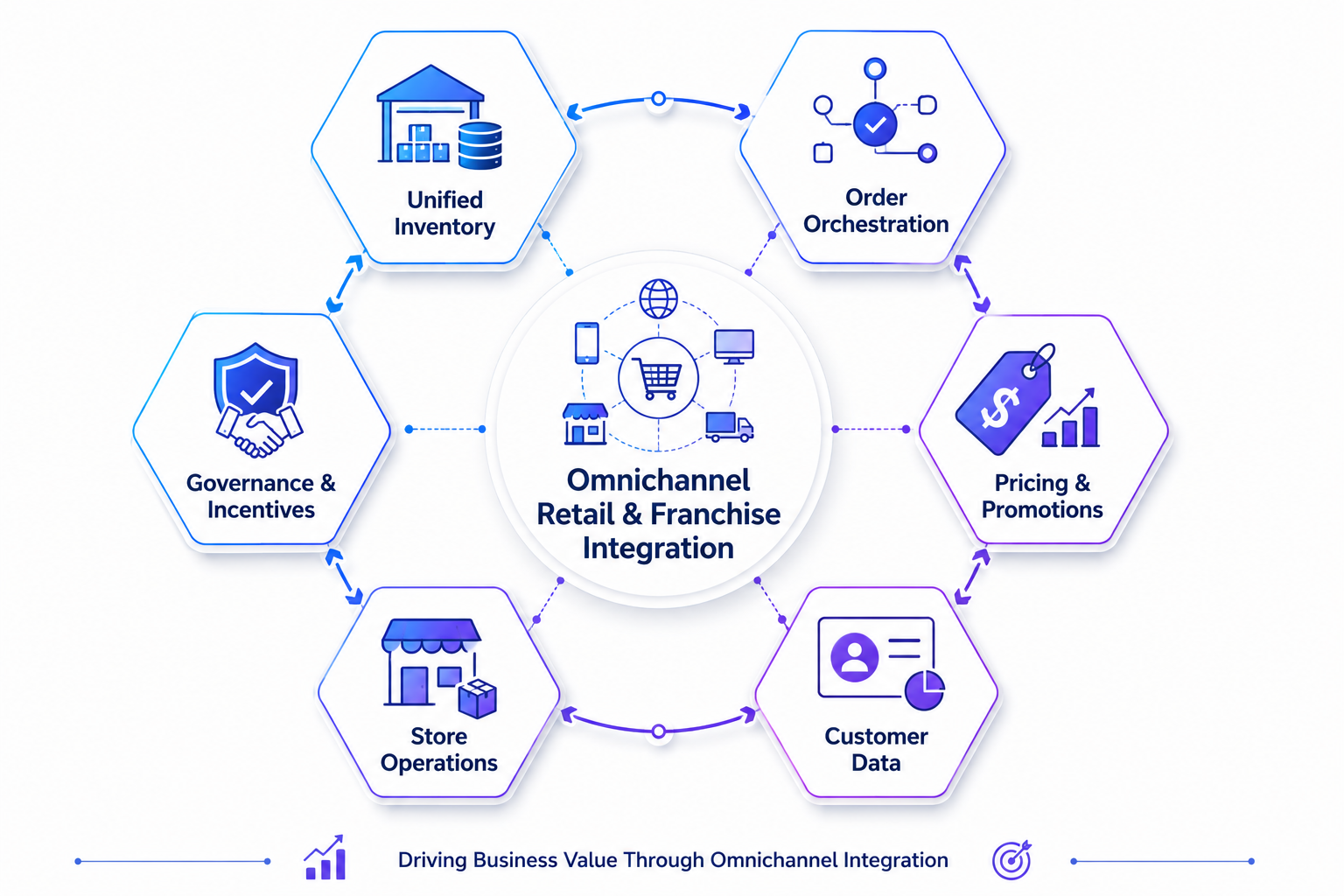
Four structural capabilities separate franchise and retail networks that make omnichannel work from those that merely announce it. Unified inventory gives every channel, and every franchise location, a single, near real-time view of available-to-promise stock, typically refreshed in under sixty seconds from point-of-sale, e-commerce, warehouse management, and third-party logistics systems. Order orchestration decides, for every order, which location or fulfillment path serves it best, based on proximity, stock, staffing, and cost, not on which system happened to capture the order first. Pricing and promotion coherence ensures a customer sees the same price and the same offer whether they are on the app, the website, or standing in a franchise location. Shared customer data means a loyalty history, a return, or a complaint recorded in one channel is visible in every other channel the customer touches next.
An Order Management System is the technical backbone that makes these four capabilities operational rather than aspirational. It functions as the central nervous system of omnichannel retail, maintaining a global inventory ledger and orchestrating fulfillment decisions against configured business rules. Retailers that get this layer right report fulfillment cost reductions of 20 to 30 percent from unified inventory alone, before any customer-facing benefit is counted.
Why Franchise Networks Face a Harder Version of This Problem
Corporate-owned retail chains struggle to unify channels across their own operations. Franchise networks face a structurally harder version of the same problem, because inventory, staffing, and local commercial decisions sit with independent operators who did not sign up to run a fulfillment node for a central e-commerce engine. A commerce OS design that ignores this reality, treating franchise locations as interchangeable warehouse extensions, will meet resistance that has nothing to do with technology and everything to do with incentives, ownership, and trust.
How Store, Franchise, and Front-Line Roles Must Evolve
Integrating e-commerce with physical retail changes what it means to run a store, whether that store is corporate-owned or independently franchised. Store managers and franchisees increasingly own a set of responsibilities that did not exist a decade ago: ship-from-store fulfillment, in-store pickup and locker management, online return processing, and location-specific digital marketing that drives foot traffic from app and social channels. Front-line staff need enough digital literacy to trust and act on a real-time stock signal, to process a return that originated online without treating it as an anomaly, and to convert a pickup visit into an incremental sale, something roughly half of BOPIS shoppers already do when the experience is executed well.
• The upside is real and well documented: Retailers offering in-store pickup see meaningfully higher online order volumes, and NRF research shows retailers integrating advanced AI-driven fulfillment can reduce operational costs by up to 10 percent while lifting sales 5 to 7 percent, but only where store teams are equipped and incentivized to execute the fulfillment step reliably.
• Real-time inventory visibility is a front-line capability, not just a systems capability: Store associates and franchise staff need accurate, real-time visibility into what is available and where, not a nightly batch update that is already stale by the time a customer walks in expecting their order to be ready.
• Unified customer data changes what good service looks like on the floor: A single customer profile spanning online browsing, in-store purchase history, and loyalty status allows store staff to deliver the kind of relevant, informed service that keeps omnichannel customers loyal at markedly higher rates than single-channel shoppers.
Unlock the Full Research
Create a free account or sign in to access the complete methodology, deep-dive analysis, and key implementation frameworks.
Don't have an account? It's free to join.
Organization Learning Labs
Research & Insights Division


Comments