Boardroom-Ready Learning for IT Services CXOs

How IT services CXOs can move learning from HR cost centre to board-monitored strategic asset using behavioural science, outcome-linked metrics, and capability governance.
Boardroom-Ready Learning: How CXOs in IT Services Can Turn Behavioural Insight into Sustainable Competitive Advantage
Why learning governance is the hidden lever separating technology leaders from laggards — and how to move it from the HR agenda to the board agenda, permanently
Abstract
Despite record technology spend, the majority of digital and transformation programmes in IT services still fail to meet their value targets — and the reason is rarely the technology itself. It is what people do differently, every day, once the new platform, process, or account strategy goes live. This article reframes learning and behaviour as a board-level, strategy-level conversation for CXOs in IT services, translating behavioural science into language that boards, investors, and P&L owners already use.
It maps a behaviour-capability-performance chain that connects micro-behaviours — asking a sharper question in a sprint retrospective, documenting a near-miss during incident response, probing a client's real problem before scoping a deal — to measurable business outcomes. It outlines design principles for learning experiences that change behaviour rather than merely transfer information, proposes outcome-linked metrics CXOs can defend in a quarterly business review, and closes with a governance model and a five-move quarterly playbook for treating learning as a board-monitored strategic asset rather than an HR line item.
1. Why Learning Belongs in the Boardroom
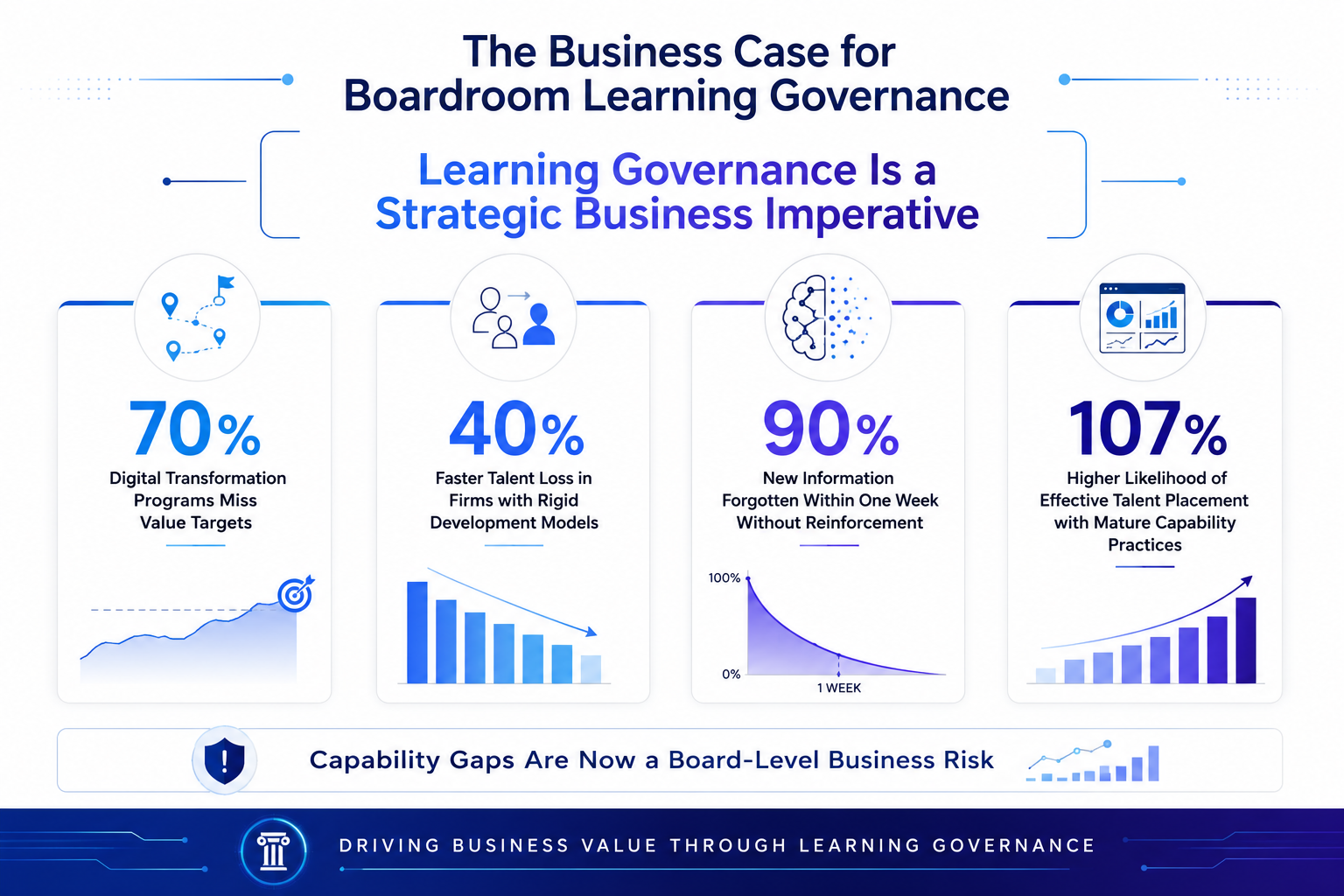
For years, consulting research — McKinsey and Boston Consulting Group among the most cited — has placed the failure rate of digital and technology transformation programmes at roughly 70 percent, measured against the value targets set at launch. That number has held remarkably steady across markets, technology cycles, and waves of new tooling. The post-mortem on a stalled transformation rarely blames the architecture diagram. It blames adoption: delivery teams reverting to familiar habits under deadline pressure, account teams continuing to sell the way they have always sold because nobody redesigned how they think rather than simply what they know, support engineers skipping a new triage process the first time a client escalates.
This article is written for CIOs, CHROs, Chief Delivery Officers, and CEOs of IT services and technology-enabled businesses who have learned — often expensively — that capability gaps now sit alongside cyber risk and regulatory exposure as material threats to enterprise value, and yet are rarely tracked, reported, or governed with anything like the same discipline.
The intent here is not to build a longer case for more training. It is to offer a translation layer between L&D, which tends to speak in courses completed and satisfaction scores, and the board, which speaks in margin, attrition cost, win rate, and time-to-value. Behavioural science gives CXOs a sharper vocabulary for the thing boards already sense matters: not what employees know, but what they reliably do under real operating conditions.
"Capability gaps in IT services now sit alongside cyber risk and regulatory exposure as material threats to enterprise value — yet are rarely tracked, governed, or reported with comparable discipline." — McKinsey Global Institute, Digital Capability Review, 2023 |
2. The Scale of the Challenge: Why Capability Is Now a Board-Level Risk
The evidence base for treating learning governance as a strategic risk management discipline — not an HR programme — is substantial and growing. Gartner's 2024 Future of Work survey found that 58 percent of IT services professionals describe their firm's career pathways as opaque or non-existent, a condition that directly correlates with attrition among the highest-potential professionals who have the most options. Deloitte's 2025 Human Capital Trends report identifies capability stagnation — the condition in which workforce skills fall progressively behind market demands — as the single largest strategic risk in professional services firms globally.
For boards governing IT services enterprises, the financial stakes are clear. The cost of replacing a mid-level technology professional in 2024 ranges from 50 to 200 percent of annual salary, when recruitment, onboarding, and productivity ramp costs are fully accounted for, according to SHRM benchmarks. McKinsey's 2023 talent research confirms that organisations with rigid utilisation frameworks lose their highest-potential employees 40 percent faster than firms with visible internal development paths. And WEF's Future of Jobs Report 2025 projects that 39 percent of existing skills will be disrupted or transformed by 2030 — a pace of obsolescence that no annual training cycle can address.
The question boards must be equipped to ask is not "do we have a learning programme?" It is "can we demonstrate, with evidence, that our capability investment is producing the behaviours that move our most critical business metrics?"
3. The Behaviour–Capability–Performance Chain
Most capability investment in IT services is designed — and measured — at the wrong altitude. Course completion is a proxy for exposure. Exposure is a proxy for knowledge. Knowledge is a proxy for the only metric that ultimately shows up in a P&L: behaviour, performed consistently, under pressure, at scale.
A four-layer chain makes the logic visible, and travels well in almost any leadership forum:
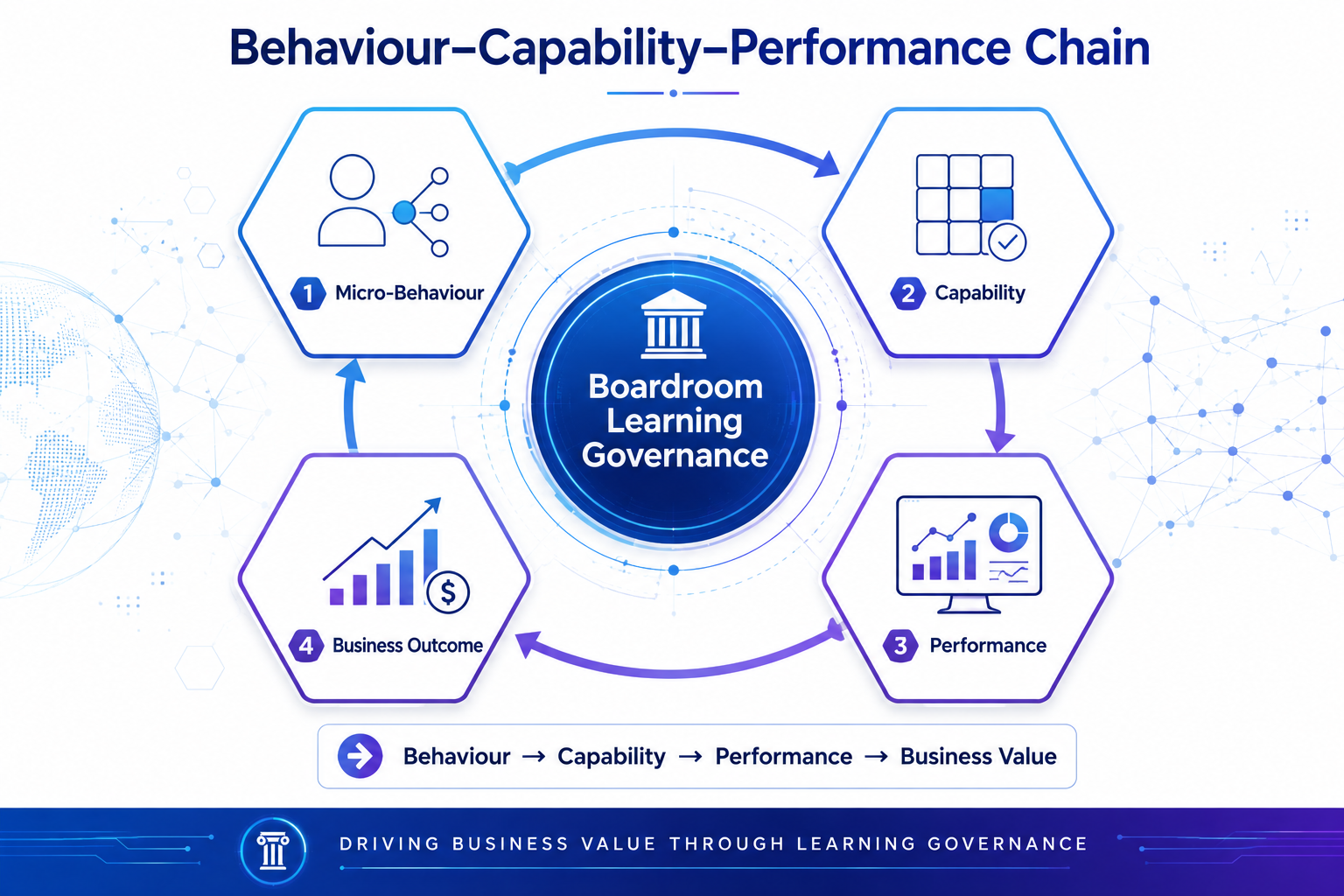
Layer | IT Services Example |
Micro-behaviour | A delivery lead asks one more clarifying question before committing to a sprint estimate |
Capability | Estimates are consistently scoped against real client constraints, not internal assumptions |
Performance | Rework and scope creep on engagements fall measurably quarter-on-quarter |
Business Outcome | Gross margin on the engagement improves; the account becomes a reference for upsell conversations |
Read the chain right to left in a quarterly business review, and left to right in a learning design session. The discipline is the same either way: every learning investment should be traceable to a named micro-behaviour, and every named micro-behaviour should be traceable to a business outcome a board would recognise. Most learning catalogues in IT services cannot complete that sentence today.
4. Behavioural Science Meets IT Services Realities
Four behavioural concepts do most of the practical work in this context, and none of them require a psychology degree to apply.
Habit Formation
Behaviour that depends on willpower in the moment is behaviour that fails under deadline pressure — which, in IT services, is most of the time. Embedding a new practice — such as a structured five-minute blameless review at the end of every incident — into an existing routine with a visible cue and a near-immediate payoff makes the new behaviour more durable than the same content delivered as a one-off workshop.
Social Norms
People in delivery and pre-sales calibrate heavily against what their peers visibly do, not what policy says they should do. A sprint ritual where senior engineers openly narrate a mistake and what they changed afterward does more to shift junior behaviour than a competency framework ever will. Structuring these moments is a governance choice, not a curriculum decision.
Friction Reduction
Behaviour change usually fails for mundane reasons: the new process takes four more clicks, the template lives in a different tool, the "right" way to escalate a client risk is slower than the workaround everyone already uses. CXOs sponsoring capability programmes get more lift from removing friction around the desired behaviour than from adding more instruction about it.
Incentive Alignment
Unlock the Full Research
Create a free account or sign in to access the complete methodology, deep-dive analysis, and key implementation frameworks.
Don't have an account? It's free to join.
Organization Learning Labs
Research & Insights Division


Comments