BFSI Risk & Compliance Training: From Fatigue to Intelligence

Checkbox compliance training is failing BFSI. Discover why scenario-based risk intelligence training is the capability imperative for banks through 2035.
Why Your Compliance Program Is Passing Every Audit and Still Failing
A relationship manager who onboarded a new corporate client last week completed the mandatory anti-money laundering module, clicked through the knowledge check, and downloaded a certificate. Ask that same manager, three weeks later, why enhanced due diligence matters for a client with a layered ownership structure, and the answer is often a shrug: "it's required." Multiply that gap across thousands of relationship managers, credit analysts, and operations staff, and you have the defining paradox of BFSI risk and compliance training today. Institutions are, on paper, fully compliant. In practice, many are one ambiguous decision away from a regulatory finding.
This is not a failure of individual employees. It is a structural failure of how the industry has designed BFSI risk and compliance training: as an auditable, scalable, once-a-year event that satisfies regulators without building the judgment employees need to recognise financial crime, protect customer data, and hold firm under commercial pressure. The evidence that this model has run its course is now impossible for boards and CXOs to ignore.
EXECUTIVE SNAPSHOT Checkbox compliance training satisfies auditors. It does not build the judgment that prevents the decisions regulators actually penalise. The gap between training completion and training effectiveness is now a board-level risk issue, not an L&D metric. |
The Real Cost of "Checking the Box"
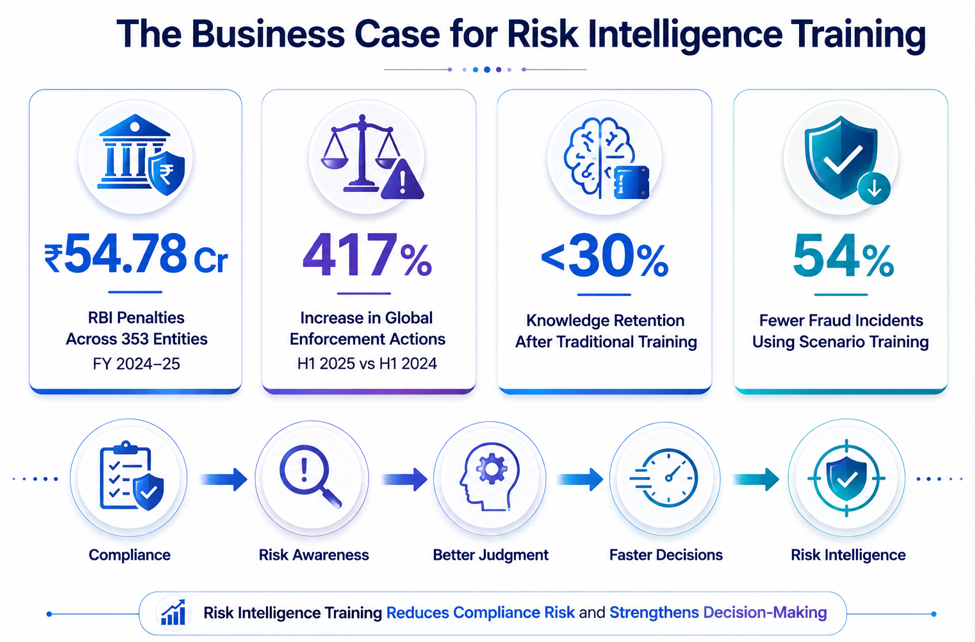
The financial case for change is stark and getting starker. In FY 2024-25, the Reserve Bank of India imposed roughly ₹54.78 crore in monetary penalties across 353 regulated entities, spanning private banks, foreign banks, NBFCs, and cooperative banks, for lapses ranging from KYC and customer due diligence failures to delayed exposure reporting and IT framework deficiencies. The list of institutions penalised includes some of the country's most sophisticated players, underscoring that scale and technology investment alone do not prevent compliance failure when frontline judgment is weak.
Globally, the picture has been volatile but directionally unmistakable. Enforcement activity spiked 417 percent in the first half of 2025 compared with the same period in 2024, before full-year global AML, KYC, sanctions, and customer due diligence penalties settled at roughly 3.8 billion dollars for 2025. Regional divergence tells its own story: penalties in the EMEA region rose 767 percent year-on-year, and Asia-Pacific penalties climbed 44 percent, even as North American enforcement eased. For any BFSI institution operating across borders or expanding into new geographies, the message is that regulatory scrutiny is not receding, it is relocating and intensifying in new markets.
Named enforcement actions illustrate what is actually at stake when training fails to translate into judgment. TD Bank's 3.09 billion dollar penalty for systemic AML governance failures, Santander UK's 107.7 million pound fine for prolonged weaknesses in monitoring business banking customers, and Danske Bank's 2 billion dollar penalty tied to suspicious transaction flows through a single branch all trace back to the same root cause: individuals who lacked the mental models to recognise risk in real time, inside institutions that had, in most cases, delivered technically complete compliance training.
The driver behind most of these failures is rarely a missing policy. It is a single moment in which an employee faced a grey area, lacked a mental framework to navigate it, and made a call they would have avoided had they truly internalised the consequences. That is the gap checkbox training cannot close, no matter how comprehensive its content library.
Why Traditional Training Doesn't Stick: The Cognitive Science
There is a well-documented reason annual e-learning fails to change behaviour. When information is presented without context, as rules without scenarios and policies without consequences, the brain stores it in short-term memory rather than wiring it into decision-making architecture. It is the cognitive equivalent of reading a phone number once. Once the training window closes, most of it evaporates.
Research from the Association of Certified Anti-Money Laundering Specialists shows that knowledge retention from single-session compliance training drops below 30 percent within two weeks. Role-specific, scenario-based training delivered in shorter, reinforced bursts performs dramatically better, with retention rates in the 65 to 70 percent range. The difference is not production value or content depth. It is whether the brain treats the material as survival-relevant.
Traditional compliance training also triggers what behavioural scientists describe as status quo bias. Employees mentally file it under corporate theatre, and the cognitive resources that would normally form new mental models simply disengage. The organisational cost of this disengagement compounds quickly. Gallup research places the cost of active employee disengagement at roughly 34 percent of salary. Applied across a five-hundred-person compliance-critical function, that is a multi-million-dollar drag on productivity and risk sensing, before a single regulatory fine is factored in.
Regulators will assess whether training programs are tailored to employees' specific roles and risk exposures. Generic, check-the-box training is no longer treated as sufficient. — U.S. Office of the Comptroller of the Currency, Comptroller's Handbook on BSA/AML |
What Makes Scenario-Based Risk Training Actually Work?
The human brain did not evolve to absorb abstract rules. It evolved to learn from experience, particularly from the felt consequences of decisions. Realistic scenarios activate pattern recognition, emotional response, memory encoding, and decision logic simultaneously, and the brain prioritises retaining information it perceives as consequential. This is why well-designed scenario-based learning outperforms lecture-based compliance training by a wide margin, improving recall by as much as 40 percent while measurably reducing post-training violations, because employees leave with practical mental models rather than memorised rules.
Unlock the Full Research
Create a free account or sign in to access the complete methodology, deep-dive analysis, and key implementation frameworks.
Don't have an account? It's free to join.
Organization Learning Labs
Research & Insights Division


Comments