BFSI Leadership Development: Capability Academies

30% of banks lack C-suite succession plans. See why structured capability academies, not ad-hoc training, are BFSI's leadership imperative through 2035.
Why Is BFSI's Leadership Pipeline Breaking Down Precisely When It's Needed Most?
Banks across India and global financial markets face a growing leadership risk that most boards have not yet named explicitly. Digital platforms, analytics, and regulatory frameworks are advancing rapidly, but the leadership pipeline is struggling to keep pace. Many BFSI organisations simply do not have enough managers who can simultaneously handle digital change, regulatory complexity, and people leadership, all at once, under real time pressure.
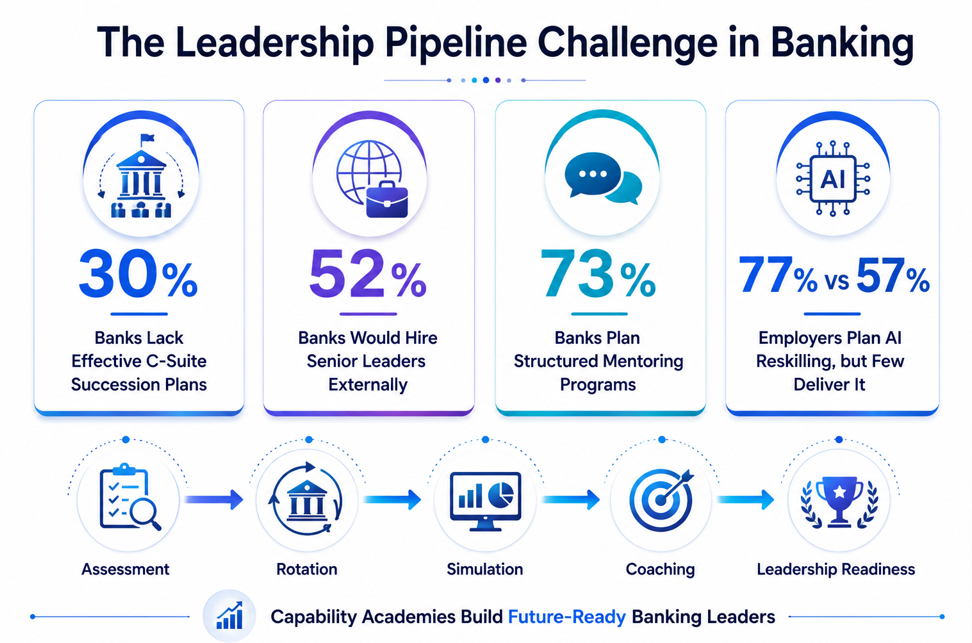
The evidence is now quantified. Roughly 30 percent of bank leaders report they lack an effective succession plan for C-suite roles beyond the CEO, a governance gap that boards would treat as urgent in almost any other risk category. More than half of banks, 52 percent, say they would likely hire senior talent from outside the institution or industry to strengthen leadership, an implicit admission that the internal pipeline cannot currently be trusted to fill the gap. Encouragingly, 73 percent of banks plan to use structured mentoring to build an executive bench over the next three years, evidence that the industry recognises the problem even where it has not yet solved it.
EXECUTIVE SNAPSHOT A leadership pipeline gap is not a talent shortage. Roughly 30% of banks lack effective C-suite succession planning while over half would look externally to fill it, an admission that internal leadership readiness, not available talent, is the actual constraint. |
This Gap Has Direct, Measurable Consequences
When digital initiatives stall, customer experience suffers, teams disengage, and regulators see execution risk in the resulting inconsistency. As a result, BFSI leadership development programs are shifting focus from ad-hoc training toward structured capability academies designed specifically for emerging leaders in banking, rather than generic leadership courses borrowed from unrelated industries.
Traditional banking leadership was built for stability. Managers were expected to follow procedures, manage risk within known boundaries, and lead relatively static teams. That world no longer exists. Today's emerging leaders must operate in environments defined by continuous technology upgrades, evolving regulatory expectations, and shifting customer behaviour. They are expected to lead cross-functional teams, interpret data, manage uncertainty, and coach people through change, often within their first two years in a managerial role.
Industry evidence consistently shows that many BFSI firms promote strong individual contributors into managerial roles without preparing them for this expanded scope. The result is predictable: new managers struggle, decision quality declines, and organisations lose both talent and momentum at precisely the moment they can least afford to. This is the leadership pipeline risk in its clearest form. It is not fundamentally a shortage of talent. It is a shortage of job-ready leaders.
Why Future Banker Programs Are Gaining Momentum
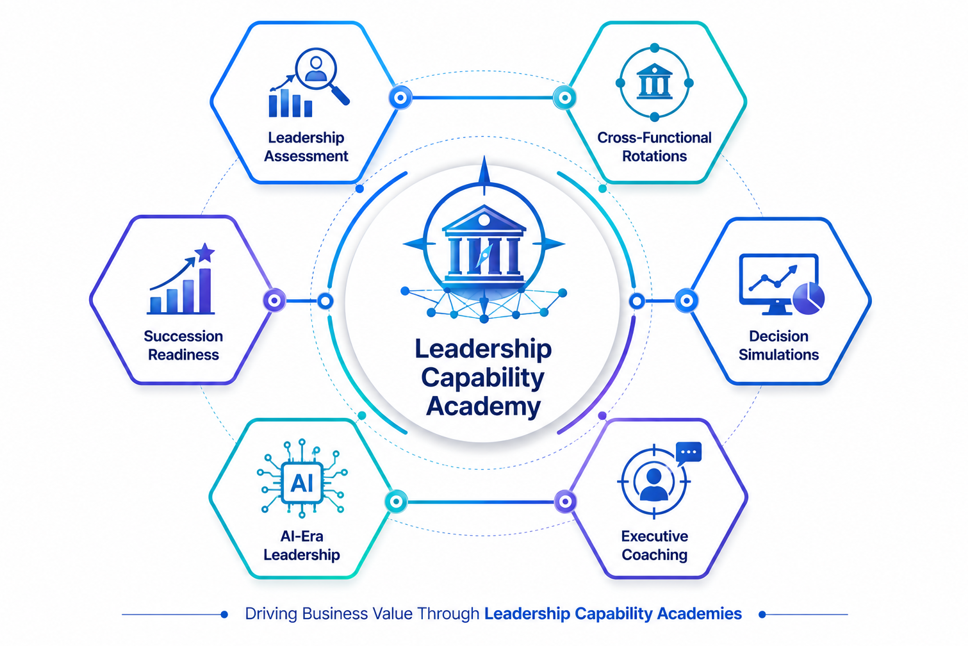
In response, leading banks are launching structured future banker programs and young-banker academies that move deliberately beyond classroom leadership training, focusing instead on building real capability through experience, reflection, and coaching. What distinguishes these programs from conventional leadership training is integration rather than any single component in isolation: classroom learning builds conceptual understanding, rotational projects expose participants to different parts of the bank, simulations develop judgment in genuinely high-risk scenarios, and coaching supports individual growth and self-awareness throughout.
Examples from Indian and global BFSI organisations show that such integrated programs accelerate readiness for leadership roles, improve retention of high-potential talent, and reduce reliance on expensive, uncertain external hiring, directly addressing the 52 percent external-hiring dependence figure cited above.
The Architecture of an Emerging Leaders Capability Academy
An effective BFSI capability academy follows a deliberate architecture rather than a loose collection of isolated courses assembled around whatever budget is left in the training calendar.
Assessment Centre as the Entry Point
The academy begins with assessment, not nomination alone. Assessment centres typically evaluate leadership potential and learning agility, decision-making style under pressure, emotional intelligence and people skills, and data comfort and analytical thinking, using methods including 360-degree feedback, psychometric tools, structured interviews, and business simulations. The outcome is a clear individual baseline that informs a genuinely personalised development journey, rather than a one-size-fits-all curriculum.
Rotational Stints Across Critical Functions
Emerging leaders then move through structured rotations rather than random job swaps: customer and business roles such as retail banking or corporate relationships, operations and technology to understand systems and constraints from the inside, risk, compliance, or credit to develop regulatory and risk judgment, and strategy or transformation projects for genuine enterprise perspective. Each rotation carries real accountability, with participants leading projects, making decisions, and experiencing the consequences, building contextual understanding that classroom learning alone cannot deliver.
Unlock the Full Research
Create a free account or sign in to access the complete methodology, deep-dive analysis, and key implementation frameworks.
Don't have an account? It's free to join.
Organization Learning Labs
Research & Insights Division


Comments