Battle-Ready Digital Capabilities for IT Services by 2030

How IT services CXOs can transform from bench-strength headcount models to battle-ready capability systems aligned to digital transformation outcomes through 2030 and beyond.
From Bench Strength to Battle Readiness: Building Enterprise-Grade Digital Capabilities in IT Services for 2030 and Beyond
Why the IT services organisations that win by 2030 will not be those with the deepest talent bench, but those with the most battle-ready capability systems — and what CXOs must do now to close the gap
Abstract
The IT services sector faces an inflection point. The traditional bench model — where large pools of certified but under-deployed talent await project activation — is structurally incompatible with an AI-accelerated market that demands teams capable of creating digital transformation, not merely executing it. By 2030, the organisations that win will not be those with the deepest talent bench; they will be those with the most battle-ready capability systems: clusters of skills, behaviours, and tools aligned to specific business outcomes.
This article defines the 2030 capability landscape, proposes a framework for designing enterprise-grade capability academies, and provides CXOs with a practical 90-day action guide to close the gap between current resourcing reality and future competitive requirement. It is written for CEO, CHRO, CIO, and practice leaders in IT services organisations who recognise that the capability competition of the next five years will be decided in the investment decisions of the next twelve months.
1. Why Bench Strength Is No Longer Enough
For decades, IT services firms have competed on bench utilisation: the ability to deploy large numbers of certified professionals rapidly across client engagements. This model worked when projects were long, technology cycles were slow, and clients paid for hands-on execution. None of those conditions reliably hold in 2025, and by 2030 they will be the exception rather than the rule.
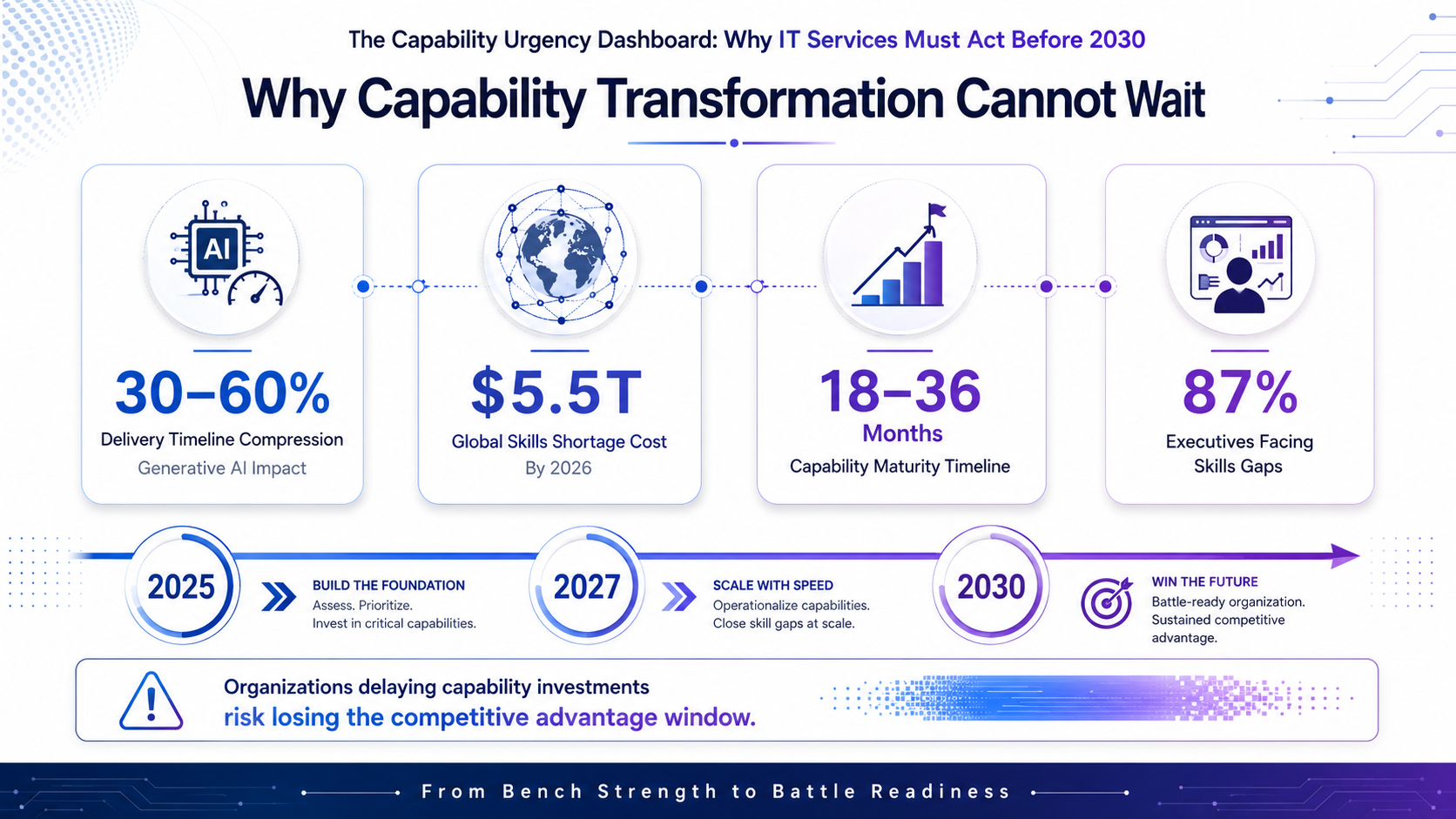
Generative AI compresses delivery timelines by 30 to 60 percent for code-intensive work, according to McKinsey's 2024 productivity research. Platform consolidation means fewer vendors now control what previously required dozens of specialised integrators. And clients — increasingly sophisticated buyers who have watched a decade of digital transformation initiatives disappoint — are shifting procurement from time-and-materials execution to outcome-linked engagements. In this environment, the question is no longer "how many certified consultants can we mobilise?" but "which teams can generate measurable business value from day one?"
"Battle-ready teams challenge a client's problem framing, architect solutions from a blank sheet, productise repeatable value, and adapt in real time when assumptions change. They combine technical depth with commercial acuity and the confidence to lead, not just deliver." — KPMG Global Technology Services Benchmark, 2024 |
Battle-ready capabilities, as defined in this article, are those that enable teams to create digital transformation outcomes — not simply to execute predefined project plans. Battle-ready teams can challenge a client's problem framing, architect solutions from first principles, productise repeatable intellectual property, and adapt in real time when assumptions change. They combine technical depth with commercial acuity and the interpersonal confidence to lead, not just deliver. Building these capabilities requires a fundamentally different investment model from the one that produced the bench.
2. Mapping the 2030 IT Services Capability Landscape
Meta-Capabilities: The Strategic Differentiators
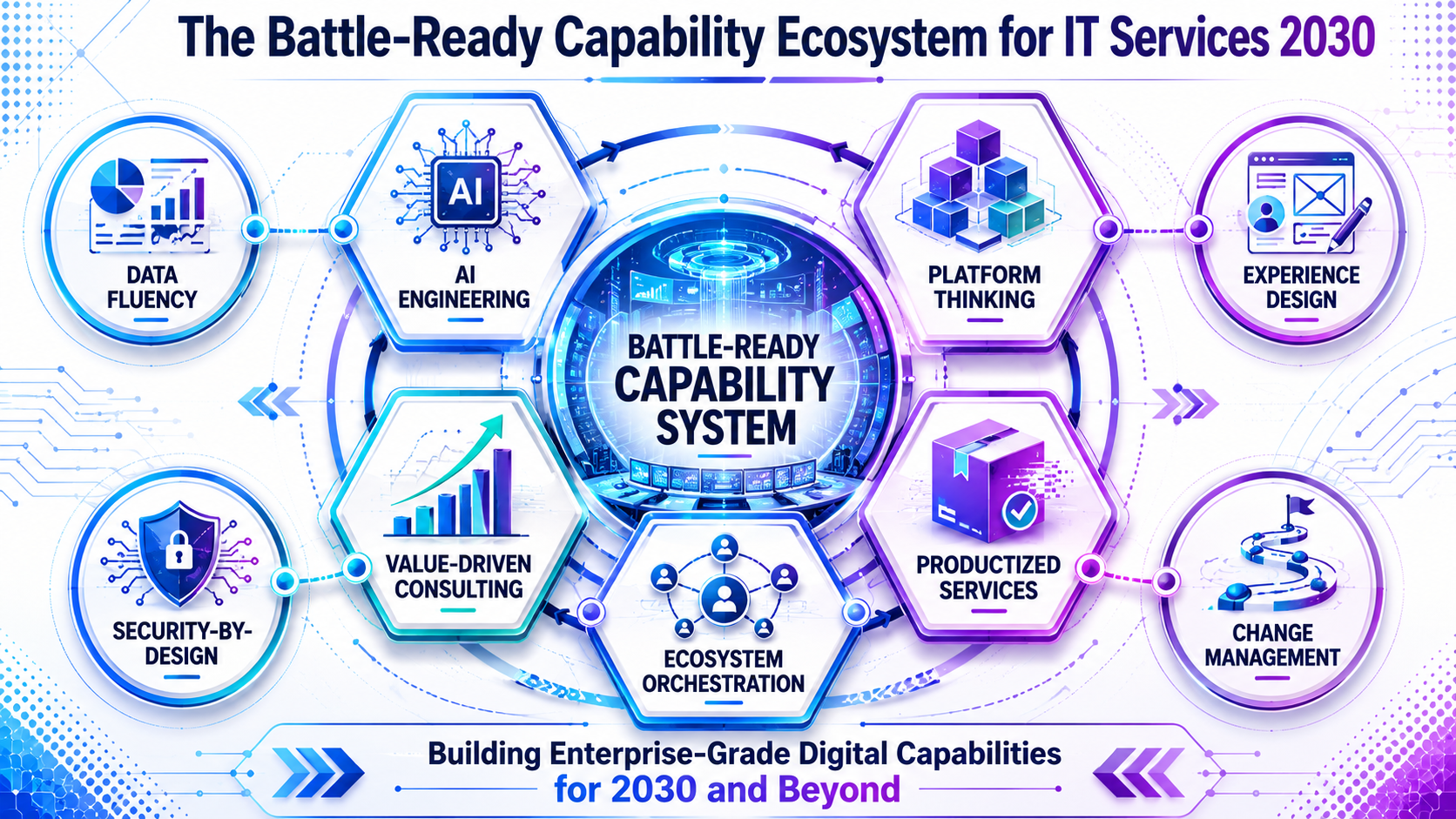
Five meta-capabilities will determine which IT services firms capture disproportionate value by 2030. Organisations that begin building these now will have 18 to 36 months of compounding advantage over those that begin in 2027 — because capability systems require that development timeline to reach market-ready maturity.
2030 Meta-Capability | Strategic Significance for IT Services |
AI Engineering | Moving beyond AI adoption into AI creation: building, fine-tuning, and operationalising models proprietary to client environments. The firms that can build AI, not just deploy it, will command premium positioning. |
Platform Thinking | Designing modular, composable architectures that clients can extend and own, rather than bespoke builds that create long-term dependency. Platform thinking is the architecture of recurring revenue. |
Value-Driven Consulting | Anchoring every engagement to measurable business outcomes — revenue, margin, customer retention — rather than technical milestones. The firms that price to outcomes, not to inputs, defend margin structurally. |
Productised Services | Packaging repeatable intellectual property into scalable offerings that decouple revenue from headcount. Productisation is the route from commodity services to IP-led competitive advantage. |
Ecosystem Orchestration | Designing and governing partner networks, marketplace channels, and co-innovation models that amplify reach beyond direct delivery capacity. The ecosystem orchestrator wins deals the solo firm cannot. |
Horizontal Capabilities: The Foundation Layer
Beneath each meta-capability, a set of horizontal competencies that all IT services professionals must develop, regardless of domain specialisation:
• Data Fluency: The ability to read, interpret, and challenge data-driven conclusions without being a data scientist. Essential for any professional who interfaces with AI model outputs or client analytics.
• Security-by-Design: Embedding security and compliance into architecture decisions from inception, not as a post-deployment audit. In a regulatory environment intensifying around data and AI, this is the baseline for client trust.
• Experience Design: Shaping end-user journeys with the same rigour applied to technical architecture. Technology that is not adopted by its users creates no value — and the CXO sponsor knows it.
• Change Management: Enabling client organisations to absorb, adopt, and sustain the capabilities being delivered. The most common reason transformation programmes fail to realise their value is not technical delivery failure — it is organisational adoption failure.
3. From Roles to Capability Systems
The first structural mistake most IT services firms make when confronted with a capability gap is to update their job description library. New titles are created, competency frameworks are appended, and hiring managers are issued revised scorecards. Within eighteen months, the gap has re-emerged — because the underlying problem was never a job description deficit.
The real challenge is that static job descriptions describe what a person is, not what a team can do. In a world of rapidly shifting client demand, what matters is the outcome the team can reliably produce — and the cluster of skills, behaviours, and tools that combine to produce it. This cluster is a capability system.
A capability system for "AI-enabled customer experience transformation," for example, would include: machine learning engineers who can fine-tune foundation models on client data; UX designers fluent in conversational interface design; business analysts who can translate contact centre KPIs into model training objectives; and change practitioners who can guide front-line staff through workflow redesign. No single job description captures this; no certification programme produces it. It must be deliberately constructed and continuously maintained.
Designing capability systems requires three steps: mapping the business outcomes the firm wants to own in the market; identifying the precise clusters of skills, behaviours, and tools each outcome requires; and building the people infrastructure — hiring, learning, deployment, and career architecture — to make those clusters sustainably available.
4. Designing Capability Academies for IT Services
The capability academy is the primary institutional vehicle for building and sustaining capability systems at scale. Unlike traditional training departments — which are typically organised around vendor certifications and compliance requirements — a capability academy is organised around market outcomes and governed by business leaders with P&L accountability, not HR functions operating independently of commercial reality.
Unlock the Full Research
Create a free account or sign in to access the complete methodology, deep-dive analysis, and key implementation frameworks.
Don't have an account? It's free to join.
Organization Learning Labs
Research & Insights Division


Comments