Ambient Learning for Workforce Capability 2030

How CHROs and CLOs can shift from episodic training to ambient, embedded learning ecosystems -- digital adoption platforms, AI nudges, and time-to-competence metrics.
Why Traditional L&D Can No Longer Keep Pace with the Velocity of Skills Change
The corporate learning and development function is confronting a structural crisis. Not a budget crisis, nor a content crisis -- a velocity crisis. The speed at which skills evolve, become relevant, and then obsolete has decisively outpaced the cadence at which traditional training programmes can respond. Organizations that still organize capability building around quarterly training cycles, annual curriculum reviews, and episodic classroom events are -- by structural design -- building yesterday's workforce.
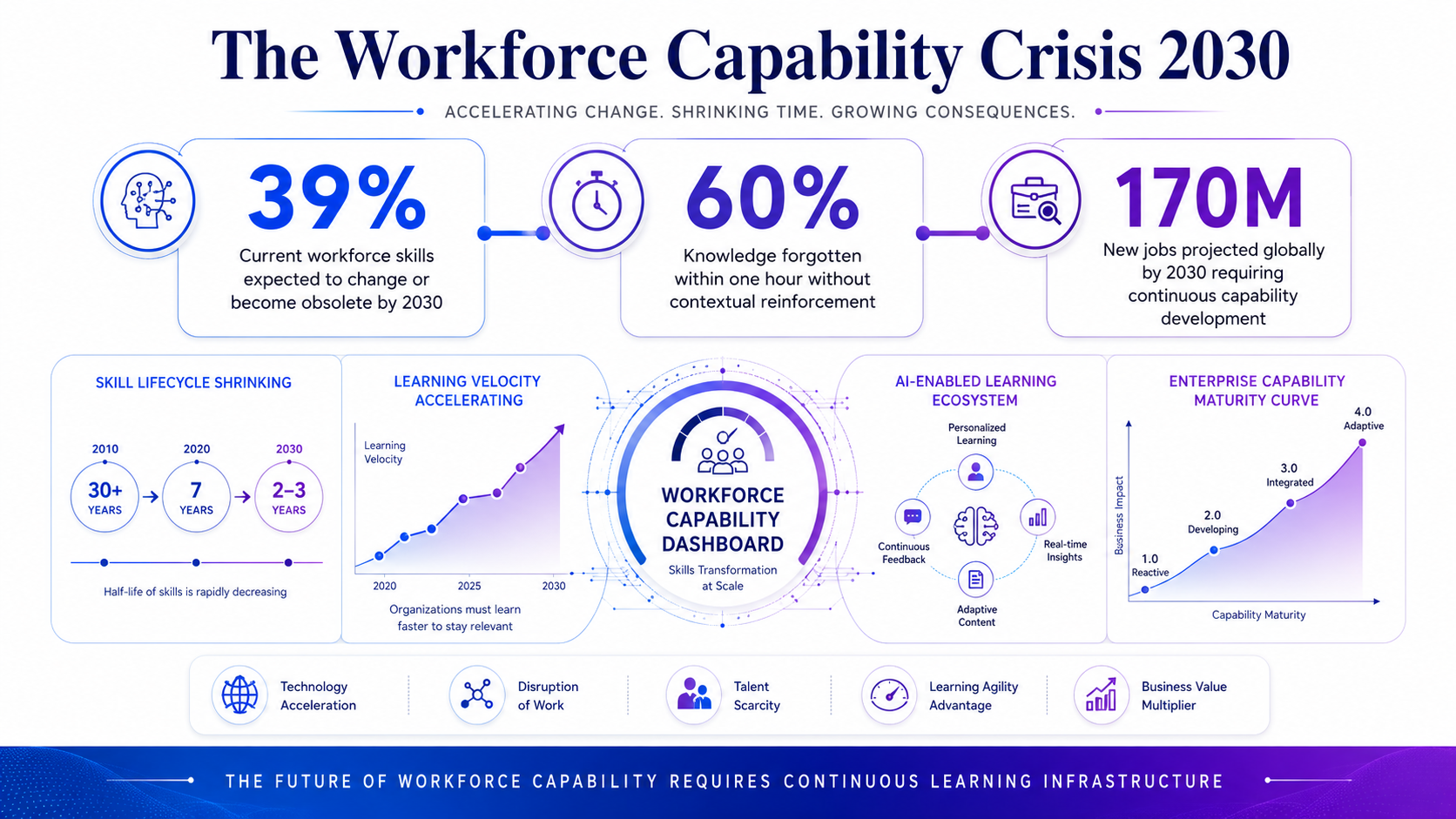
The empirical evidence is unambiguous. The World Economic Forum's Future of Jobs Report 2025 projects that 39% of current workforce skills will be transformed or become obsolete by 2030. McKinsey Global Institute research projects a 25-29% increase in demand for tech skills and an 11-14% rise in social and emotional skill requirements by 2030. The LinkedIn Workplace Learning Report 2025 confirms that hybridization of work is driving demand for learning embedded within the platforms and workflows where employees actually operate -- not in separate learning management systems that require a deliberate context switch to access.
Against these projections, the cognitive science case for change is equally compelling. Research on the Ebbinghaus Forgetting Curve demonstrates that learners forget approximately 60% of newly acquired information within an hour of instruction without contextual reinforcement. Traditional training events -- however well-designed -- deliver the bulk of their content at precisely the wrong moment: in isolation from the actual work contexts where that content will be applied. The result is not merely inefficient learning. It is systematically wasted investment.
39%Of current workforce skills will be transformed or become obsolete by 2030, creating a structural inadequacy in episodic, calendar-driven training models (World Economic Forum, Future of Jobs Report 2025) |
"The shift from episodic content delivery to orchestrating integrated learning ecosystems is not a trend -- it is the survival strategy for L&D functions in the decade ahead." -- LinkedIn Workplace Learning Report 2025 |
What Is Ambient Learning -- and Why Does It Represent a Fundamental Paradigm Shift?
Ambient learning is a capability-building architecture in which employees receive contextual guidance, micro-content, and decision support directly within the tools and workflows they use daily -- without leaving those environments to access a separate learning platform. Rather than treating learning as an activity that competes with work for time and attention, the ambient model treats learning as invisible infrastructure: a continuous support layer that strengthens decision-making and performance enhancement as work happens.
The conceptual distinction is precise and important. In traditional models, learning and work are separate activities scheduled on different parts of the calendar. In the ambient model, they are the same activity -- learning is embedded in work so thoroughly that the boundary between them dissolves. A customer-facing employee encountering an unfamiliar product query receives contextual support at the moment of need. A new system user gets step-by-step guidance within the interface rather than sitting through a pre-launch training session weeks before they need the knowledge. A manager reviewing a performance challenge receives a just-in-time micro-module contextually aligned to the specific situation.
For the 55% of frontline workers who report learning new technology on the fly, and the 46% who feel constant pressure to adapt to stay relevant (Aptara Workplace Learning Survey, 2024), the ambient model is not a premium learning experience -- it is the only viable response to the pace of their work reality.
What Are the Core Design Patterns of Effective Ambient Learning Systems?
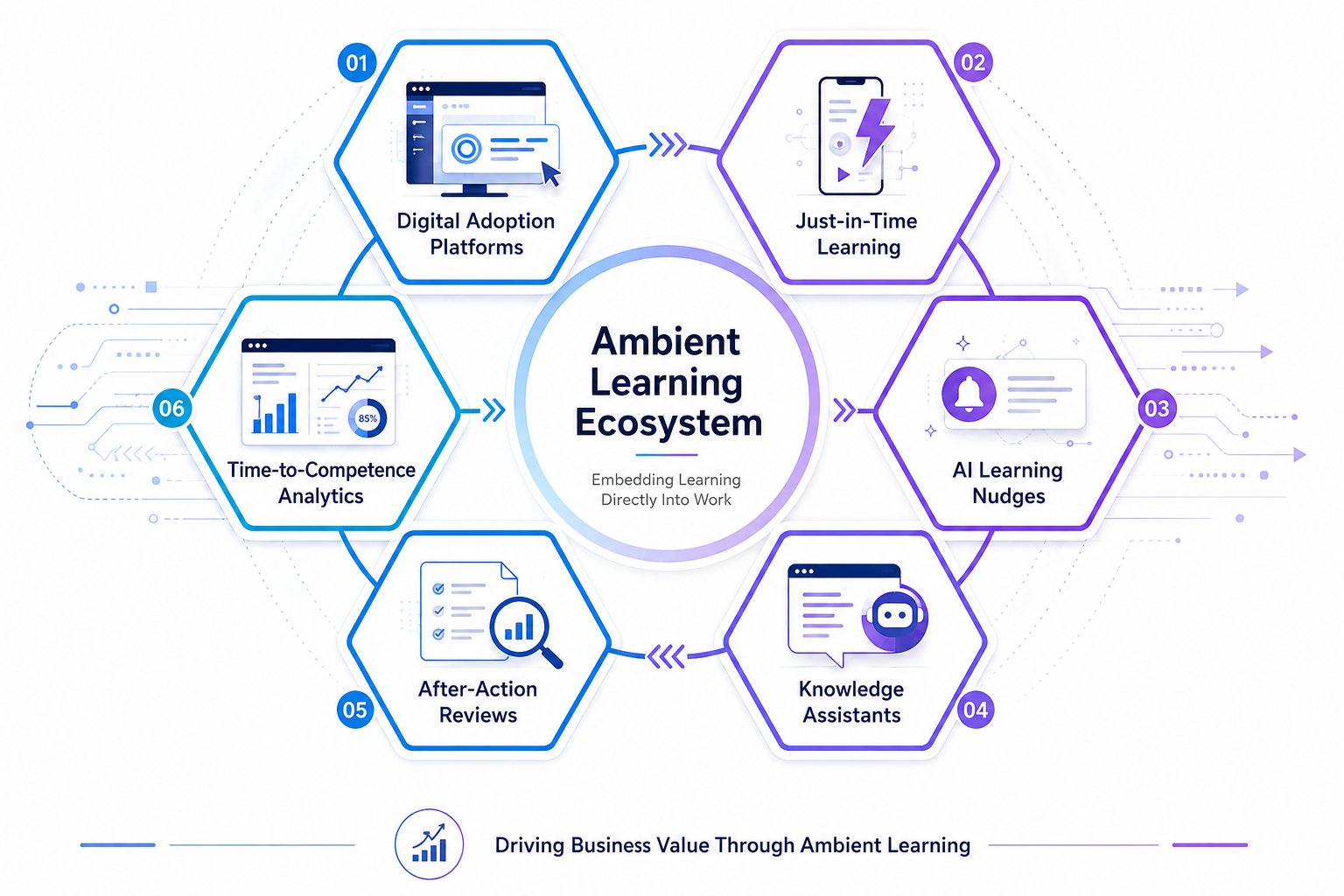
Digital Adoption Platforms: Embedding Guidance Where Work Happens
Digital adoption platforms (DAPs) function as intelligent, real-time guides embedded directly within enterprise applications. Rather than requiring employees to complete training before accessing a new system -- and hoping the learning transfers when the moment of need eventually arrives -- DAPs provide contextual, step-by-step guidance within the application interface, precisely at the point where action is required.
When a new employee accesses an ERP system, a CRM platform, or a procurement tool, the DAP guides them through their first task interactively -- highlighting the relevant fields, sequencing the required actions, and providing explanatory context -- all without requiring them to leave the application. This transforms learning from a separate preparatory event into an integrated performance support mechanism. For organizations deploying complex enterprise systems across large and distributed workforces, DAPs offer scalable, consistent, effective learning experiences regardless of employee seniority or prior system exposure.
Just-in-Time Micro-Content: Learning at the Point of Need
Complementing DAPs are micro-learning modules strategically positioned within workflow tools and triggered by the specific task an employee is attempting or the challenge they are navigating. These short, focused content pieces -- typically three to seven minutes -- address a single, specific skill or knowledge requirement. The innovation is not content brevity per se; it is contextual placement and trigger logic. The learning resource appears because the employee needs it now, not because a training calendar says it is due.
The 2025 workplace learning landscape has established that micro-content delivered within workflows outperforms equivalent content delivered in separate LMS environments on both retention and application metrics. Mobile delivery ensures this content reaches employees regardless of location, supporting the distributed nature of modern work and removing the friction of accessing a separate platform.
AI-Powered Learning Nudges: Behavioral Science at Scale
The evolution from generic training notifications to intelligent, context-aware nudges represents one of the most significant advances in ambient learning architecture. Traditional learning reminders -- 'Complete your course by Friday' -- are broadcast uniformly and largely ignored. AI-powered nudges, by contrast, are generated from real-time analysis of individual learner behaviour, performance signals, and progression patterns, and delivered with precision timing and contextual relevance.
Unlock the Full Research
Create a free account or sign in to access the complete methodology, deep-dive analysis, and key implementation frameworks.
Don't have an account? It's free to join.
Organization Learning Labs
Research & Insights Division


Comments