Alternative Protein Capability: R&D, Talent and Strategy

Plant-based and alternative protein markets are maturing past the hype cycle. A leadership guide to building durable R&D, manufacturing and talent capability.
From Trend to Transformation: Building R&D, Manufacturing and Talent Capability for Plant-Based and Alternative Proteins
The alternative protein category has moved past its hype cycle. What remains is a harder, more durable capability question for food and beverage leaders
The Alternative Protein Inflection: Past the Hype, Into the Hard Part
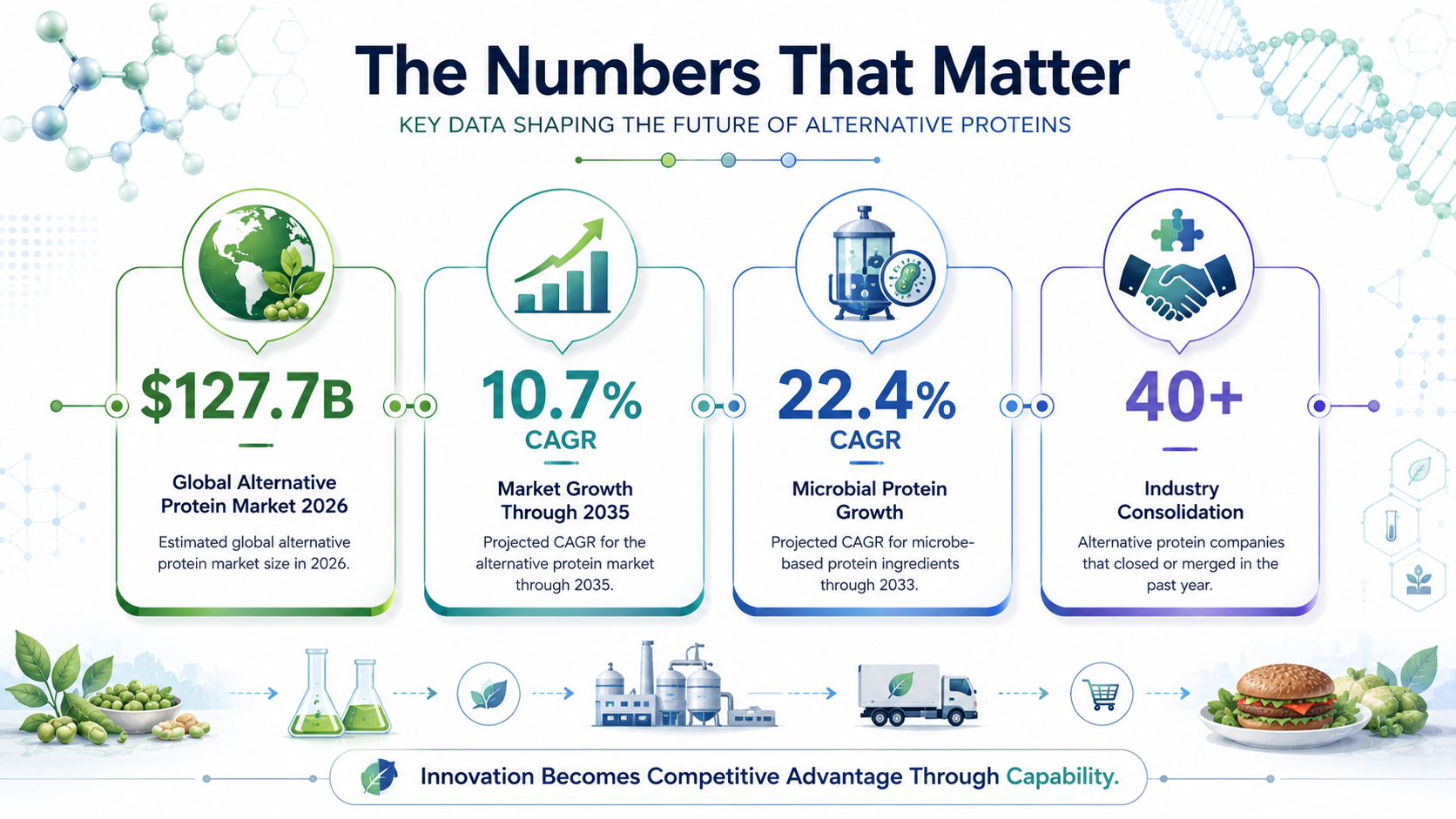
Alternative protein has completed its first full market cycle. The initial wave of consumer enthusiasm, venture capital, and headline product launches has given way to a more sober, more commercially demanding phase, one where more than forty companies in the category closed or merged in the past year alone, and where plant-based meat sales in the United States have declined even as plant-based dairy continues to hold roughly two-thirds of category revenue. None of this means the opportunity has shrunk. Global Market Insights projects the alternative protein market will grow from roughly 128 billion dollars in 2026 to over 318 billion dollars by 2035, a trajectory that assumes the category matures rather than disappears. What it does mean is that the easy phase, where a plausible product and a compelling sustainability story were enough to attract capital and shelf space, is over.
The risk facing incumbent food and beverage companies now is not missing the trend. Most large players have already launched at least one alternative protein product line. The risk is treating that launch as a marketing initiative rather than what it actually requires: integrated capability across protein chemistry, sensory science, process engineering, and consumer education, built with the same rigor a company would apply to any core R&D platform. Companies that jumped into the category without building this underlying capability are precisely the ones now retreating from it, and the retreat is being read by boards, incorrectly, as evidence the category itself failed rather than evidence that the capability build was skipped.
The Capability Stack for Plant-Based and Alternative Protein
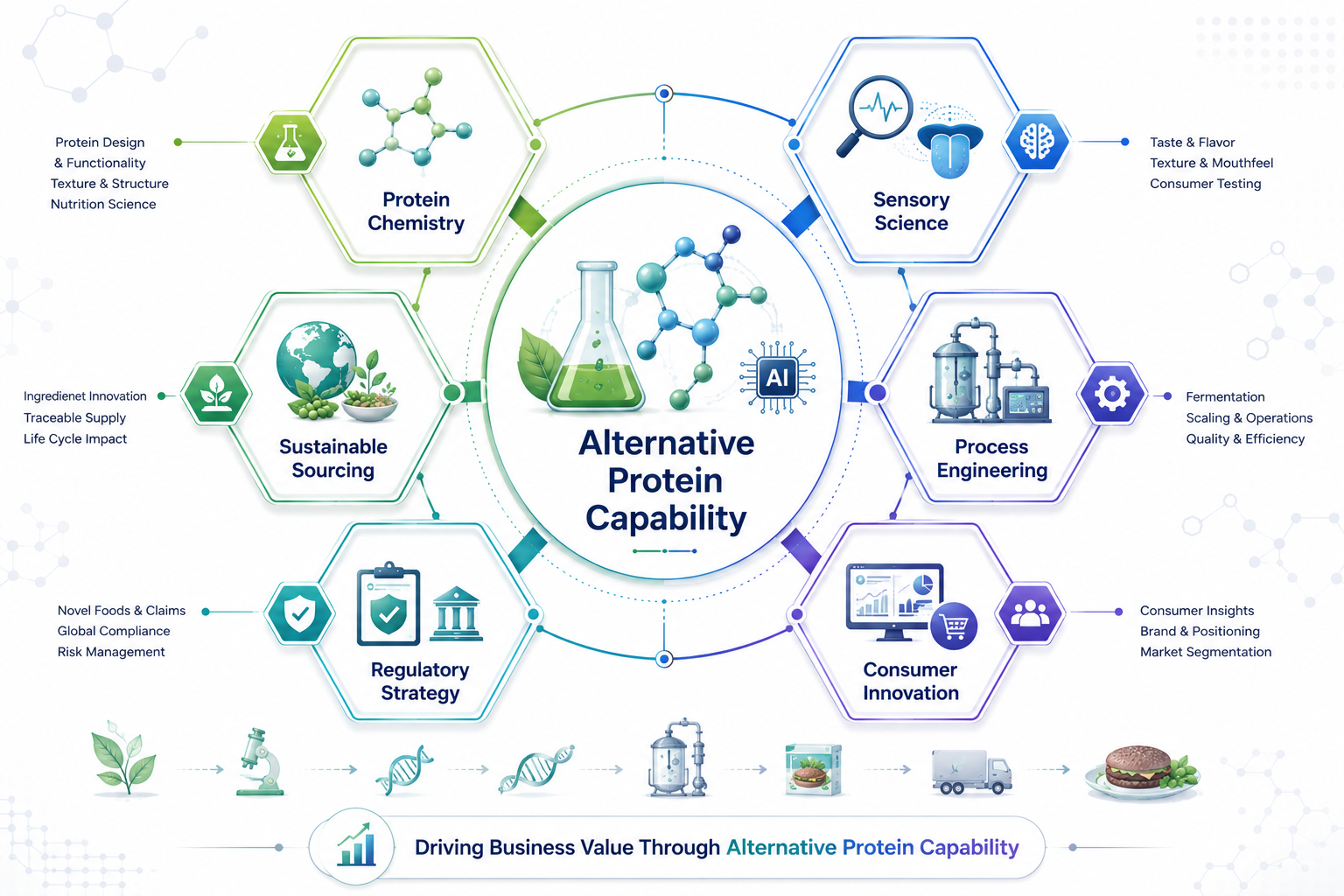
Alternative protein product development sits at the intersection of disciplines that traditional food R&D organizations have rarely needed to combine at this depth. Protein chemistry and texture engineering determine whether a product actually replicates the mouthfeel and structural integrity consumers expect, a challenge that has proven far harder to solve durably than early industry optimism suggested. Flavour engineering and nutrition science must work in tandem, since masking off-notes from plant or microbial protein sources without compromising the clean-label positioning that drew health-conscious consumers to the category in the first place is a genuinely difficult formulation problem, not a marketing one.
Process engineering and sensory research round out the technical core, but commercial capability matters just as much and is more frequently neglected. Market segmentation that distinguishes flexitarian mainstream consumers from committed vegan and vegetarian buyers, sustainability storytelling that holds up to increasingly sophisticated scrutiny, and pricing strategy that accounts for the reality that materials and ingredients alone can represent a fifth of total product cost, all require capability that sits outside a traditional food science function.
STRATEGIC INSIGHT Materials and ingredients account for roughly 20% of total cost in plant-based meat products. Companies that have not built sourcing and formulation capability specific to pea, soy, and emerging microbial proteins are structurally disadvantaged on cost before a single unit reaches shelf. |
Talent Archetypes in the Alt-Protein Ecosystem
The talent profile alternative protein innovation actually requires rarely exists inside a traditional food company's existing bench, and it rarely appears fully formed in the external labour market either. Food scientist-communicators, who can translate complex formulation science into consumer-credible sustainability and nutrition narratives, are especially scarce. Sensory innovation leads who understand both the chemistry of taste and the psychology of consumer expectation sit at a genuine premium. Regulatory navigators fluent in the fast-shifting rules around novel ingredients, cultivated protein, and labeling claims across multiple jurisdictions are equally hard to find and increasingly indispensable as microbial and fermentation-derived proteins, now the fastest-growing segment of the category, move from pilot to commercial scale.
Sustainability strategists who can credibly connect a product's environmental claims to verifiable life-cycle data, rather than to a marketing brief, complete the archetype set. What unites all four profiles is hybridity: none of them map cleanly to a traditional food science, marketing, or regulatory affairs job description, which means recruiting, leveling, and retaining them requires an organizational design conversation most food companies have not yet had.
Learning Architectures for Alt-Protein R&D and Operations
Unlock the Full Research
Create a free account or sign in to access the complete methodology, deep-dive analysis, and key implementation frameworks.
Don't have an account? It's free to join.
Organization Learning Labs
Research & Insights Division


Comments